
White Pine Weevil on Spruce: Symptoms and Prevention Tips
Identifying White Pine Weevil on Spruce: Symptoms and Signs
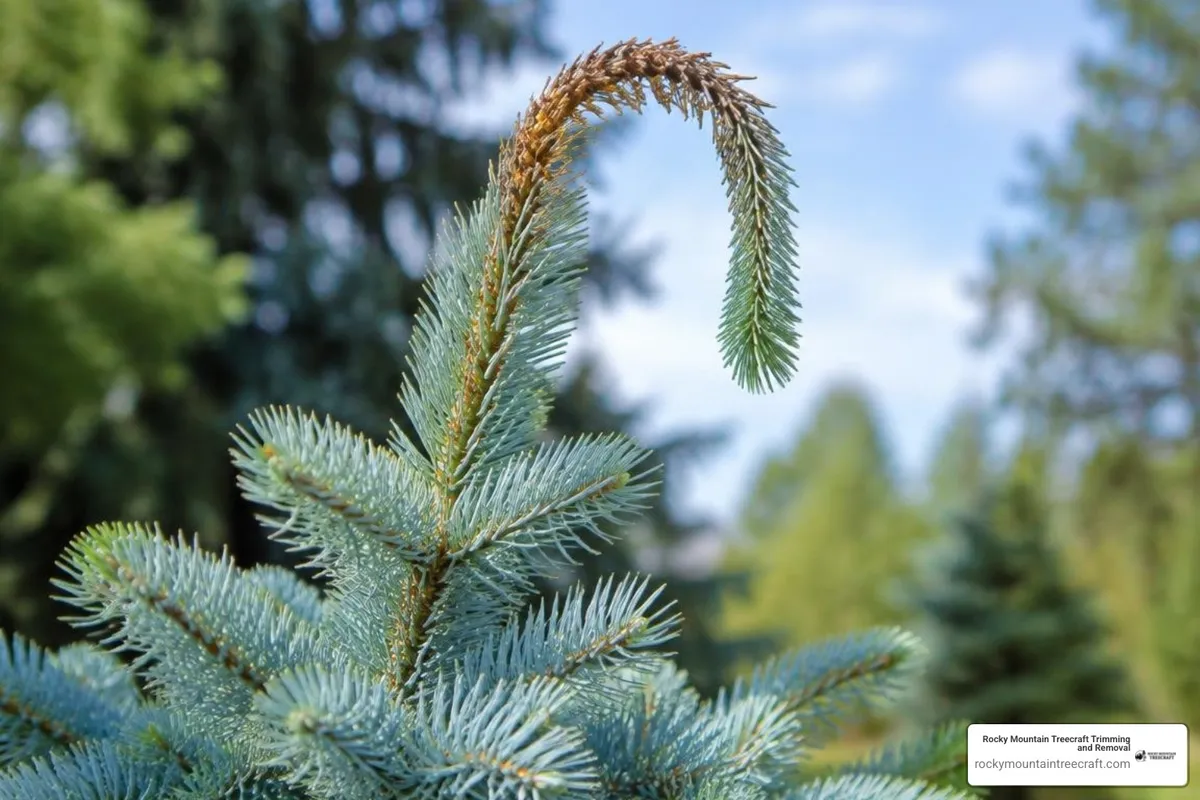
Spotting an infestation early can save your spruce from severe structural deformities. The primary sign of damage is the wilting of the central terminal shoot at the very top of the tree. As larvae feed beneath the bark, they sever the vascular tissue carrying water and nutrients, causing new spring growth to droop into a characteristic "shepherd's crook."
Beyond terminal wilting, look closely at the bark of the previous year's leader. You will often see tiny, pinhead-sized feeding punctures leaking clear droplets of sticky sap or resin exudation. Later in summer, round exit holes roughly two millimeters wide appear as new adults chew their way out of the dead leader.
Symptom / Sign | White Pine Weevil | Frost Injury | Drought Stress |
|---|---|---|---|
Primary Location | Central terminal leader only | Branch tips across upper canopy | Entire tree, starting at lower inner needles |
Visual Appearance | Distinct shepherd's crook curl | Limp, brown, or blackened new growth | Fading color, brittle foliage throughout |
Bark Evidence | Pin-sized holes, pitch drops, chip cocoons | Clean bark, no tunneling or punctures | Dry, tight bark without larval tunnels |
Growth Affected | Destroys current and previous year shoots | Affects only tender, newly emerged shoots | Slows overall tree extension across all limbs |
Distinguishing Weevil Damage from Frost and Fungal Blight
It is easy to mistake weevil damage for other common conifer ailments. Late spring frosts often nip tender new growth, causing shoot tips across the entire outer canopy to turn brown and limp. However, frost damage affects multiple lateral branches simultaneously, whereas weevils specifically target the main central leader.
Fungal diseases like Rhizosphaera needle cast cause needle discoloration and drop, but they typically progress from the lower branches upward and leave the main stem's inner wood intact. Drought stress causes overall needle loss and general branch dieback rather than localized terminal collapse. Reviewing expert guidance on spruce diagnostic steps can help you confirm the visual signs before deciding on a treatment course. If you notice a drooping leader but are unsure whether pests, frost, or disease are responsible, a tree health assessment can identify the cause and guide the next step.
Host Susceptibility Across Spruce Species
While named for eastern white pine, the white pine weevil (Pissodes strobi) readily attacks several spruce species common in mountain landscapes. Colorado blue spruce (Picea pungens), Norway spruce (Picea abies), Engelmann spruce (Picea engelmannii), Sitka spruce (Picea sitchensis), and white spruce (Picea glauca) are all vulnerable.
Weevils show clear preferences based on tree stature and vigor. Attacks are most frequent on trees under 20 feet (6 meters) tall with thick, healthy terminal leaders measuring greater than 4 millimeters in diameter. Weevils rarely attack mature spruce trees taller than 30 feet. Understanding these insights on terminal growth vulnerability helps target monitoring efforts on younger plantings where terminal loss is most disruptive.
Understanding the Biology and Seasonal Life Cycle
The white pine weevil completes one generation each year. Adults are small, rough-textured beetles measuring 6 to 7 millimeters in length, featuring a long snout, mottled brown and white patches on their wing covers, and a prominent white spot near the rear of each wing cover.
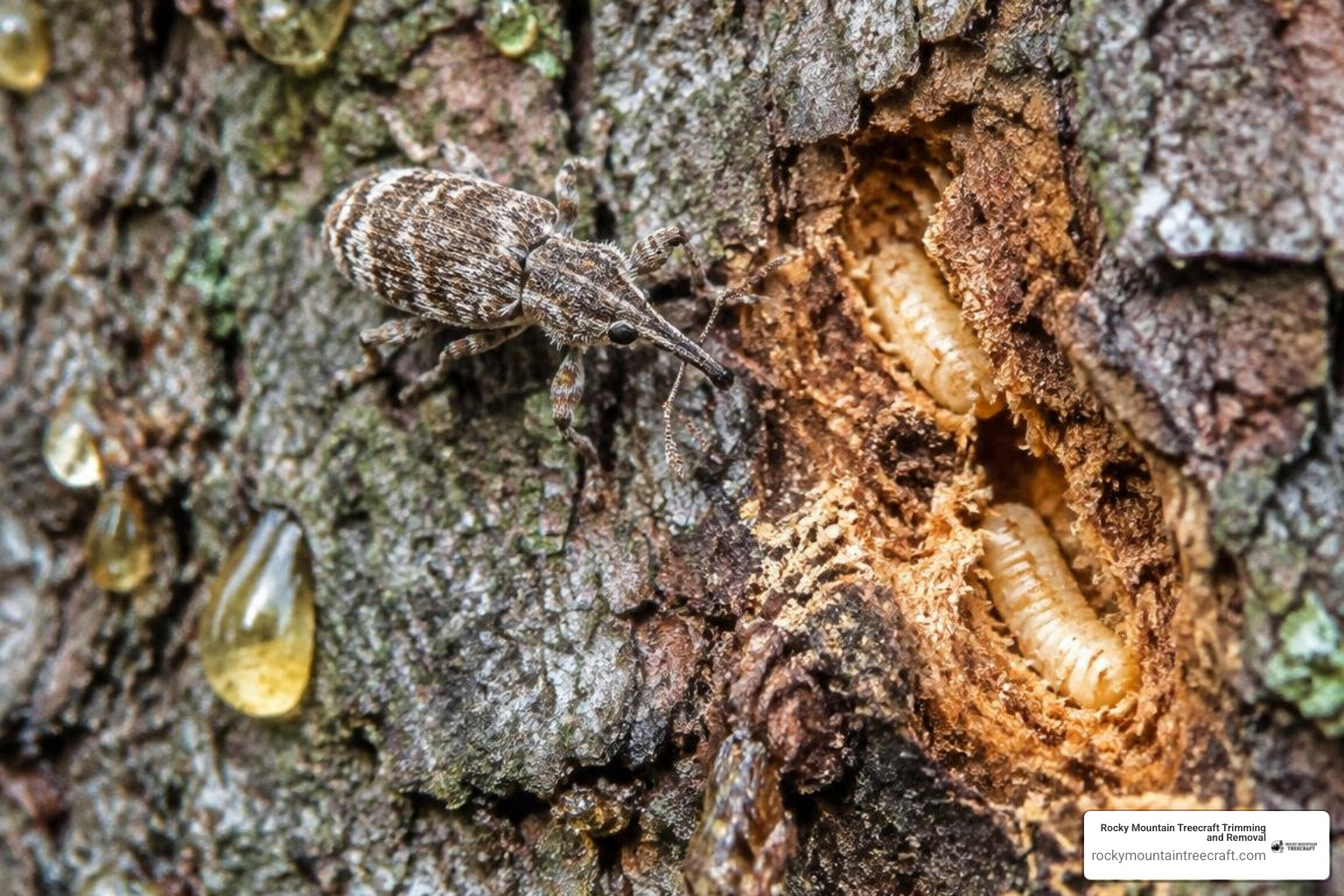
Adults spend the winter dormant in leaf litter and duff directly beneath host trees. As temperatures rise in early spring, they become active, crawl or fly up to the highest terminal shoot, and begin feeding and mating.
Life Cycle of the White Pine Weevil on Spruce
Adult weevils emerge from the soil when ground temperatures exceed 50°F, typically between 7 and 58 growing degree days (GDD). A single mated female can lay 100 or more eggs by chewing small cavities into the bark of the previous year's leader throughout May and June.
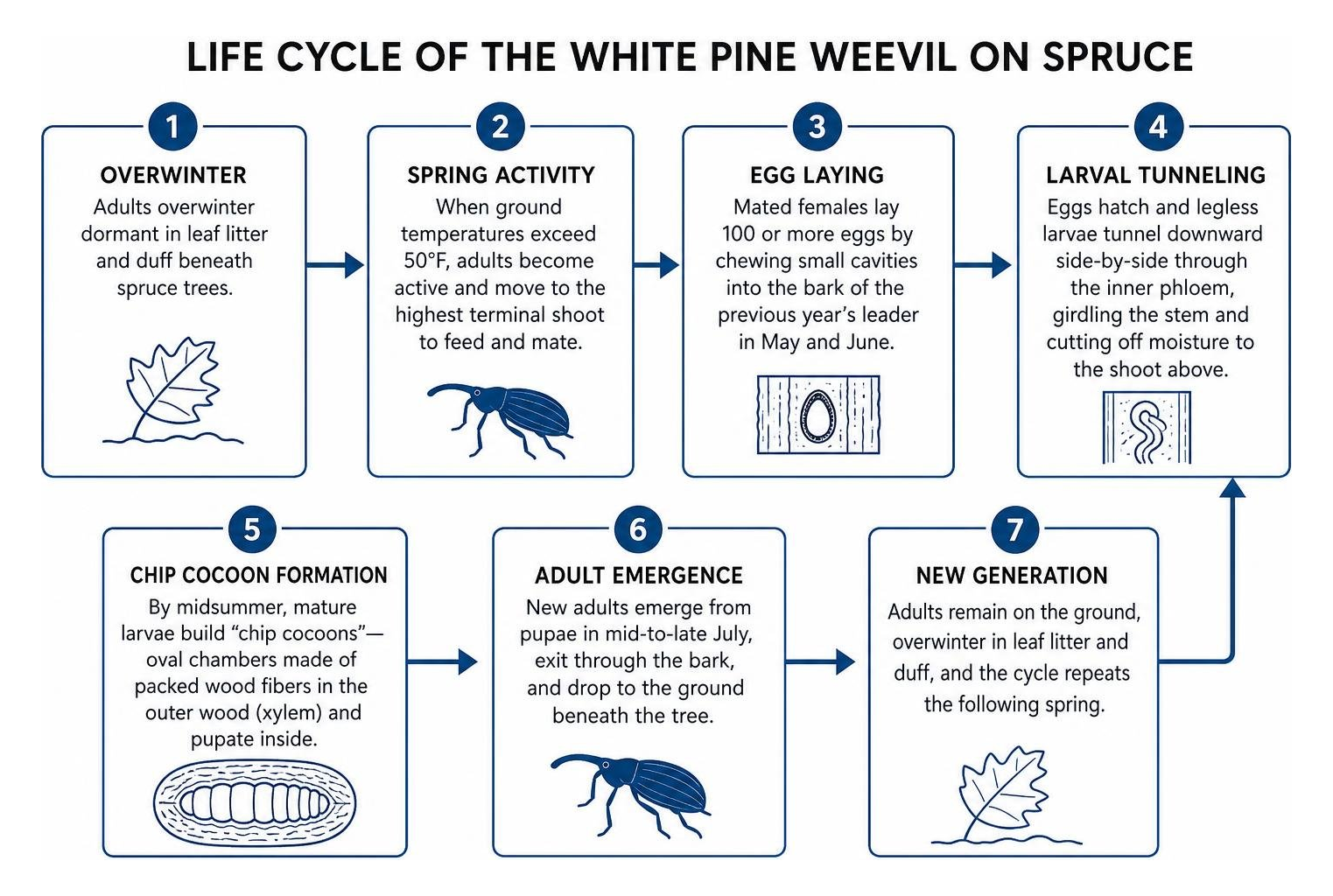
Once hatched, the small, legless white grubs tunnel downward side-by-side through the inner phloem layer. This tunneling girdles the stem, cutting off moisture to the shoot above. By midsummer, mature larvae construct "chip cocoons," oval chambers formed from packed wood fibers in the outer wood layer (xylem). They pupate inside these chambers and emerge as new adults in mid-to-late July. Reviewing research on adult emergence timing highlights why control methods must interrupt this cycle before pupation finishes.
Long-Term Impact on Tree Structure and Timber Value
A single weevil infestation typically destroys at least two years of terminal leader growth. On very small spruce seedlings under two feet tall, larval tunneling can extend down the entire main stem, killing the tree outright.
On established trees, losing the central leader destroys the natural apical dominance. Multiple lateral branches bend upward to compete for the role of the main leader, resulting in a crooked trunk, structural forks, or a stunted, multi-topped deformity known as a "cabbage tree" (Robert & Bohlmann, 2010). In snowy mountain environments, multi-leader trees are far more prone to splitting under heavy winter snow loads and wind stress.
How to Treat and Control Active Infestations
Managing white pine weevil requires an integrated approach that combines mechanical removal with properly timed treatments. Addressing active infestations quickly prevents the local weevil population from multiplying and spreading to nearby conifers. Maintaining overall vigor with proper pruning of trees ensures that your landscape retains strong structural integrity.
Pruning and Mechanical Leader Removal
Sanitation pruning is the most practical mechanical control for active infestations. Pruning must be completed in early summer, typically late June through early July, after the shepherd's crook forms but before adult weevils emerge from their chip cocoons.
Cut the wilted leader off several inches below the lowest point of larval feeding, making sure you cut into healthy, green wood. Inspect the cut end: if you see brown larval galleries or packed wood chips, make another clean cut further down the stem.
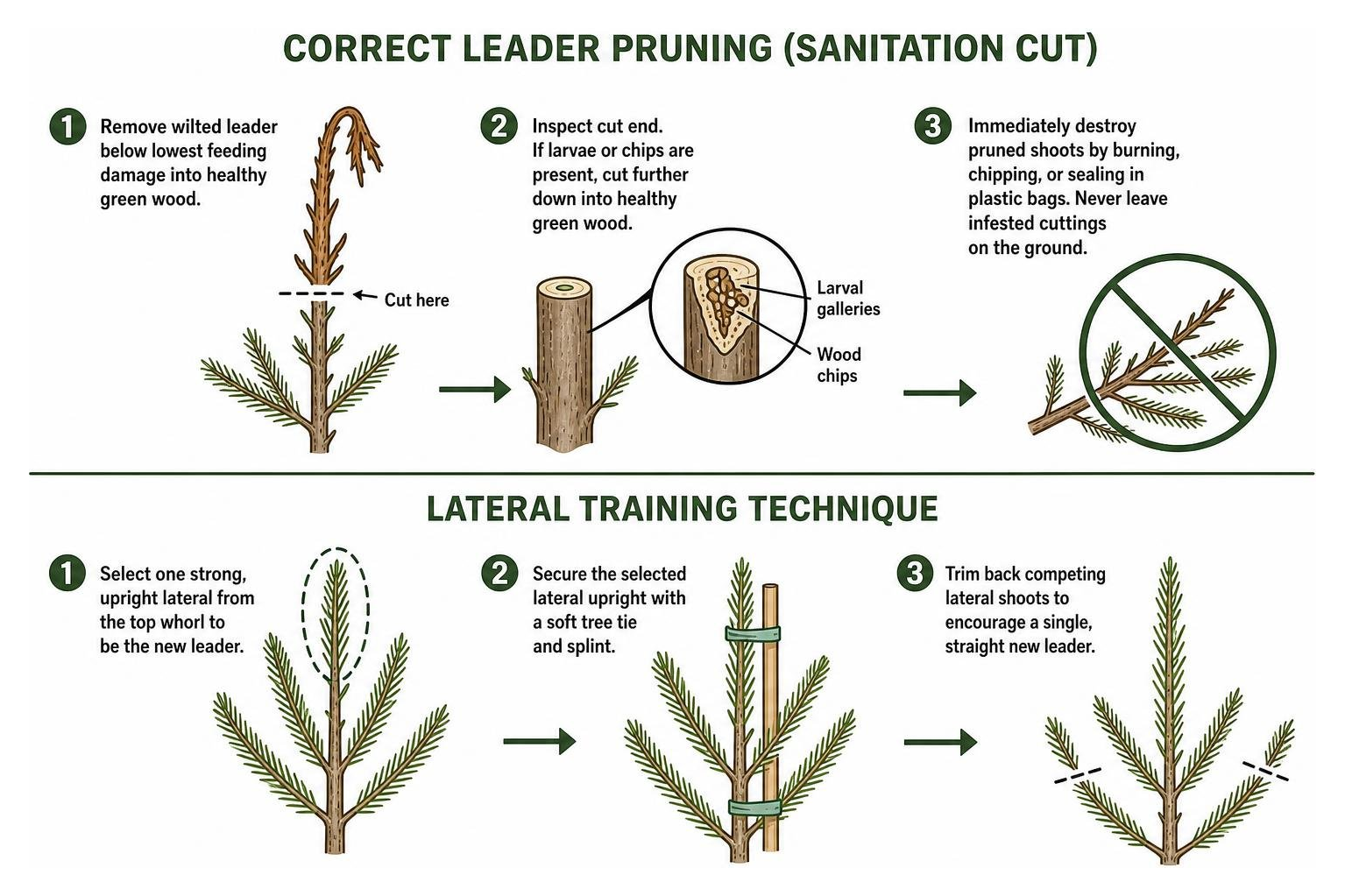
Immediately destroy the pruned shoots by burning, chipping, or sealing them securely in plastic bags to prevent larvae from completing their development. Never leave infested cuttings on the ground. After removing the damaged terminal, select one strong, upright lateral branch from the top whorl to serve as the new leader. Gently secure it in an upright position with a soft tree tie and splint, while trimming back competing lateral shoots. You can explore standard tree trimming and pruning techniques to master structural correction cuts. For larger trees or leaders that are difficult to reach safely, a local tree care company can handle the pruning and lateral training without putting you at risk.
Chemical Control Options and Timing
When mechanical pruning is not enough for high-risk or heavily infested trees, chemical controls can help protect young spruce terminals.
Spring Topical Sprays: Apply a pyrethroid insecticide (such as bifenthrin, permethrin, or cyfluthrin) directly to the terminal leader in early spring when adults emerge from overwintering sites. Timing is critical: sprays must coat the bark before females begin laying eggs, which often aligns with initial spring warm-ups above 60°F to 70°F. A second application 10 to 14 days later maintains coverage during peak egg-laying.
Systemic Soil Drenches: Imidacloprid applied to the soil around the root zone in autumn allows the tree to absorb and move the active ingredient into the terminal shoots by the following spring.
Always apply products according to labeled rates and local regulations. Integrating these treatments into regular seasonal tree shrub care protects young trees during their most vulnerable growth stages.
Effective Prevention and Cultural Management Strategies
Preventing white pine weevil involves cultural choices that make spruce trees less attractive to adult beetles. Weevils strongly prefer sunny, warm, open-grown terminal leaders with vigorous vertical growth. Silvicultural practices such as partial canopy shading create microclimates that discourage weevil feeding while supporting conifer health.
Modifying the growing environment and selecting appropriate planting locations reduces pest pressure significantly across residential properties. Consistent watering practices also help young spruce trees maintain adequate internal moisture, enhancing natural defensive resin flow during early spring emergence.
How to Prevent White Pine Weevil on Spruce in New Plantings
When planting new spruce trees, consider planting in locations that receive partial afternoon shade rather than full, open sun. Maintaining overstory trees or planting nurse trees keeps terminal bark temperatures cooler in spring, which discourages female weevils from feeding and laying eggs.
Physical barriers can also protect specimen leaders on young trees. Wrapping terminal shoots with breathable nylon mesh or stocking covers from early spring until active shoot expansion blocks adults from accessing the bark during oviposition. Pairing these physical measures with routine spring tree care routines helps young conifers develop strong root systems capable of handling environmental stress.
Selecting Genetically Resistant Spruce Varieties
Research into conifer genetics has identified specific traits that make certain spruce genotypes naturally resistant to weevil attacks. Resistant trees produce higher densities of traumatic resin ducts when attacked. These ducts flood larval feeding galleries with sticky resin, trapping and killing the grubs before they can girdle the stem (Robert & Bohlmann, 2010).
Studies have also linked elevated levels of specific monoterpenes, such as (+)-3-carene, to feeding deterrence and delayed ovarian development in female weevils (Robert & Bohlmann, 2010). However, studies on spruce resistance mechanisms indicate that trees bred for weevil resistance remain susceptible to other common pests like gall aphids (Adelges species) and spruce bud moth (Zeiraphera canadensis). A balanced monitoring plan should always account for the full spectrum of conifer pests.
Frequently Asked Questions about White Pine Weevil on Spruce
Will white pine weevil kill my entire spruce tree?
On established spruce trees over two feet tall, the white pine weevil rarely kills the entire tree. Instead, it kills the top two to three years of growth, leaving the lower trunk and branches alive but structurally deformed. However, on small seedlings under two feet in height, larval tunneling can extend down the entire stem, resulting in complete tree mortality.
When is the best time to spray spruce trees for weevils?
The best time to apply topical insecticides is early spring, usually in April, when ground temperatures reach 50°F and adult weevils begin emerging from duff. A follow-up application two weeks later ensures protection during peak mating and egg laying. Systemic soil treatments are best applied in the autumn so the chemical has ample time to translocate upward before spring activity begins.
Can a spruce tree recover after losing its main leader?
Yes, a spruce can recover its pyramidal shape with proper structural training. After you prune out the dead leader down to sound wood, select one vigorous upper lateral branch and gently splint it upward into a vertical orientation. Prune back the tips of neighboring side shoots in that top whorl to prevent them from competing, allowing the chosen lateral shoot to establish clear apical dominance.
Protect Your Spruce Trees with Rocky Mountain Treecraft
Managing conifer health in northern Utah's mountain terrain requires prompt attention and careful structural pruning. White pine weevil infestations can quickly compromise the beauty and structural stability of your landscape spruces, leaving them vulnerable to heavy winter snow loads and wind failure.
At Rocky Mountain Treecraft, we help homeowners throughout Heber City, the Heber Valley, and Wasatch County maintain healthy, resilient trees. Whether you need an accurate diagnosis of a drooping leader, corrective structural trimming, or hazardous tree management, we provide locally focused solutions tailored to mountain climates.
If you suspect weevil activity or notice wilting terminals on your conifers, schedule a comprehensive tree health assessment with our team today to protect the long-term health of your property.
References
Robert JA, Bohlmann J. "Behavioral and Reproductive Response of White Pine Weevil (Pissodes strobi) to Resistant and Susceptible Sitka Spruce (Picea sitchensis).." Insects, 2010. PMID 26467397.