
Branching Out: A Beginner's Guide to the Proper Pruning of Trees
Why Proper Pruning of Trees Makes All the Difference
Pruning of trees is the most common tree maintenance procedure — and also one of the most misunderstood. Done right, it protects your property, keeps your trees structurally sound, and adds real beauty to your landscape. Done wrong, it can permanently wound a tree or even kill it.
Here is what you need to know at a glance:
The basics of proper tree pruning:
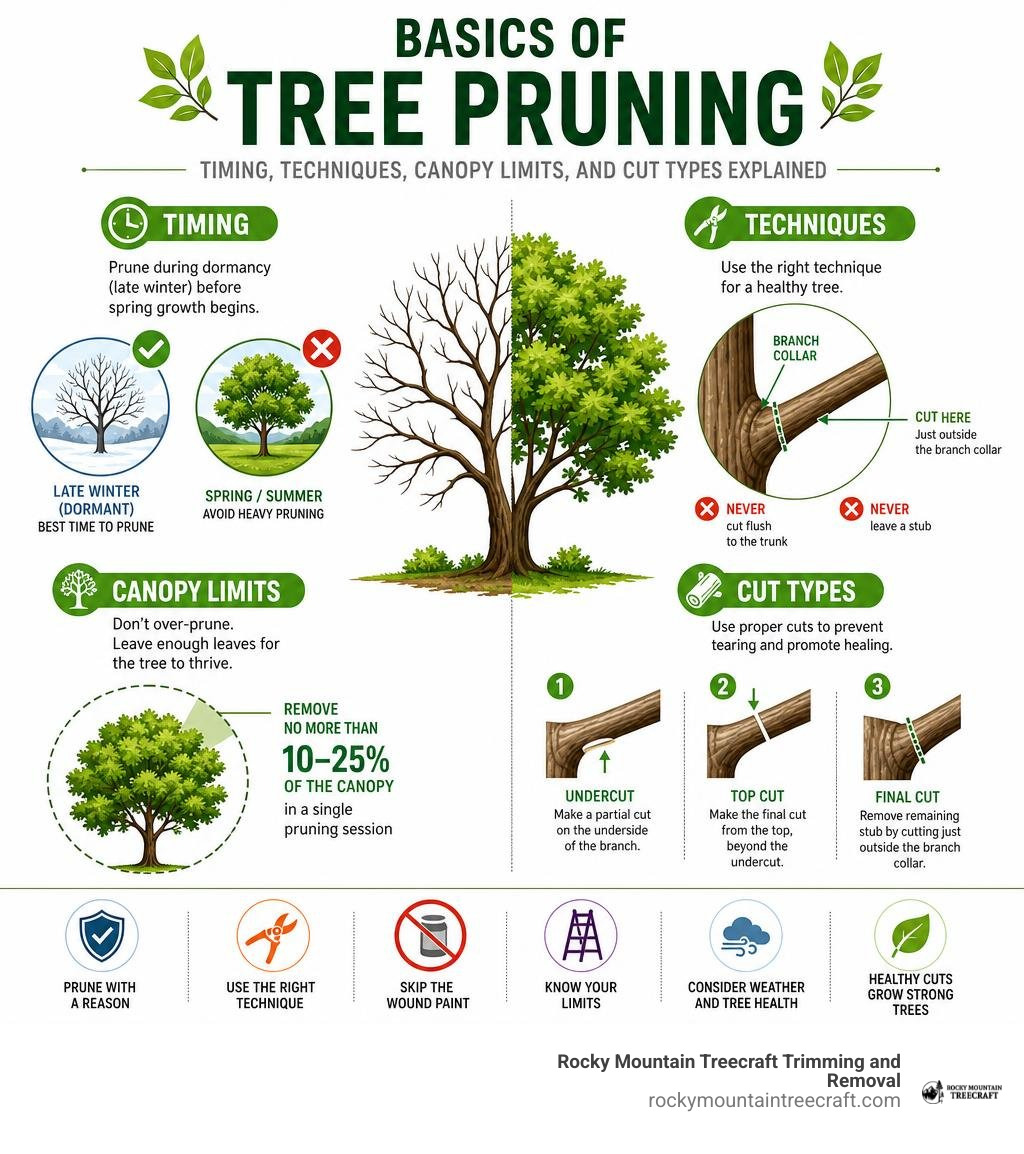
Prune with a reason. Never remove a branch without a clear justification — safety, structure, or disease control.
Time it right. Most trees are best pruned during dormancy (late winter), before the spring growth flush.
Use the right technique. Cut just outside the branch collar — never flush to the trunk, never leave a stub.
Don't over-prune. Remove no more than 10–25% of the canopy on mature trees in a single session.
Skip the wound paint. Research consistently shows that sealants trap moisture and slow the tree's natural healing.
Know your limits. Large limbs, high branches, and trees near power lines are jobs for a certified professional.
Unlike trees growing in a forest — where competition and natural forces shape their structure over decades — landscape trees grow in a very different environment. They have more space, more light, and no natural competition to guide their form. That means they need you to help shape them.
And here in Heber City, the stakes are real. Heavy Wasatch snowpack, strong seasonal winds, and sudden storms put serious stress on trees with poor structure or dead wood. A branch that might hang on through a mild winter somewhere else can become a hazard when it's carrying a foot of wet Utah snow.
The good news: a little knowledge goes a long way. This guide walks you through everything — from timing and technique to tools and tree biology — so you can prune with confidence and know when to call in the pros at Rocky Mountain Treecraft.
Timing Your Cuts: When to Prune for Maximum Health
When it comes to the pruning of trees, timing isn't just a minor detail—it is the difference between a thriving canopy and a stressed, disease-ridden tree. Trees are complex living organisms with distinct active and dormant phases. Making heavy cuts at the wrong moment can disrupt their energy cycles, drain their resources, and leave them vulnerable to pests.
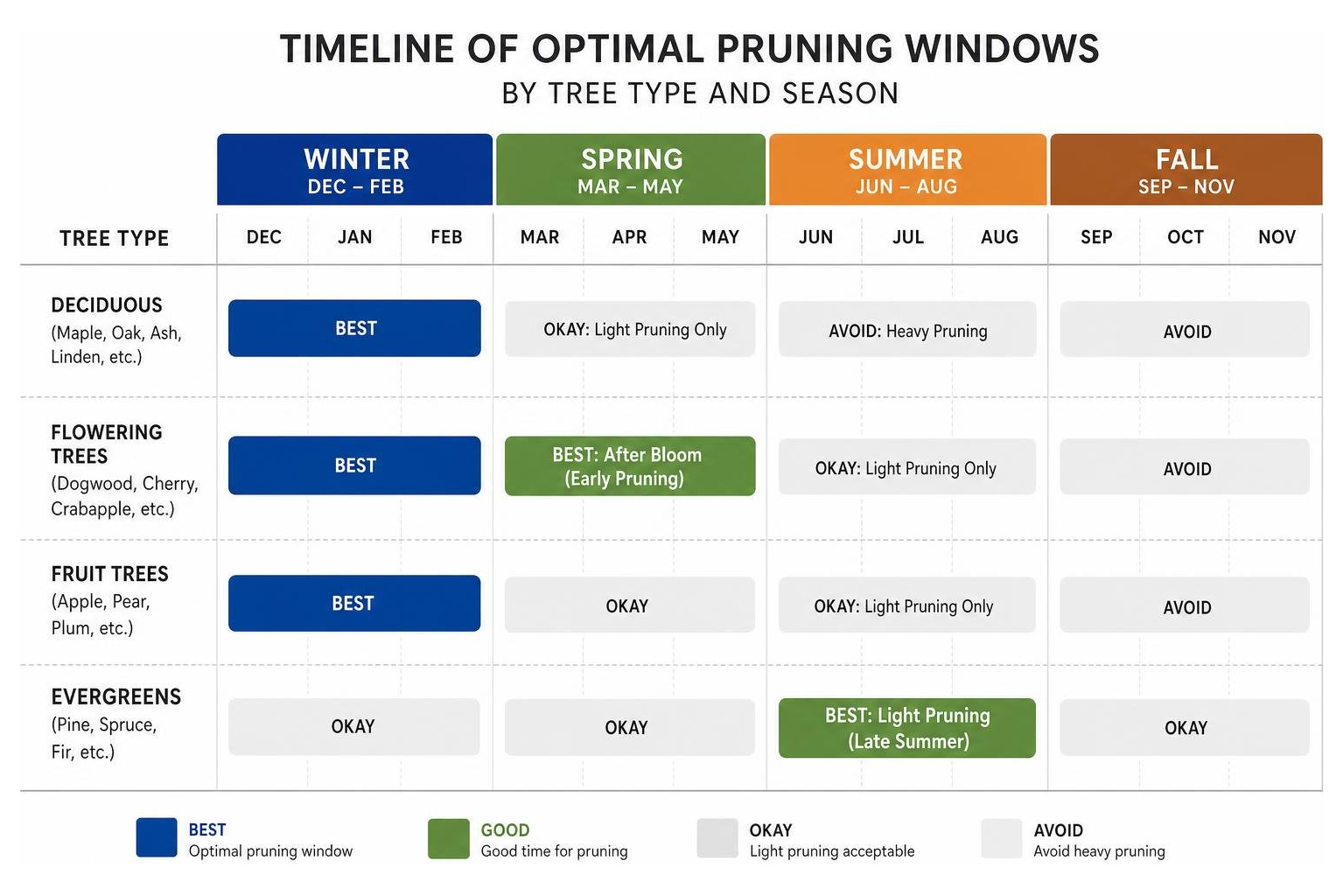
For the vast majority of trees in the Heber Valley and Summit County, the absolute best time for major pruning is during the dormant season, specifically from January to March. During this late-winter window, the tree is inactive, and its energy reserves are safely tucked away in the trunk and root system.
Pruning just before the spring growth flush is ideal because it allows the tree to immediately direct its fresh spring energy toward sealing the wounds. Furthermore, because deciduous trees have dropped their leaves, their branch structure is entirely visible, allowing you to make highly precise structural decisions.
Conversely, you should avoid heavy pruning of live tissue immediately after the spring growth flush. At this point, the tree has just expended a massive amount of its stored energy to push out new leaves and shoots. Cutting off branches now leaves the tree in a weakened state with depleted food reserves, severely limiting its ability to recover and seal wounds.
Another critical factor in timing is disease transmission. Open pruning wounds are essentially open doors for pathogens. For example, during warm months, active insect vectors can spread devastating diseases like fire blight (which commonly attacks local apple, pear, and crabapple trees) or oak wilt. Keeping your shears in the shed during active transmission seasons is a simple way to protect your landscape.
Furthermore, some trees are notorious "bleeders." Species like maples, birches, and dogwoods have intensive spring sap flow. If you prune them in late winter, they may seep sap heavily. While this bleeding is largely cosmetic and rarely harms a healthy tree, it can be alarming. To minimize sap loss, you can wait to prune these species in the summer after their leaves have fully matured, as the expanding leaves actively consume the sap and reduce the internal pressure.
For a deeper dive into the science of seasonal tree care, you can read the Principles & Practices for Pruning Trees | Home & Garden Information Center .
How the Pruning of Trees Varies by Season
To keep your yard looking its best year-round, it helps to understand how different seasons affect your pruning strategy. For more tailored advice, you can check out our seasonal guide on Tree Care Tips.
Winter Dormancy: This is the gold standard window. With the leaves gone, you can easily spot crossing branches, structural defects, and deadwood. The cold weather also keeps fungal spores and insects dormant, virtually eliminating the risk of infection.
Summer Pruning: While winter is for heavy structural work, summer is perfect for light, corrective pruning. Because the canopy is full, defective, sagging, or dead limbs are incredibly easy to see. Summer pruning can also be strategically used to slow down or "dwarf" the development of unwanted branches, directing the tree's energy to healthier limbs.
Fall Restrictions: If there is one golden rule of pruning, it is this: do not prune in the fall. Autumn is when decay fungi spread their spores most profusely, and wet weather helps them thrive. Additionally, because trees are preparing for dormancy, their wound-sealing processes slow down dramatically, leaving fresh cuts exposed to infection all winter long.
Essential Techniques for the Pruning of Trees
Pruning is not about randomly hacking away at limbs until the tree looks smaller. It is a precise practice that requires specific techniques to achieve distinct goals.

Depending on what your property needs, we typically utilize four primary maintenance pruning methods, as outlined in the Tree Pruning Essentials :
Crown Cleaning: This is the most basic and essential form of pruning. It involves the selective removal of dead, dying, diseased, crowded, and low-vigor branches from the canopy. It cleans up the tree's appearance and removes potential safety hazards before they can fall.
Crown Thinning: By selectively removing secondary branches, thinning increases light penetration and air movement through the canopy. This reduces the "sail effect" during high winds, helping the tree withstand strong canyon winds without tipping or breaking.
Crown Reduction: When a tree has grown too large for its space, reduction decreases its height or spread. This is done by cutting back leaders to lateral branches that are large enough (at least one-third the diameter of the cut stem) to assume the terminal role.
Crown Raising: This technique removes the lower branches of a tree to provide vertical clearance for pedestrians, vehicles, driveways, or to open up views of our beautiful Utah valleys.
Making the Cut: Target Pruning and the Three-Cut Method
Understanding where and how to cut is vital. Trees do not actually "heal" damaged tissue the way humans do; instead, they wall off the injured area to prevent decay from spreading. This biological defense mechanism is known as compartmentalization.
To help the tree seal a wound successfully, you must practice target pruning. This means making your cut just outside the branch collar (the swollen bulge of tissue at the base of the branch) and the branch bark ridge (the dark line of raised bark where the branch meets the trunk).
The branch collar belongs to the parent stem, not the branch itself. It contains specialized, chemically active cells that are responsible for sealing off the wound. If you make a flush cut — cutting flat against the trunk — you destroy this collar, leaving a massive, permanent wound that the tree cannot easily close, opening the door to wood-rotting organisms. Conversely, if you leave a long stub, the tree cannot grow over it, and the dead wood will eventually rot straight back into the heart of the trunk.
To learn more about how we evaluate tree wounds and structural safety, visit our page on Tree Health Assessment.
When removing any branch larger than an inch in diameter, the weight of the limb can easily tear the bark down the trunk as it falls. To prevent this severe damage, always use the Three-Cut Method:

The Undercut: Make a cut on the bottom of the branch about 12 to 15 inches away from the trunk. Cut about one-quarter to one-third of the way through the branch. This prevents the bark from stripping if the branch snaps early.
The Overcut: Move an inch or two further out on the branch and cut from the top down. The branch will break cleanly between the two cuts without tearing any bark on the trunk.
The Final Cut: Now that the heavy weight of the limb is gone, make a clean, precise cut just outside the branch bark ridge and branch collar, removing the remaining stub.
Thinning, Heading, Topping, and Pollarding
Understanding the terminology of pruning cuts helps prevent catastrophic landscaping mistakes. The two primary types of cuts are thinning cuts (which remove a branch at its point of origin or back to a strong lateral) and heading cuts (which cut a branch back to a stub, bud, or weak lateral).
While heading cuts are useful for shaping hedges, they should never be used on mature trees. Indiscriminate heading of large limbs is called topping, and it is perhaps the most harmful tree pruning practice known. Topping starves the tree by removing its food-producing leaves, exposes the trunk to sunburn, and triggers a panic response: a flush of rapid, weakly attached shoots called watersprouts. These shoots grow incredibly fast but are poorly anchored to the outer xylem, making them highly prone to snapping under winter snow loads.
Sometimes confused with topping, pollarding is a highly skilled, historical training system dating back to the Middle Ages. It involves cutting young branches back to the exact same point annually, creating swollen "knuckles" or knobs of callus tissue. These knobs contain specialized defense zones that prevent decay from entering the main limbs. While pollarding can be used on specific street trees to control their size, it requires intense, lifelong annual maintenance and is rarely appropriate for typical residential shade trees.
Pruning Practice | Cut Type Used | Impact on Tree Health | Long-Term Structural Result |
|---|---|---|---|
Thinning | Thinning Cuts | Highly beneficial; promotes natural sealing and airflow | Preserves the tree's natural form and structural strength |
Heading | Heading Cuts | Stressful; removes terminal buds and triggers dense growth | Leads to crowded, bushy, and structurally weak branches |
Topping | Abusive Heading | Extremely destructive; causes decay, starvation, and shock | Creates a hazardous tree with weakly attached, dangerous limbs |
Pollarding | Specialized Heading | Sustainable if started young and maintained annually | Results in unique, knobby knuckles that sprout seasonal shoots |
The Goldilocks Rule: Safe Canopy Removal Limits
When it comes to removing live foliage, more is definitely not better. Removing green leaves reduces the tree's ability to photosynthesize and feed itself. To keep your trees safe, follow these strict limits on how much of the live canopy can be removed in a single season:
Young, newly established trees: Can handle a heavier hand — up to 33% (and occasionally up to 50% for structural training) of their foliage, as they are vigorous and recover quickly.
Medium-aged trees: Limit removal to a maximum of 25% of the live canopy.
Mature trees: Be extremely conservative. Never remove more than 10% of a mature tree's canopy in a single year. Older trees do not tolerate stress well and have limited energy reserves.
Over-pruning also opens up the inner canopy to intense, direct sunlight. In our high-altitude Utah climate, this sudden exposure can actually cause the tree to get "sunburned" (sun scald), killing functional growth cells on the limbs and leaving the bark cracked and peeling.
Formative Pruning: Training Young Trees for Wasatch Winters
The best time to ensure a tree grows up strong, beautiful, and safe is when it is young. Structural pruning performed on young trees (typically between 1 and 5 years old) prevents major structural failures decades later. Smaller wounds on young trees close incredibly fast, and correcting a structural issue early saves you from having to make massive, high-risk cuts on a mature tree later on.
To discover how we help young trees get the best start in your yard, explore our Residential Tree Services.
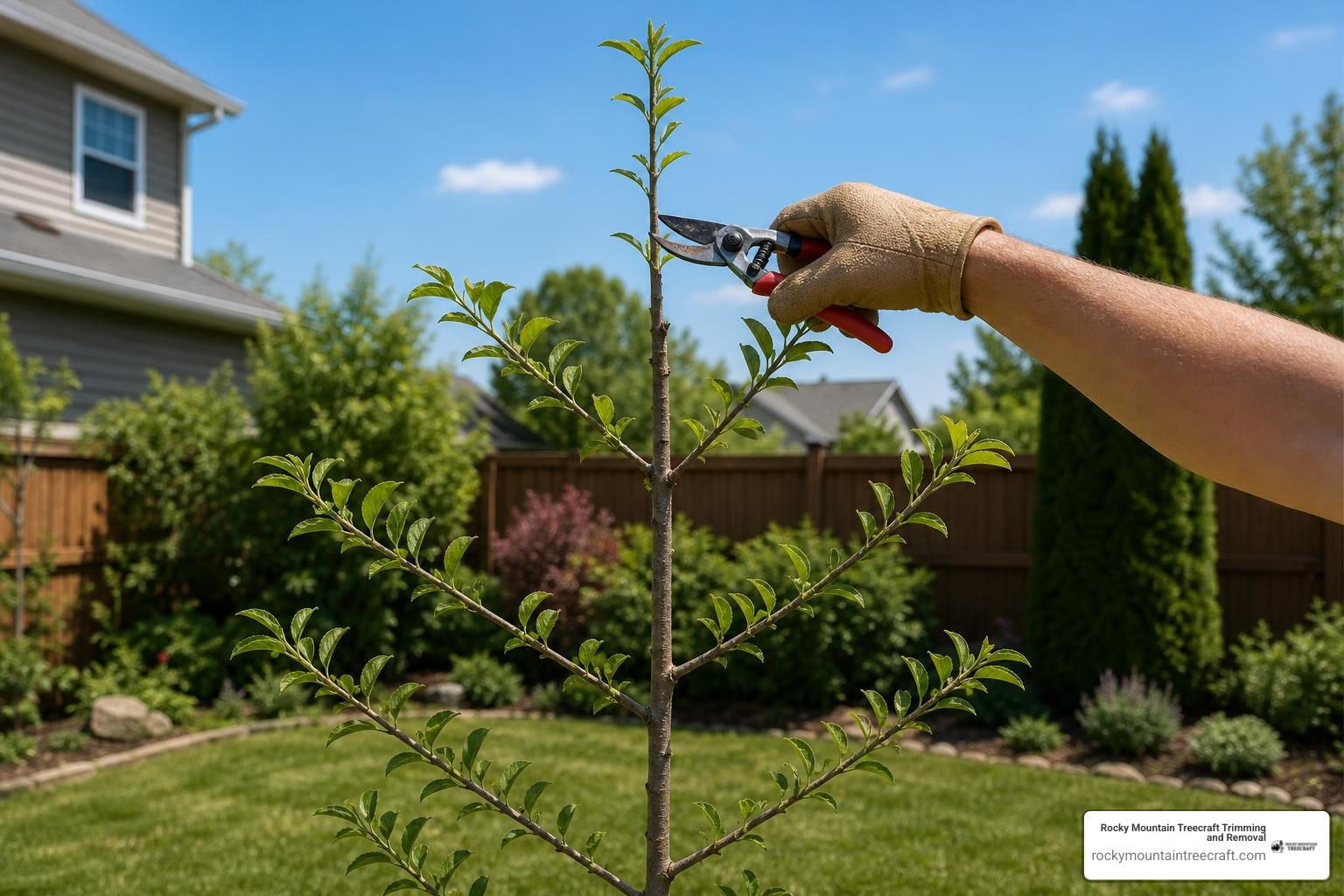
When training a young tree, our primary goal is to establish a strong, single central leader (the main upright trunk). We also select well-spaced scaffold branches (the permanent structural side branches).
One of the most important factors we look at is the attachment angle of these side branches. Branches with wide attachment angles — greater than 30 degrees (ideally closer to 45 to 60 degrees) — are incredibly strong. Branches with narrow, V-shaped angles are highly prone to splitting. As the tree grows, bark becomes trapped inside the tight junction (known as included bark), preventing the wood from bonding securely. Under the weight of a heavy Wasatch winter snow load, these V-shaped crotches act like a wedge, easily splitting the tree in half.
Structural Pruning of Trees in Their Youth
To build a resilient structural framework, we focus on both radial and vertical spacing:
Radial Spacing: Side branches should be distributed evenly around the trunk, like spokes on a wheel, rather than all growing out of one side.
Vertical Spacing: Permanent scaffold branches should be spaced vertically along the trunk — about 8 to 12 inches apart for smaller ornamental trees, and 18 to 24 inches apart for large shade trees like oaks.
Suppressing Co-dominant Stems: If two competing leaders develop, we suppress one by cutting it back to a lateral branch, allowing the other to become the dominant, strong central trunk.
Progressive Pruning: We never try to fix a young tree's structure all at once. By using progressive pruning cycles over 2 to 3 years, we slowly guide the tree's growth without causing excessive stress.
Special Considerations: Conifers, Palms, and Species-Specific Rules
Different tree species have vastly different biological rules when it comes to pruning.
For example, coniferous trees (needle-type evergreens like our local Blue Spruce, Austrian Pine, and Douglas Fir) handle pruning very differently than deciduous trees. Conifers do not generate new growth from old, hardened wood. If you prune a conifer branch back past the green needles into the bare inner wood, that branch will remain bare forever.
To prune pines correctly, you must target them during the spring "candle stage" — when the new, soft spring growth resembles tightly packed candles. You can pinch or cut these candles in half to control the tree's size and promote a denser canopy without damaging the branch's ability to grow.
To see how we apply these specialized techniques to your property's evergreen trees, check out our Tree Trimming services.
And while you won't find many palm trees swaying in Heber City's snowy winters, understanding how they are pruned highlights a fascinating contrast in tree biology. Unlike broadleaf trees, palm wounds do not close or heal; any cut to a palm trunk is permanent. This is why professional arborists never use climbing spikes on palms. Furthermore, palm pruning is strictly limited to removing dead, brown lower fronds; removing green fronds that point above a horizontal line can severely weaken the tree's terminal bud.
Back in our mountain climate, we rely heavily on the biological rules of CODIT (Compartmentalization of Decay in Trees) to guide our maximum cut sizes:
The 2-Inch Rule: For tree species that seal wounds poorly (such as maples, birches, poplars, aspens, and crabapples), pruning cuts should be kept under 2 inches in diameter to ensure the tree can successfully compartmentalize the wound before decay sets in.
The 4-Inch Rule: For species that are highly effective compartmentalizers (such as most oaks, elms, lindens, and hornbeams), a 4-inch diameter branch is the absolute maximum size that should be removed.
The Arborist's Toolbox: Essential Gear and Maintenance
Using the right tool for the job makes pruning safer, easier, and much healthier for the tree. Dull or improper tools tear plant tissue, leaving jagged wounds that are difficult for the tree to seal.
Here is a look at the essential tools we use for proper pruning:
Bypass Pruners: These operate like scissors, with a curved blade sliding past a flat jaw. They make incredibly clean, close cuts on small twigs and branches up to 0.5 inches in diameter. Avoid anvil-action pruners, which crush the live stem tissue instead of cutting it cleanly.
Lopping Shears: Featuring long handles for extra leverage, loppers are designed for branches between 0.5 and 1.5 inches in diameter.
Pruning Saws: Unlike standard carpentry saws, pruning saws are designed to cut on the pull stroke, giving you maximum control in tight spaces. They are ideal for branches up to 6 inches in diameter.
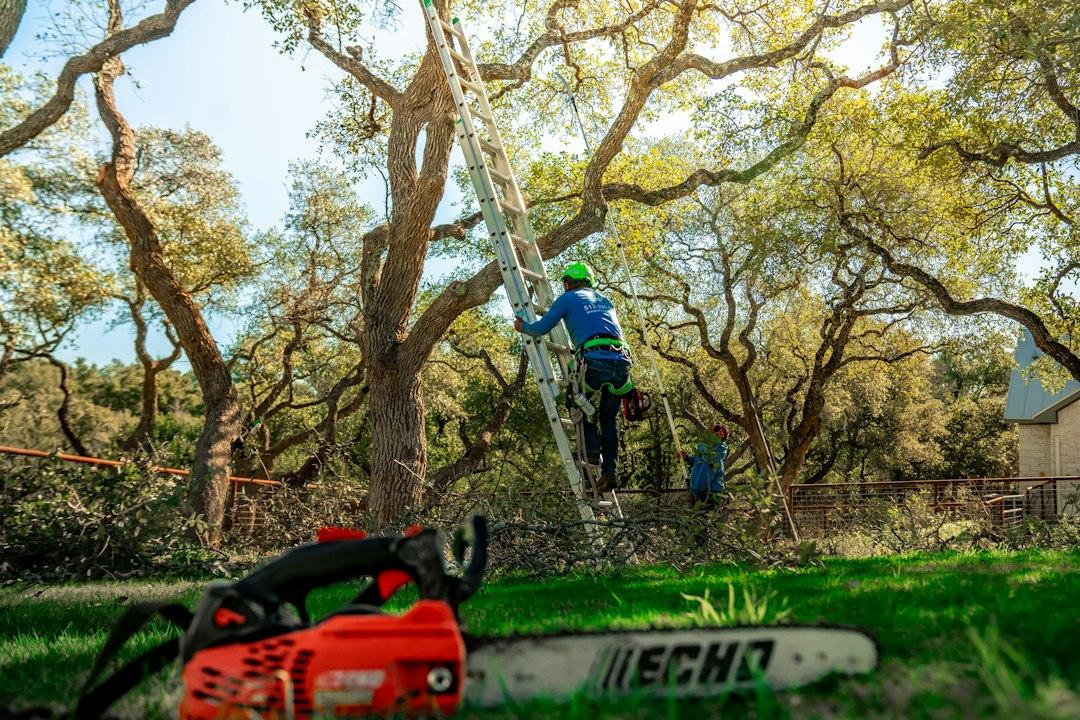
Chainsaws: Reserved for limbs larger than 3 inches, chainsaws require specialized training and safety gear. They should never be used on a ladder or for delicate, detailed pruning where a hand saw provides better precision.
Keeping your tools clean is just as important as keeping them sharp. Rust pockets on blades can harbor harmful bacteria and fungal spores. When pruning diseased wood (such as branches infected with fire blight), you must sterilize your blades between every single cut using isopropyl rubbing alcohol or a 1:9 bleach-to-water solution. Once you are finished, dry your tools thoroughly and apply a light coat of oil to prevent rust.
Finally, never skimp on safety gear. Always wear thick leather gloves, safety glasses, and long sleeves before making any cuts. Stand to the side of your work, and keep your free hand well away from the cutting blade.
Frequently Asked Questions about Tree Pruning
Why do landscape trees need pruning?
Unlike forest trees, which grow close together and naturally shed their lower, shaded limbs, landscape trees grow in open, human-populated environments. They require a higher level of care to maintain structural integrity, prevent safety hazards (like limbs hanging over roofs or driveways), and maintain a beautiful, balanced appearance. Proper pruning also removes deadwood and diseased branches before they can attract pests or fall on your property.
Should I apply wound dressing or paint to a fresh cut?
No. Decades of scientific research have debunked the myth of pruning paint. Applying wound dressings, tars, or sealants actually harms the tree by trapping moisture underneath the coating, creating a perfect, dark breeding ground for wood-rotting fungi. It also interferes with the tree's natural hormone production, slowing down the compartmentalization process. The best thing you can do for a fresh cut is to make a clean, proper collar cut and let the tree seal itself naturally.
When should I hire a professional arborist instead of doing it yourself?
If a pruning job requires you to leave the ground, use a ladder, work anywhere near power lines, or operate a chainsaw on large limbs, it is time to call in a professional. High-climb work is incredibly hazardous, and large, heavy limbs behave unpredictably when cut.
Certified arborists have the specialized rigging equipment, safety gear, and deep biological knowledge required to prune large trees safely without damaging your home or the tree's health. For commercial properties, HOAs, and municipal areas, our Commercial Tree Services ensure your landscape stays safe, beautiful, and fully compliant with local safety standards.
Conclusion: Partner with Heber Valley’s Tree Experts
Proper pruning of trees is both an art and a science. It requires a deep understanding of local tree biology, seasonal weather patterns, and precise cutting techniques. Here in Heber City and across Wasatch and Summit Counties, our trees face unique environmental challenges — from heavy, wet winter snows to dry, windy summers.
At Rocky Mountain Treecraft, we specialize in providing fast, reliable, and locally-based tree care tailored to our beautiful mountain terrain. Whether you need structural pruning to prepare your young trees for winter, hazard reduction on a mature oak, or safe tree removal, our team is here to help protect your home and keep your landscape thriving.
Don't wait until the next big storm puts your property to the test. Schedule professional tree trimming services with Rocky Mountain Treecraft today, or contact us for a free, honest estimate on your property's tree care needs.