
How to Keep Your Trees and Shrubs Thriving All Year
Why Tree & Shrub Care Is One of the Best Investments You Can Make for Your Property
Proper tree & shrub care can add as much as 15% to the value of your home — and yet most homeowners don't think about it until something goes wrong.
Here's what good tree and shrub care covers:
Fertilization — feeding roots with the right nutrients at the right time
Pest and disease control — stopping problems before they spread
Pruning and structural support — keeping plants safe and shaped correctly
Soil health — fixing compaction and nutrient deficiencies that silently starve roots
Seasonal inspections — catching early warning signs like discolored leaves, thinning canopy, or bark damage
For homeowners in Heber City and across Wasatch County, the stakes are even higher. Harsh winters, dry summers, and heavy clay soils create stress that weakens trees and shrubs over time. Many plants look fine on the surface while quietly declining underneath — because healthy-looking foliage isn't always a reliable sign of plant health.
The good news? Most tree and shrub problems are preventable with a consistent, season-by-season care plan.
This guide walks you through everything you need to know — from fertilization methods and pest control to structural safety and choosing the right care program for your landscape.
The Core Benefits of a Professional Tree & Shrub Care Program

Many homeowners view their trees as permanent, self-sustaining fixtures of the yard. However, the suburban environment is vastly different from a natural forest. In a forest, falling leaves decompose and return vital nutrients to the soil. In our manicured yards, we rake away those leaves, starving the soil of its natural food source.
Investing in a professional program offers several key benefits:
Preventative Disease & Pest Management: It is much easier (and cheaper!) to prevent a fungal outbreak or bug infestation than it is to cure one. Proactive treatments keep your plants' natural defenses strong.
Enhanced Property Value: Healthy, mature trees are major financial assets. A well-landscaped yard with thriving greenery can significantly boost your home's curb appeal and market value.
Long-Term Structural Safety: Regular professional evaluations identify weak branch attachments and internal decay before a heavy Utah winter snowstorm causes a limb to crash onto your roof.
Tailored Nutrition: Instead of generic, store-bought fertilizer spikes that can burn tender roots, professional care delivers balanced, slow-release nutrients designed for our specific mountain soil.
To truly understand what is happening beneath the bark, we always recommend starting with a professional Tree Health Assessment. This evaluation acts as a diagnostic physical exam for your green investments, catching silent stressors before they become fatal.
Essential Services in a Comprehensive Maintenance Plan
A truly comprehensive tree & shrub care program does not rely on a single, magic-bullet solution. Instead, it combines several science-backed practices to support plant health from the roots to the highest leaves in the canopy.
Soil Health Optimization: Healthy plants start with healthy soil. We look at nutrient levels, pH balances, and compaction to ensure roots have an ideal environment to grow.
Strategic Pruning: Pruning should never be done on a whim. The timing and technique must be tailored to the specific plant variety. For example, some ornamental shrubs should be pruned immediately after their spring bloom, while other trees are best trimmed during their dormant winter phase to prevent the spread of disease.
Proper Mulching: Mulch is a tree's best friend. It regulates soil temperature, retains precious moisture during dry mountain summers, prevents weed growth, and protects trunks from lawnmower damage. Just remember to avoid "mulch volcanoes" piled high against the bark, which can trap moisture and cause decay.
Customized Watering Guidelines: Trees and shrubs have watering needs that differ wildly from turfgrass. While lawns thrive on frequent, shallow watering, trees require deep, infrequent watering that saturates the soil several inches down, encouraging deep root systems.
Designing a Custom Tree & Shrub Care Schedule
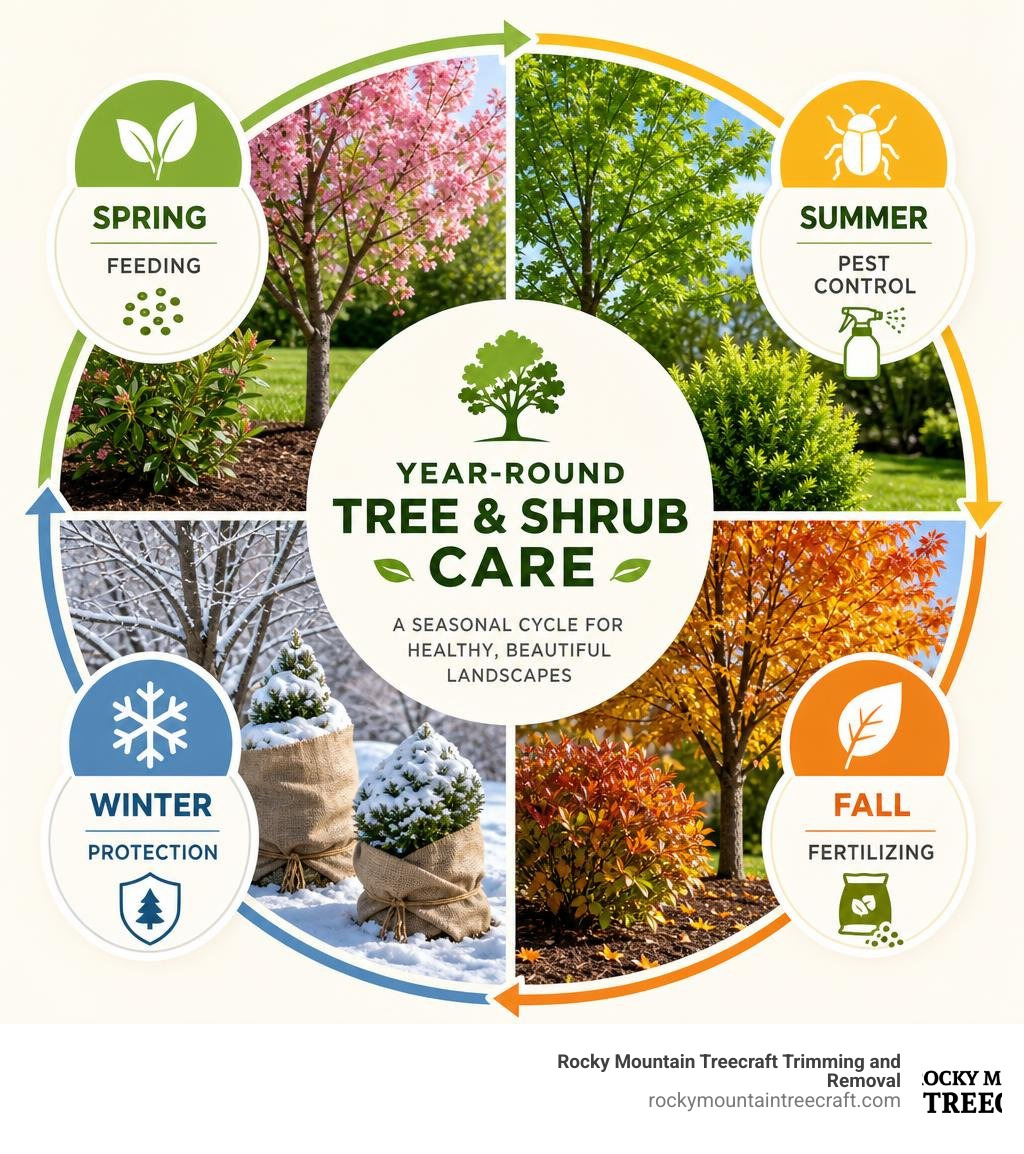
A successful schedule is dictated by the seasons. In the mountain West, our weather swings dramatically, which means our treatment timing must be incredibly precise. A typical high-performing schedule includes:
Late Winter / Early Spring (Dormant Stage): This is the window for applying dormant oils. These oils coat the branches and suffocate overwintering insect eggs and scale pests before they can hatch and destroy spring buds.
Mid-Spring (Active Growth): As buds break, we apply targeted foliar sprays to protect delicate new leaves from hungry pests and early fungal infections.
Summer (Stress Management & Pest Control): High heat and dry winds stress plants. We monitor for active pests like aphids and spider mites, applying localized treatments while ensuring the root zones are properly hydrated.
Fall (Root Development & Winter Prep): This is the ideal window for deep root fertilization. As top growth slows down, roots actively absorb nutrients to store for winter survival and explosive spring growth.
Local microclimates also play a huge role. The challenges faced by homeowners managing properties in Park City or looking for professional tree care in Heber City can differ from those dealing with the unique wind patterns of Hideout or the riverside soils of Midway. No matter where you live in the Wasatch Back—from Kamas to Charleston—your care schedule must be customized to your property's specific elevation, soil type, and wind exposure.
Deep Root Fertilization vs. Surface Applications
Many homeowners try to feed their trees by broadcasting granular fertilizer over the lawn or driving plastic fertilizer spikes into the ground. While well-intentioned, these surface methods are highly inefficient.
Most of a tree's active feeder roots live in the top 2 to 8 inches of the soil. When you throw fertilizer on top of your lawn, the aggressive roots of your turfgrass steal the vast majority of those nutrients before they can sink deep enough to reach your trees. Furthermore, dry fertilizer spikes concentrate high levels of salts in tiny areas, which can actually cause chemical root burn.
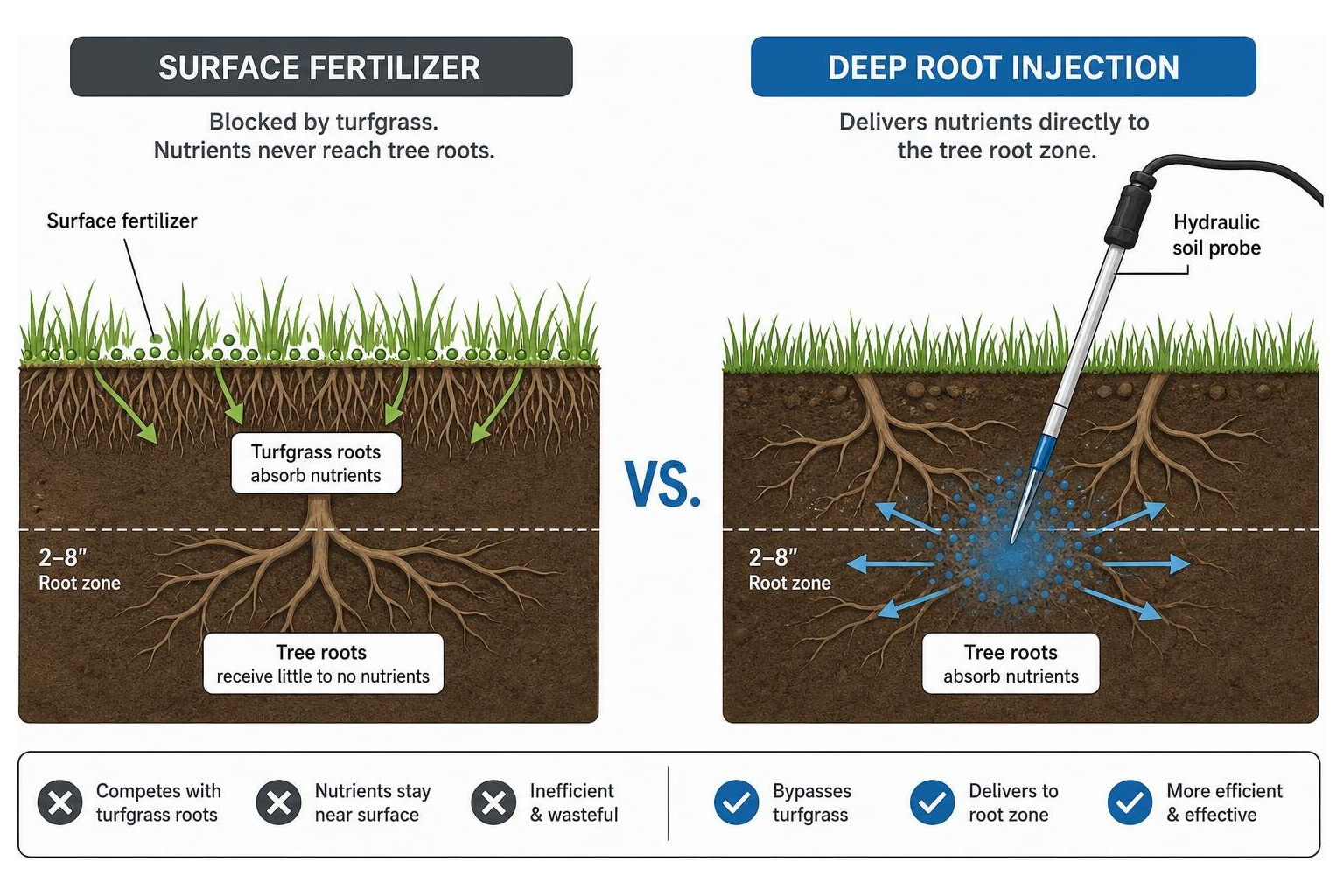
The professional solution is deep root fertilization. This process uses a specialized hydraulic soil probe to inject a liquid blend of slow-release nutrients, organic matter, and biostimulants directly into the root zone, about 4 to 8 inches below the surface.
This method is superior for several reasons:
Bypasses Turfgrass: Delivers nutrients directly to the tree's root system, completely bypassing greedy lawn roots.
Relieves Compaction: The high pressure of the injection physically fractures compacted clay soil, creating tiny pockets (macropores) that allow oxygen and water to reach the roots.
Zero Runoff: Because the nutrients are injected subterraneanly, there is zero risk of fertilizer washing away into local Utah waterways during heavy rain or snowmelt.
For a deeper scientific dive into proper nutrient application rates and the biology behind root absorption, check out this guide on Fertilizing Trees & Shrubs | Home & Garden Information Center.
Structural Support and Safety Inspections
Sometimes, keeping a tree healthy is about physical physics as much as biology. Trees with co-dominant stems (two main trunks of similar size growing from the same point) or narrow, V-shaped branch attachments are highly susceptible to splitting down the middle under the weight of heavy mountain snow or high canyon winds.
Rather than removing these structurally compromised but otherwise beautiful trees, we can often install structural support systems:
Cabling: High-strength steel or dynamic synthetic cables are installed in the upper third of the canopy to limit how much co-dominant limbs can sway independently during storms, reducing the risk of a catastrophic split.
Bracing: Threaded steel rods are inserted directly through the weak crotch of the tree to provide rigid, physical support against twisting forces.
These systems require specialized training to install correctly; placing a cable in the wrong spot can actually increase the leverage on a weak branch and cause it to fail sooner. Incorporating these safety checks into your routine Residential Tree Services is a vital step in protecting your home, family, and surrounding landscape.
Identifying Common Pests, Diseases, and Environmental Stressors

Our local Utah mountain climate is beautiful, but it presents unique challenges for plants. High-altitude UV rays, alkaline clay soils, dry summers, and freezing winters can leave trees stressed and highly vulnerable to pests and diseases.
Here are the most common threats we see in our local service areas:
Pest/Disease Common Target Plants Key Symptoms Primary Treatment Aphids Aspens, Maples, Lindens Sticky residue (honeydew) on leaves and cars, curled leaves, black sooty mold Systemic soil drenches or targeted spring foliar sprays Spider Mites Evergreens, Junipers, Elms Fine webbing on needles, dusty or bronze-colored foliage, premature needle drop Miticide treatments and proper deep watering to reduce drought stress Scale Insects Pine, Aspen, Ash Hard, waxy bumps on twigs, yellowing leaves, dieback of smaller branches Dormant oil applications in late winter and systemic insecticides Bronze Birch Borer Birch Trees Twig dieback starting at the top of the canopy, D-shaped exit holes in the bark Systemic borer injections and keeping the tree well-watered Iron Chlorosis Maples, Oaks, Fruit Trees Yellow leaves with dark green veins, stunted growth, leaf scorch Soil acidifiers, iron chelate trunk injections, or deep root applications
Recognizing When Your Plants Need Professional Tree & Shrub Care
Plants cannot speak, but they do send out clear distress signals when they are struggling. Homeowners should keep a watchful eye out for these common warning signs:
Discolored or Spotted Leaves: Yellowing leaves (chlorosis) or dark fungal spots indicate nutrient deficiencies or active diseases.
Thinning Canopy: If your tree's canopy looks sparse, or if you can see right through it compared to previous years, the tree is likely under severe stress.
Early Leaf Drop: If your deciduous trees start dropping their leaves in July or August instead of October, they are shutting down early to conserve water and energy.
Bark Splitting and Cracking: Deep cracks in the trunk can be signs of internal decay, frost cracks, or sunscald from harsh winter sun.
Twig and Branch Dieback: Dead wood at the outer tips of branches indicates that the root system is struggling to push water and nutrients to the edges of the canopy.
If you notice any of these symptoms, it is crucial to act quickly. Catching these signs early often means we can save the tree through targeted Tree Trimming and health treatments, rather than having to perform an expensive removal down the road.
Mitigating Soil Compaction and Clay Challenges
One of the biggest silent killers of suburban trees in Utah is clay soil compaction. When heavy construction equipment preps a home site, or when kids and pets run across the yard, the tiny spaces between soil particles are crushed.
This compaction leads to a loss of "macropores"—the microscopic air pockets that roots rely on to breathe. Yes, tree roots need oxygen! In heavily compacted clay, roots literally suffocate, and water cannot penetrate the hard, concrete-like dirt.
To combat this, we use advanced soil conditioners and biostimulants. Products like Tree & Shrub – MitoGrow use specialized biostimulants to encourage rapid root development and help plants use existing nutrients more efficiently. Additionally, liquid carbon and microbial blends like Nutri-Tree & Shrub™ | Mirimichi Green work to break up tough clay bonds, introduce beneficial fungi (mycorrhizae), and drastically improve root absorption.
Comparing Program Levels: Good, Better, and Best Care Plans
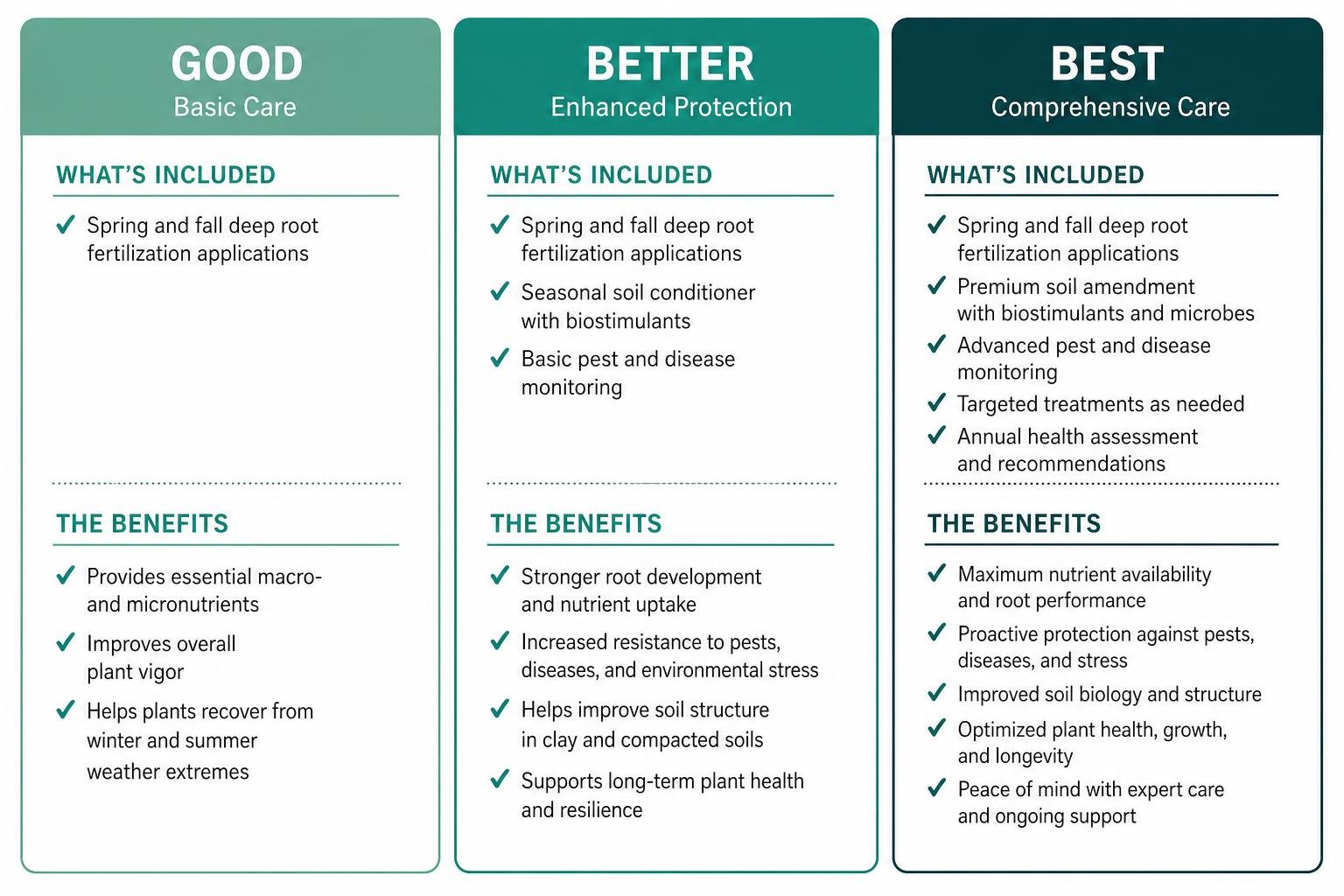
Every landscape is different. A newly planted yard has different needs than a property shaded by 80-year-old historic cottonwoods. To help you choose the right level of protection for your budget and goals, we recommend looking at care programs through a tiered framework:
The "Good" Plan: Basic Nutrition & Stress Relief
This foundational plan is designed for young, healthy landscapes that just need a little boost to stay on track.
What's Included: Spring and fall deep root fertilization applications.
The Benefits: Provides essential macro- and micronutrients, improves overall plant vigor, and helps plants recover from winter and summer weather extremes.
The "Better" Plan: Nutrition + Systemic Pest Protection
Our most popular tier, this plan is designed for established yards with a mix of ornamental shrubs and mature shade trees.
What's Included: Everything in the "Good" plan, plus a late-winter dormant oil application and spring systemic insect treatments.
The Benefits: Knocks out overwintering pests before they hatch and provides up to 12 months of internal systemic protection against leaf-chewing and boring insects.
The "Best" Plan: Complete Landscape Shield
This elite tier is designed for high-value landscapes, estate properties, or yards with sensitive, exotic, or aging specimen trees that require maximum protection.
What's Included: Everything in the "Good" and "Better" plans, plus multiple targeted spring fungicide applications, summer foliar sprays, and specialized winter evergreens protection.
The Benefits: Offers complete protection against fungal diseases, immediate knock-down of active summer pests, and prevents winter drying (desiccation) on valuable evergreens.
Frequently Asked Questions about Tree and Shrub Maintenance
How often should trees and shrubs be inspected for pests and diseases?
We recommend having your landscape professionally inspected at least three to four times a year, ideally coinciding with seasonal transitions (early spring, mid-summer, and mid-fall). This structured monitoring allows us to catch pest cycles and fungal infections during their critical early phases when they are easiest to treat.
What is the best time of year to fertilize and apply pest control?
The absolute best time for deep root fertilization is late summer through mid-fall. During this period, trees have stopped growing new leaves and can direct 100% of their energy into absorbing nutrients and building a robust root system for the coming year. For pest control, late winter/early spring is the ideal window to apply dormant oils, while systemic soil drenches should be applied in mid-spring so the tree has time to draw the protection up into its leaves before bugs emerge.
How can homeowners distinguish a certified arborist from an unqualified provider?
Always look for a provider who employs ISA Certified Arborists (International Society of Arboriculture). Certified arborists have passed rigorous, comprehensive exams covering all aspects of tree biology and safety. Additionally, ensure the company carries robust liability insurance and workers' compensation, uses modern safety gear, and has deep, locally-based experience with our specific Utah climate and native tree species.
Conclusion
Your trees and shrubs are the crown jewels of your property. They provide shade, beauty, and privacy while quietly increasing your home's equity. But without consistent, professional tree & shrub care, these living investments can easily fall victim to drought, compacted clay, and hungry pests.
As of July 2026, the hot summer sun is in full force across Utah. Now is the perfect time to give your landscape the professional care it deserves. At Rocky Mountain Treecraft, we pride ourselves on providing fast, reliable, and locally-based expertise tailored specifically to the unique climate and terrain of Heber City, Midway, Park City, and the surrounding Wasatch and Summit Counties.
Don't wait for your leaves to turn brown or your branches to split. Schedule a professional Tree Trimming consultation today and let us help you keep your landscape beautiful, safe, and thriving for generations to come!