
A Practical Guide to Identifying and Controlling White Pine Weevil
How to Spot and Stop White Pine Weevil
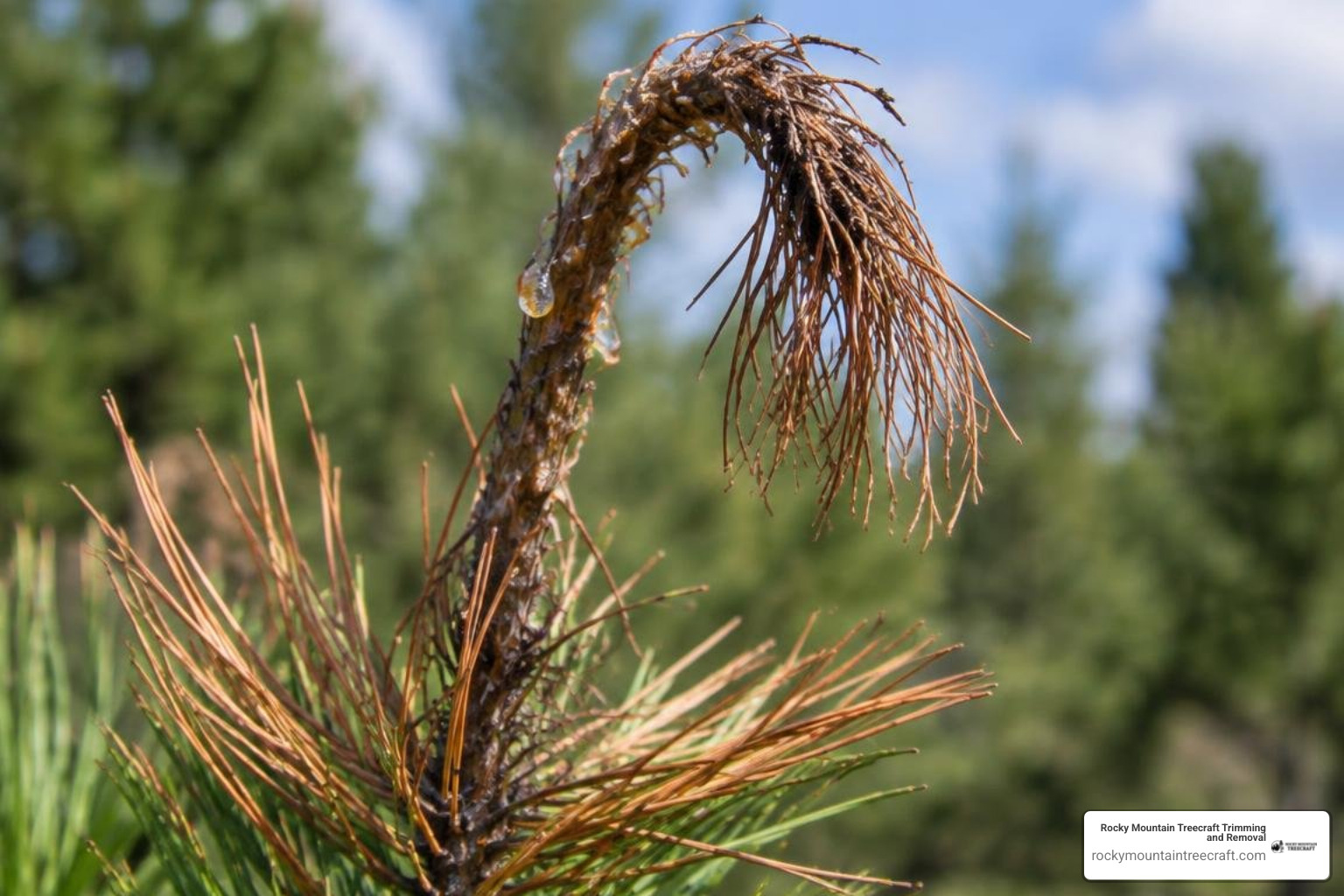
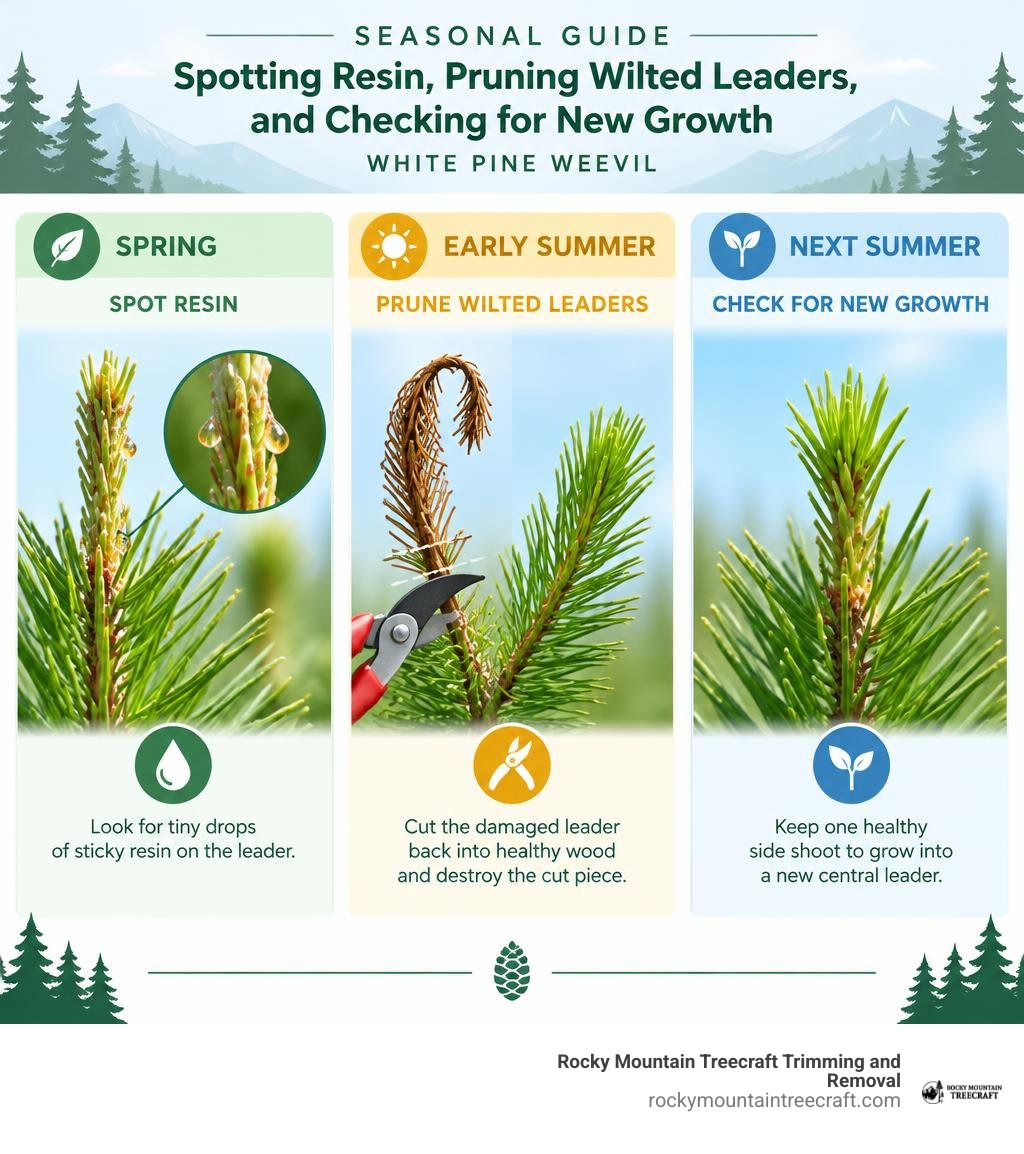
Check the top shoot of a young pine or spruce. White pine weevil often leaves tiny drops of sticky resin on the leader in spring. By early summer, the tip may wilt, bend like a hook, and turn brown. If you find larvae beneath the bark, cut the damaged leader back into healthy wood and destroy the cut piece before new adults emerge, often by mid-July. Keep one healthy side shoot to grow into a new central leader.
The beetle is small, but repeated attacks can leave a tree forked or crooked. Early checks give you the best chance to protect its shape.
Biology and Life Cycle of the White Pine Weevil
Understanding how this small snout beetle operates through the seasons makes managing it far simpler. The white pine weevil completes a single generation each year, yet a single season of feeding can destroy years of vertical growth on prized yard conifers and plantation trees alike.
Spring Emergence and Oviposition
Adult weevils (Pissodes strobi) spend the winter sheltered under needles and leaf litter directly beneath their host trees. When ground temperatures consistently exceed 50°F in early spring, usually between 7 and 58 Growing Degree Days (GDDs), the adults awaken. In our high-elevation mountain valleys across Heber City and Wasatch County, snowmelt timing and warm spring afternoons trigger this upward movement.
Adult beetles measure about 1/4 inch (6 to 7 mm) long. They have a characteristic elongated snout and mottled brown-and-white wing covers. Once active, adults fly or crawl upward to the terminal shoot of the previous year's growth. They feed heavily on the inner bark roughly 7 to 10 inches below the terminal bud cluster.
Females chew small feeding cavities into the bark, deposit an average of 100 tiny eggs (each about 1 mm long), and seal the punctures with a protective fecal plug. Detailed scientific research on weevil phenology and emergence shows that adult beetles can survive multiple seasons, with some adults living up to four years and flying substantial distances to colonize new trees.
Larval Feeding and Pupation
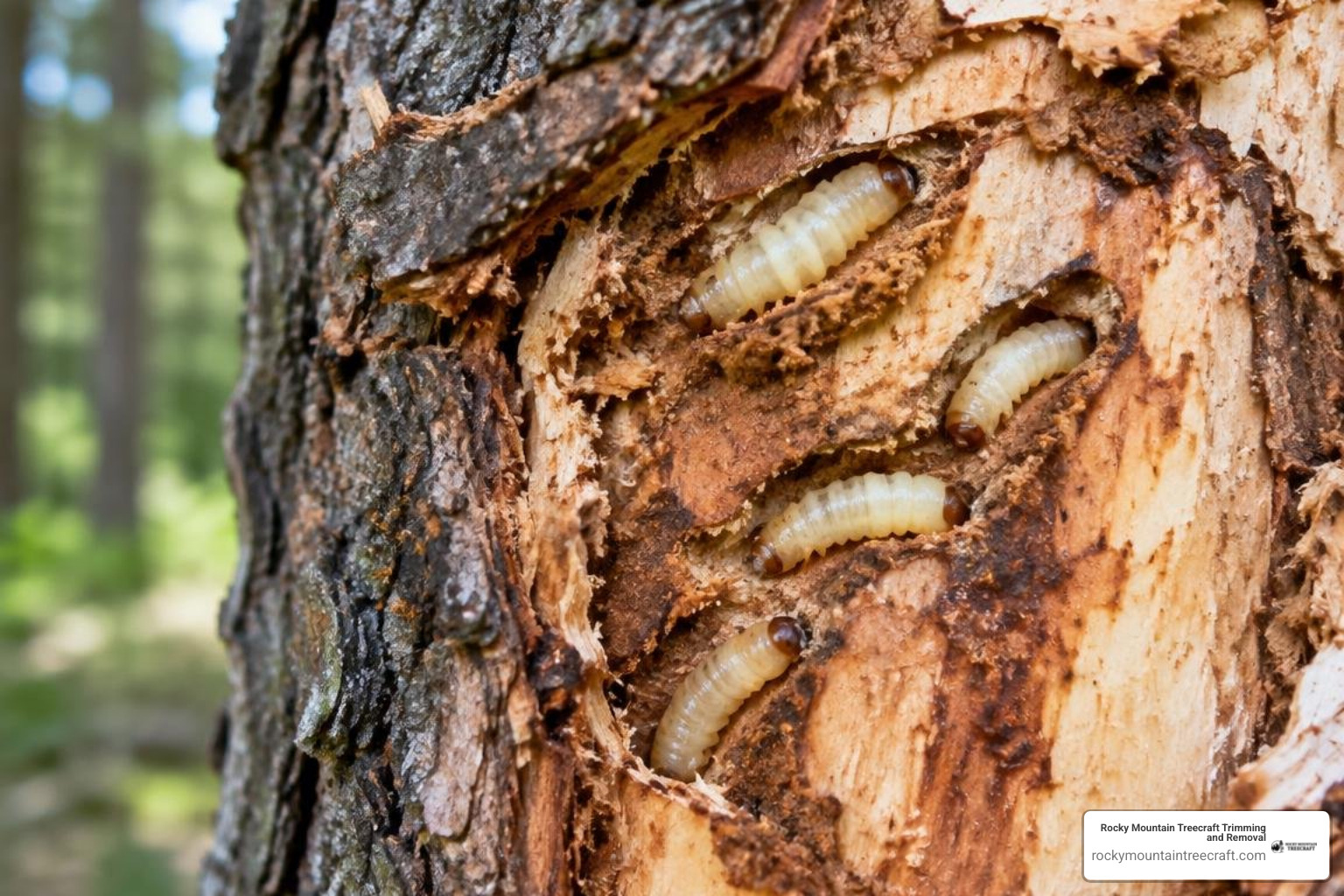
Eggs hatch within 6 to 14 days, revealing tiny, yellowish-white, legless grubs with distinct brown head capsules. These larvae are the true destructive engine of the insect.
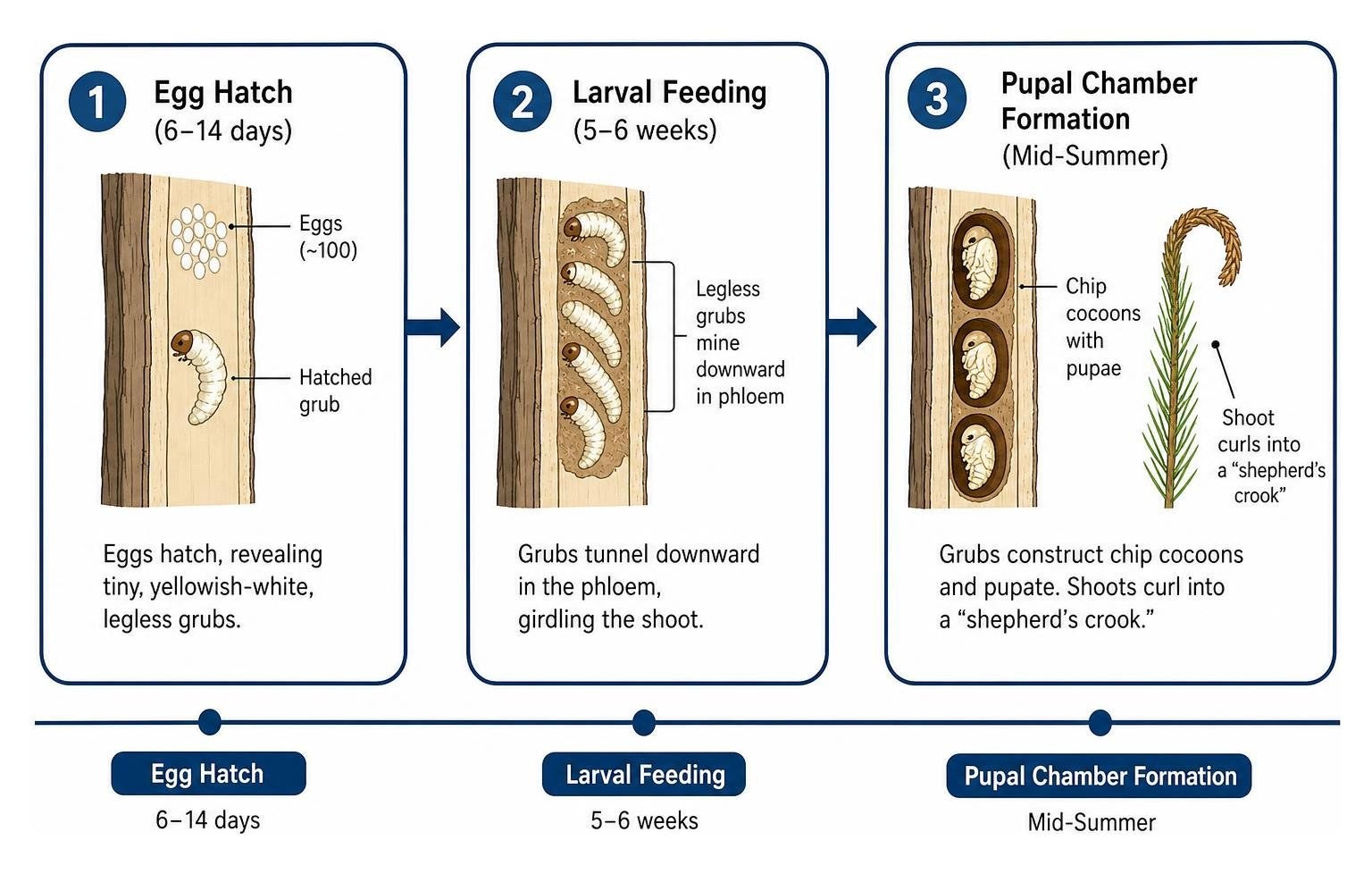
As the larvae feed, they tunnel downward shoulder-to-shoulder in the phloem and cambium layer just beneath the outer bark. This mass feeding girdles the stem, cutting off the flow of water and nutrients to the new shoot above.
Key larval development facts:
Larvae grow up to 2/5 inch (1 cm) in length over five to six weeks.
Feeding destroys the current year's growth and commonly kills two to three years of vertical growth below it.
By early July, mature larvae bore deeper into the wood tissue to build fibrous "chip cocoons" made of chewed wood fragments.
Pupation lasts roughly 10 to 15 days inside these secure wooden chambers.
New callow adults chew circular exit holes through the bark to emerge from late July through early September.
After emerging, the new adult beetles feed briefly on lateral branch tips before dropping into the ground litter to overwinter.
Recognizing Symptoms and Signs of Infestation
Because adult weevils are small and active high in the canopy, infestations often go unnoticed until physical damage becomes obvious. Regular inspections from April through July help catch attacks before larvae tunnel into multi-year wood.
Identifying White Pine Weevil Damage on Conifers
The most recognized visual symptom of an attack is the classic "shepherd's crook." As larval grubs girdle the upper stem during June and July, the succulent new leader loses water pressure, wilts, bends sharply downward into a hook shape, and turns a dull reddish-brown.
If left unmanaged, the tree loses its central leader entirely. The following spring, several upper side branches bend upward to compete for dominance. This creates a multi-stemmed form often called a "cabbage pine" or forked tree. In young timber or ornamental landscape settings, this structural defect ruins the straight trunk form and significantly reduces tree stability under heavy mountain snow loads.
State university extensions provide comprehensive diagnostic guides for forest pests and diseases to help property owners distinguish weevil symptoms from other common conifer problems.
Pest / Condition | Primary Target Area | Key Visual Signs | Wood & Bark Clues |
|---|---|---|---|
White Pine Weevil | Top terminal leader (1–3 years growth) | Shepherd's crook curl, wilted leader, reddish needles | Chip cocoons under bark, resin droplets, round exit holes |
Bark Beetles (e.g., Ips) | Main trunk and upper canopy branches | General canopy fading, yellowing needle clusters | Boring dust in bark crevices, pitch tubes on trunk |
Root Rot (Armillaria) | Lower trunk base and root collar | Overall tree decline, thin foliage throughout crown | White fungal mats under basal bark, honey mushrooms |
Frost / Winter Injury | Branch tips and exposed outer foliage | Reddish-brown needles across outer branch perimeter | Buds remain alive, no larval galleries or chewed wood |
Resin Droplets and Stem Girdling
Before the leader wilts completely, early feeding leaves telltale clues. In spring (April and May), inspecting the previous year's leader reveals glistening droplets of clear sap oozing from tiny, pin-sized feeding and egg-laying punctures.
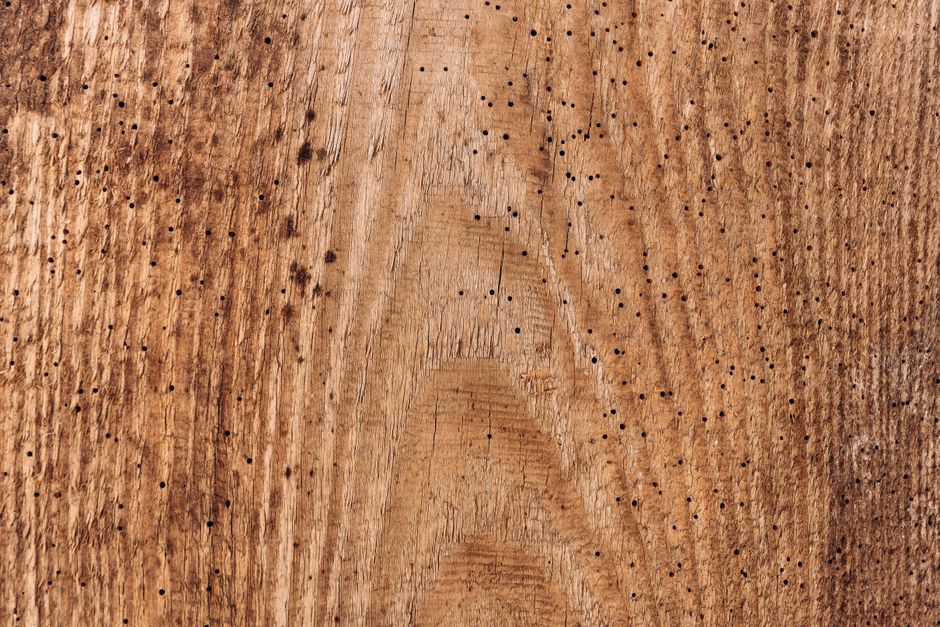
As summer progresses, you may notice:
Drops of hardened pitch running down the top 10 to 18 inches of the stem.
Spongy bark that feels loose when pressed.
Small round exit holes (about 2 mm wide) where adult beetles emerged.
Entry points for fungal pathogens like red rot, which often enter through weevil chew wounds and cause interior wood decay.
Learning to inspect trunk tissue and canopy health early is a core part of effective property care. You can explore practical conifer evaluation techniques to sharpen your eye for early warning signs on your landscape trees.
Susceptible Host Species and Environmental Risk Factors
While its common name suggests a single host, this native pest attacks a wide variety of native and planted pines and spruces across North America.
Host Trees and Stand Vulnerability
The insect attacks trees ranging from small seedlings to trees up to 30 feet tall, showing a strong preference for young trees between 3 and 15 feet high with thick, vigorous leaders greater than 4 mm in diameter.
Commonly attacked tree species include:
Spruces: Colorado blue spruce, Norway spruce, Engelmann spruce, White spruce, and Sitka spruce.
Pines: Eastern white pine, Jack pine, Scotch pine, Mugo pine, Limber pine, Pitch pine, and Western white pine.
Other Conifers: Occasionally Douglas-fir and native fir species.
In residential yards and managed landscapes throughout northern Utah, Colorado blue spruce and ornamental white pines are frequent targets. Reviewing our seasonal pine health guidelines helps property owners keep conifers vigorous through changing mountain weather. You can also consult university extension research on host susceptibility to assess which trees on your property carry the highest vulnerability.
Sun Exposure and Microclimate Conditions
Weevils are warmth-seeking insects. Trees growing in full, open sunlight are significantly more vulnerable to heavy attack than those growing under partial canopy shade.
Direct sun creates two major advantages for the pest:
Warmer Bark Temperatures: Sunny exposures heat the terminal bark to optimal larval development temperatures (78°F to 88°F).
Thicker Phloem: Fast-growing, open-grown trees produce thick, nutrient-rich inner bark that feeds dense broods of developing grubs.
In open landscapes, standalone specimen conifers often experience repeated attacks year after year. Conversely, conifers growing under roughly 40% to 50% overstory shade develop thinner terminal leaders and cooler bark, making them far less attractive to egg-laying adults.
Integrated Management and Control Options
Protecting your trees requires an Integrated Pest Management (IPM) approach that pairs routine scouting with physical sanitation and targeted treatments when damage thresholds are met.
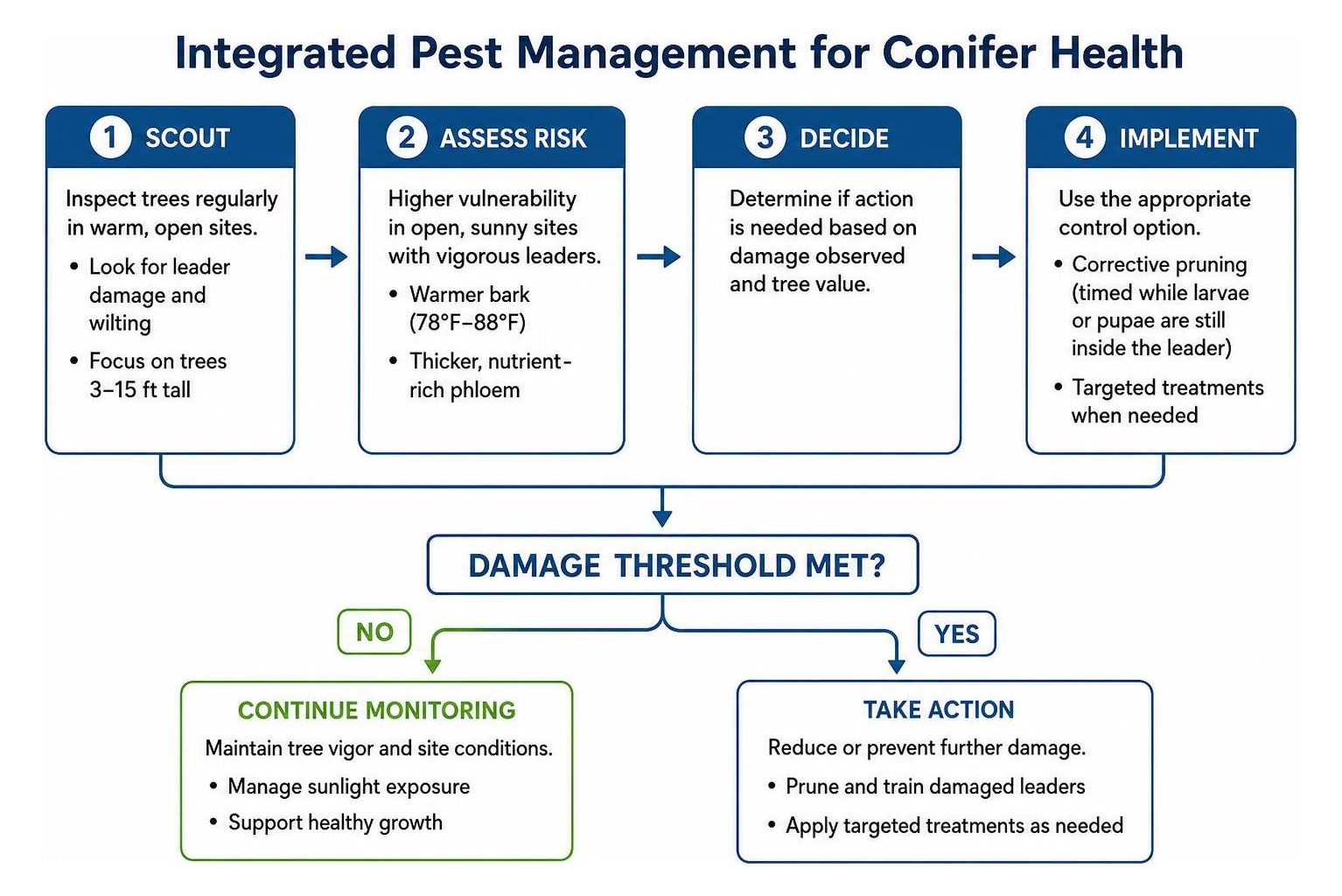
Corrective Pruning and Leader Training
Mechanical sanitation is the most reliable, non-chemical way to eliminate a localized infestation. Timing is critical: you must prune while the larvae or pupae are still trapped inside the leader.
Follow these steps to prune and train a damaged tree:
Prune by Early July: Inspect your trees in late June when the top shoot begins to droop. Make your cut well below the wilted section into healthy, green wood, ensuring you cut below all larval galleries.
Destroy the Clipped Shoots: Never leave pruned leaders on the ground or in open compost piles, as developing beetles can finish pupating and emerge. Burn the cuttings where permitted, or seal them tightly in heavy bags for disposal.
Select a New Leader: Inspect the whorl of lateral side branches just below your cut. Choose the strongest, most upright healthy side shoot to become the new central trunk.
Train the Shoot: Carefully bend the chosen branch upward and secure it with a soft stake or wooden splint using flexible tree tie tape.
Trim Competing Shoots: Shorten the remaining lateral branches in that upper whorl by half. This redirects the tree's energy into your chosen replacement leader, restoring proper apical dominance.
Using proper tree and shrub pruning techniques preserves the natural pyramidal shape of your conifers and prevents weak, multi-stemmed fork structures from failing under winter snow.
Managing White Pine Weevil with Targeted Treatments
When managing larger properties or high-value landscape specimens where annual pruning alone is impractical, chemical and cultural tools provide additional control:
Targeted Spring Foliar Sprays: Apply an approved contact or systemic insecticide to the upper third of the tree and terminal leader in early spring. Timing is critical: apply when soil temperatures reach 50°F and adult weevils begin feeding, usually mid-April to early May. A second application two weeks later may be necessary in prolonged cool springs.
Bait Trapping: Monitoring traps baited with ethanol and pine turpentine can track adult emergence in spring, allowing precise spray timing before egg-laying starts.
Silvicultural Shading: When establishing new windbreaks or conifer stands, interplanting with nurse trees or maintaining partial overstory shade reduces weevil pressure naturally.
Managing Severely Compromised Trees: Trees that have suffered consecutive years of severe top dieback, trunk rot, or severe structural distortion may become hazardous. In these situations, explore options for safely managing severely damaged hazard trees to protect nearby structures and preserve overall landscape safety.
Frequently Asked Questions
What is the most noticeable sign of an active infestation?
The most unmistakable symptom is the shepherd's crook, where the top terminal shoot of the tree wilts, curls downward into a hook, and turns reddish-brown in late June or early July. In early spring, you can also spot glistening drops of clear resin oozing from small feeding holes near the top bud.
When is the best time to prune infested leaders?
Prune infested leaders between late June and mid-July, as soon as the top shoot shows wilting but before adult beetles emerge from their wood-chip cocoons. Cut several inches below the damaged area into clean wood, and immediately burn or dispose of the cuttings to prevent the insects from completing their life cycle.
Can a tree recover after losing its central leader?
Yes, conifers can recover good form if corrective training is performed promptly. After removing the damaged leader, select one vigorous side branch from the top whorl, splint it upright to form a new main stem, and prune back competing side shoots to restore a single, strong central trunk.
Protect Your Mountain Conifers with Rocky Mountain Treecraft
A damaged terminal shoot does not have to ruin the beauty and structural integrity of your pine and spruce trees. Catching weevil activity early through spring monitoring and precise corrective pruning keeps your landscape sturdy against Utah's heavy mountain snowfalls and gusty canyon winds.
At Rocky Mountain Treecraft, we help property owners across Heber City, Wasatch County, and nearby mountain communities safeguard their trees against seasonal pests, disease, and structural stress. If you notice wilting leaders, oozing pitch, or declining branch tips, contact us today for a tree health assessment or request a free estimate to keep your property safe and vibrant all year long.