
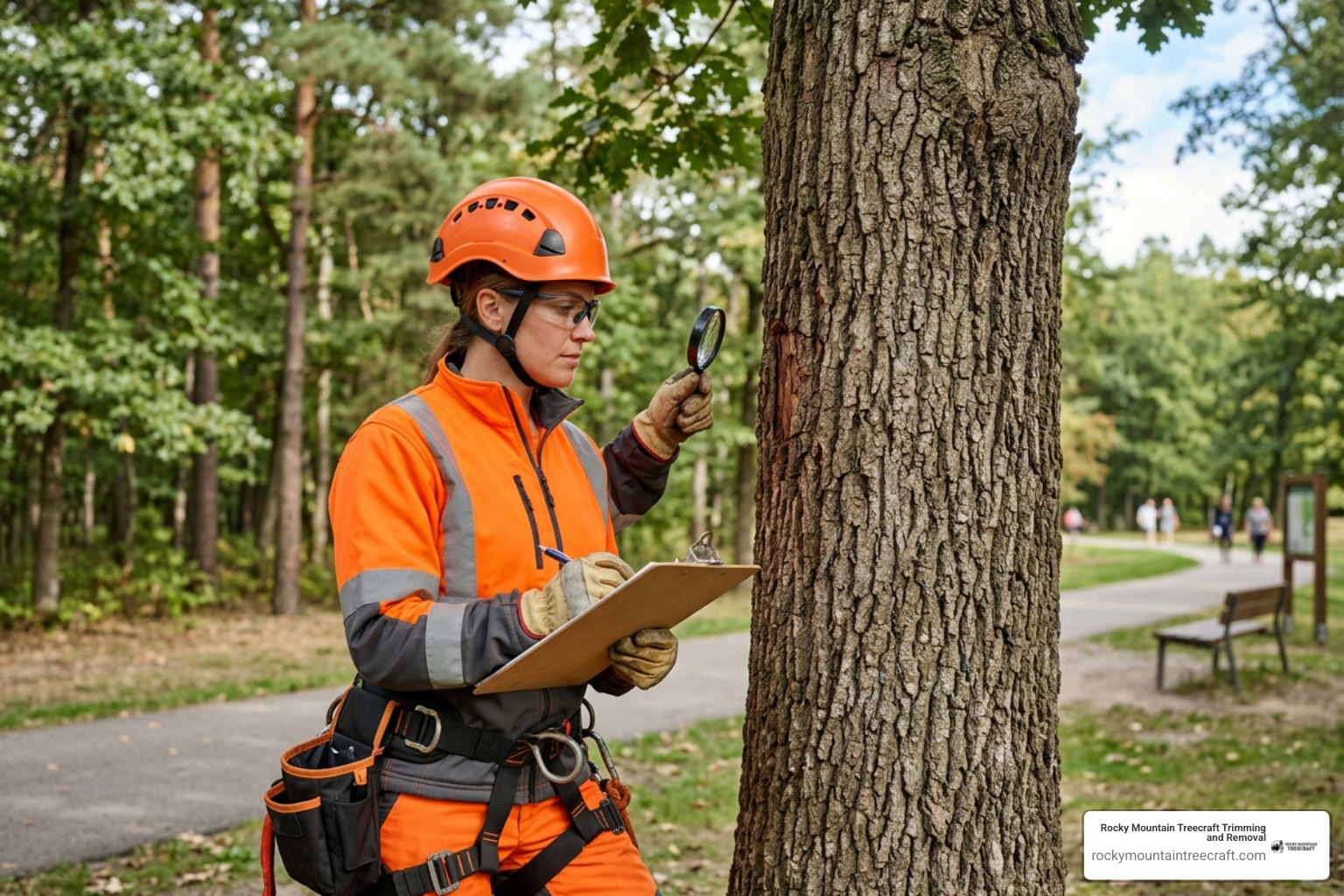
The Ultimate Guide to Finding an Intermediate Tree Inspection Course
Why an Intermediate Tree Inspection Course Matters
An intermediate tree inspection course helps people move beyond basic hazard spotting and build the skills needed to assess tree condition, structural defects, and risk more carefully.
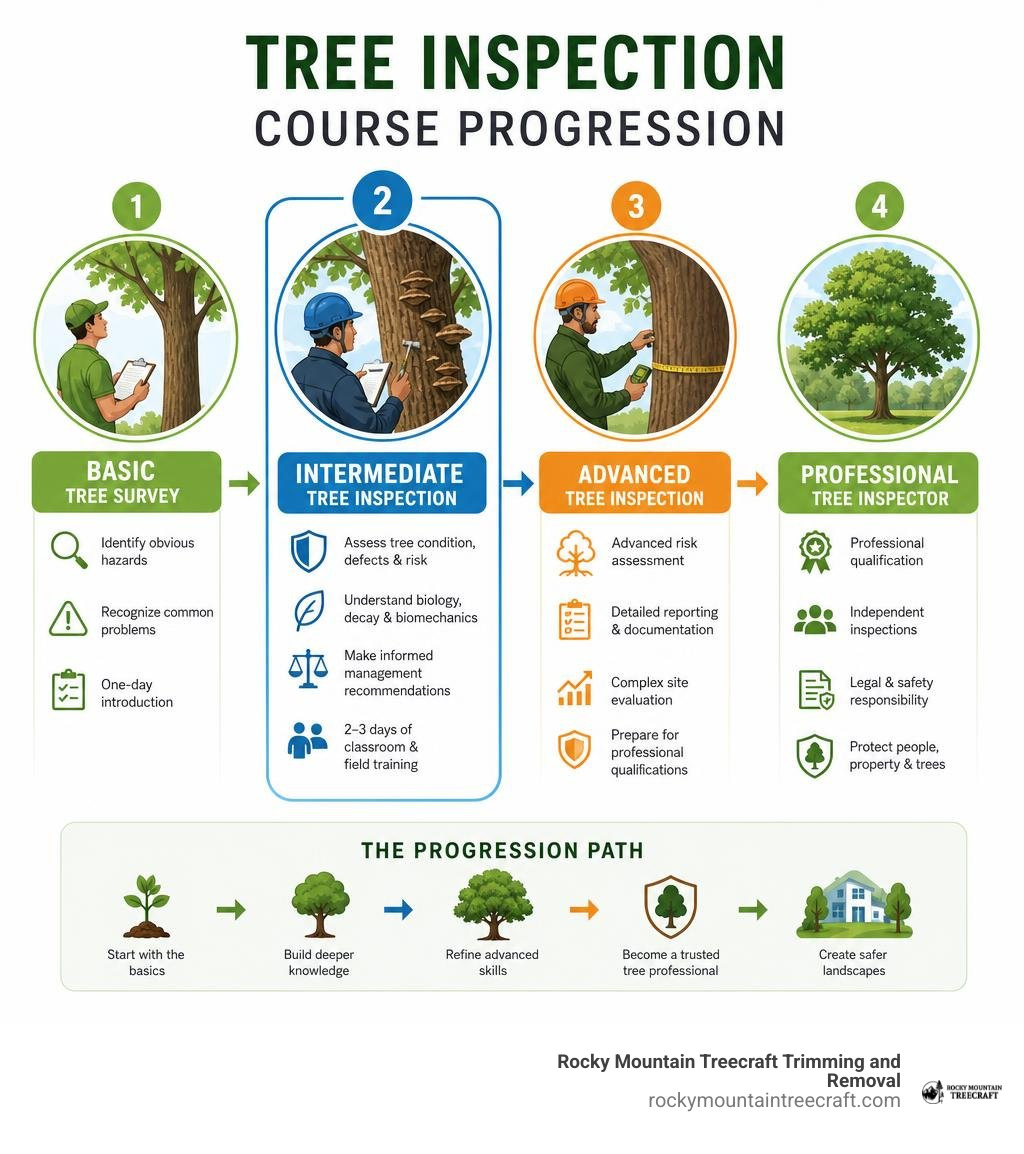
Purpose: Bridge the gap between a one-day basic tree survey class and advanced professional inspection training.
Best for: Arborists, property and estate managers, park staff, rangers, ecologists, and others responsible for tree safety.
Typical format: Usually two or three days, with classroom learning and practical Visual Tree Assessment fieldwork.
What it covers: Tree biology, decay fungi, biomechanics, visible defects, risk assessment, legal duties, and clear management recommendations.
What you receive: Often a certificate of attendance or skills feedback, rather than the formal professional qualification itself.
For homeowners in Heber City, Heber Valley, and Wasatch County, this training path matters because sound tree inspection supports safer decisions around storm-damaged, leaning, decaying, or overgrown trees. It also helps tree-care professionals know when a visual check is enough and when a more detailed assessment is needed.
Understanding the Purpose of an Intermediate Tree Inspection Course
When managing trees across residential yards, commercial grounds, or public parks, identifying hazards before they cause severe damage is a top priority. A basic one-day tree survey course introduces how to recognize obvious dangers—like hanging limbs or completely hollow trunks. However, basic training rarely equips inspectors to evaluate complex decay patterns, understand tree biomechanics, or make nuanced management recommendations.
That is where an intermediate tree inspection course fits in. The main purpose of an intermediate course is to build a systematic foundation for identifying structural defects, assessing health, and evaluating risk in a defensible manner. Rather than simply spotting a problem, participants learn why the tree is responding in a certain way and how to calculate the likelihood of failure.
In professional arboriculture, inspection guidelines emphasize evaluating tree mechanics alongside biological responses. Trees actively respond to injury or decay by forming reaction wood or compartmentalizing rot. Recognizing these visual cues—often referred to as the "body language of trees"—allows an inspector to judge whether a defect compromises structural safety.
During intermediate training, participants learn to:
Conduct systematic visual assessments from root flare to crown canopy.
Differentiate between simple surface defects and structural compromises.
Apply principles of industry standards (such as British Standard BS3998 recommendations or equivalent regional tree work standards) when specifying corrective action.
Balance public safety duties against tree retention, ecological value, and client objectives.
By mastering these skills, field inspectors can distinguish between minor cosmetic flaws and dangerous hazards. For property owners across Wasatch County, receiving an accurate Tree Health Assessment ensures that trees are neither removed unnecessarily nor left in a condition that threatens homes during heavy mountain snowfalls.
Prerequisites and Who Should Attend an Intermediate Tree Inspection Course
Intermediate inspection courses are tailored for individuals who already possess a fundamental understanding of tree care or basic surveying techniques. While entry requirements vary slightly between course providers, candidate pools typically include:
Field Arborists and Tree Care Practitioners: Crew leaders and ground crew members who want to step into diagnostic and risk evaluation roles.
Tree Officers and Municipal Staff: Local government employees responsible for public safety, park safety audits, and urban canopy management.
Estate Managers, Rangers, and Wardens: Land custodians overseeing large properties, public trails, or private estates where tree hazard management is mandatory.
Ecologists and Landscape Architects: Professionals who design or evaluate landscapes and need to understand tree risk and preservation requirements.
As for prerequisites, candidate profiles generally lean on prior completion of an entry-level hazard recognition program—such as a 1-day Basic Tree Survey & Inspection course—or equivalent industry experience. A foundational knowledge of basic plant biology and common tree identification helps participants get the most out of the intensive coursework.
Core Curriculum Covered in an Intermediate Tree Inspection Course
An intermediate curriculum blends indoor theory with outdoor field practicals. The focus stays heavily weighted toward hands-on diagnostics, ensuring that students do not just memorize facts but actually apply them under practical field conditions.
The core learning modules usually cover:
Visual Tree Assessment (VTA): Practicing a structured, step-by-step method to observe tree architecture, foliage health, bark abnormalities, and root crown stability.
Tree Biomechanics and Structural Defects: Understanding mechanical stress, trunk taper, crack propagation, codominant stems, inclusions, and reaction wood formation.
Fungi and Wood Decay Biology: Learning how common wood-decaying fungi break down cellulose and lignin, affecting structural integrity differently depending on whether sapwood or heartwood is involved.
Tree Risk Assessment Principles: Utilizing frameworks like Quantified Tree Risk Assessment (QTRA) or standard risk matrices to calculate risk based on failure probability, target exposure, and potential impact severity.
Legal Responsibilities and Standards: Reviewing statutory law, common law duties of care, owner liabilities, and emergency response planning.
Organizations like the Arboricultural Association - Intermediate Tree Inspection have helped standardize these educational objectives to ensure students leave with practical, real-world inspection tools.
How Intermediate Courses Bridge the Gap to Professional Certification
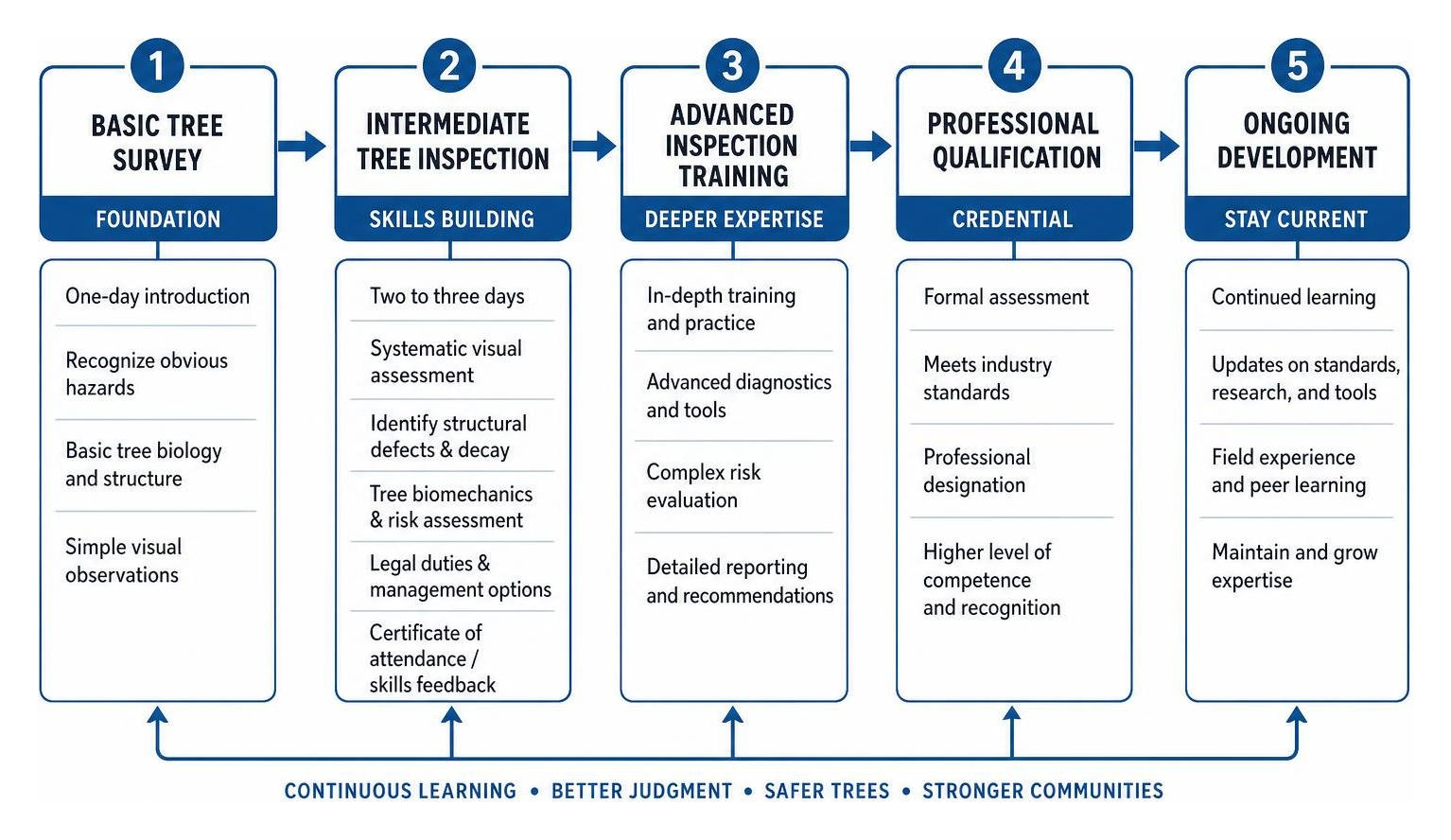
One of the greatest challenges for aspiring tree inspectors is jumping straight from an entry-level hazard awareness class to advanced professional examinations. High-level certifications—such as Lantra's 3-day Professional Tree Inspection (PTI) course—are rigorous, assessed programs that expect candidates to possess mature diagnostic skills, extensive fungal knowledge, and flawless survey methodology on day one.
Historically, pass rates for direct entry into advanced professional exams reflect how demanding those tests can be. An intermediate course acts as a crucial stepping stone. It provides a supportive environment where candidates can practice visual assessments, receive one-on-one coaching from instructors, and uncover gaps in their knowledge before sitting for high-stakes formal qualifications.
By working through field walks and practical exercises, students build confidence in identifying complex rot, recognizing subtle biomechanical cues, and prioritizing work schedules.
Industry insights show that candidates who complete an intermediate step before taking the Professional Tree Inspection - Lantra qualification show significantly stronger performance in field testing, report clarity, and overall exam pass rates.
Comparing 2-Day and 3-Day Course Formats
When looking for an intermediate tree inspection course, you will notice different formats offered by industry training centers. Most options fall into either a 2-day intensive format or a 3-day extended workshop format.
Feature / Aspect 2-Day Intermediate Course 3-Day Extended / Improver Course Typical Target Audience Arborists with basic survey experience wanting exam preparation. Practitioners wanting extra hands-on field practice and coaching. Primary Focus Intensive bridging curriculum, VTA review, defect identification. In-depth fungal identification, practical VTA walks, report exercises. Classroom vs. Field Split 50% Classroom / 50% Field Work 40% Classroom / 60% Field Work Prerequisites Basic tree survey certificate or equivalent practical experience. Basic survey knowledge; open to estate staff and rangers. Outcome / Credential Attendance Certificate & Personalized Skills Gap Assessment. Attendance Certificate & Comprehensive Field Evaluation.
Choosing between a 2-day or 3-day course depends on your existing field experience. If you perform tree work daily and simply need to formalize your inspection approach, a 2-day intensive course is often ideal. If you are newer to diagnostic evaluations or want extensive practice under instructor supervision, a 3-day program gives you additional field time.
Preparing for Advanced Qualifications and Real-World Assessment
Training courses provide theoretical models, but real-world tree inspection takes place in variable weather conditions across diverse landscapes. In our local Heber Valley environment, trees face unique stressors—including heavy winter snow loads, freeze-thaw cycles, high wind gusts through mountain passes, and dry summer periods that elevate wildfire risks.
An intermediate inspection course prepares candidates to handle these real-world variables by teaching them how to maintain standardized, defensible records.

During ground-based evaluations, inspectors learn to use basic diagnostic hand tools effectively:
Sounding Mallets: Tapping the trunk or root flare to detect internal hollows or loose bark through pitch changes.
Probes: Checking cavity depth and identifying soil separation near the root plate.
Binoculars: Inspecting higher canopy unions, deadwood, codominant tops, and structural cracks from ground level.
When visual or basic tool inspections reveal serious internal decay, advanced tools—such as sonic tomographs or microdrills—may be required. Intermediate training teaches inspectors to recognize when a visual check is sufficient and when to call for specialized diagnostic equipment.
Beyond field diagnostics, practical courses focus heavily on generating defensible management recommendations. An inspector must specify work priorities with realistic timeframes based on target risk. For helpful guidance on maintaining canopy health before severe structural issues arise, explore our practical Tree Care Tips.
When trees display severe structural compromise, leaning, or large suspended limbs following heavy storms, homeowners and property managers should never approach unstable trees or attempt risky DIY cuts near utility lines. In these situations, qualified professional evaluation is essential to manage site safety safely.
Frequently Asked Questions About Tree Inspection Courses
Navigating professional arboricultural training options can raise many questions regarding prerequisites, costs, and career benefits. Below are answers to common questions prospective students ask when exploring intermediate tree inspection training.
What Qualification Do You Earn From an Intermediate Course?
An intermediate tree inspection course is primarily a training and skills-building course rather than a formal qualification or licensing exam. Upon completion, participants typically receive a Certificate of Attendance along with an instructor-led Skills Assessment Report.
This report highlights your diagnostic strengths and pinpoints specific study areas to focus on before enrolling in an advanced professional exam. The certificate also serves as documented evidence of Continuing Professional Development (CPD) for industry professionals.
How Much Does an Intermediate Tree Inspection Course Cost?
Course fees vary depending on the provider, geographical location, training venue, and course format.
Tuition fees generally depend on the host organization and location, typically covering classroom materials, field workbook access, and direct instructor feedback during field exercises. Prospective students should check directly with specific training providers for exact pricing details.
Is an Intermediate Course Mandatory Before Taking the PTI Exam?
No, an intermediate course is generally not a mandatory prerequisite for enrolling in advanced certifications like the Professional Tree Inspection (PTI) exam. Candidates with extensive academic backgrounds in arboriculture, years of practical experience, or rigorous self-study can often enroll directly in professional-level courses.
However, taking an intermediate course is highly recommended. It provides a low-pressure environment to test your diagnostic speed, practice systematic Visual Tree Assessment, and refine your work specifications before facing formal certification grading.
Advancing Tree Safety and Management in Heber Valley
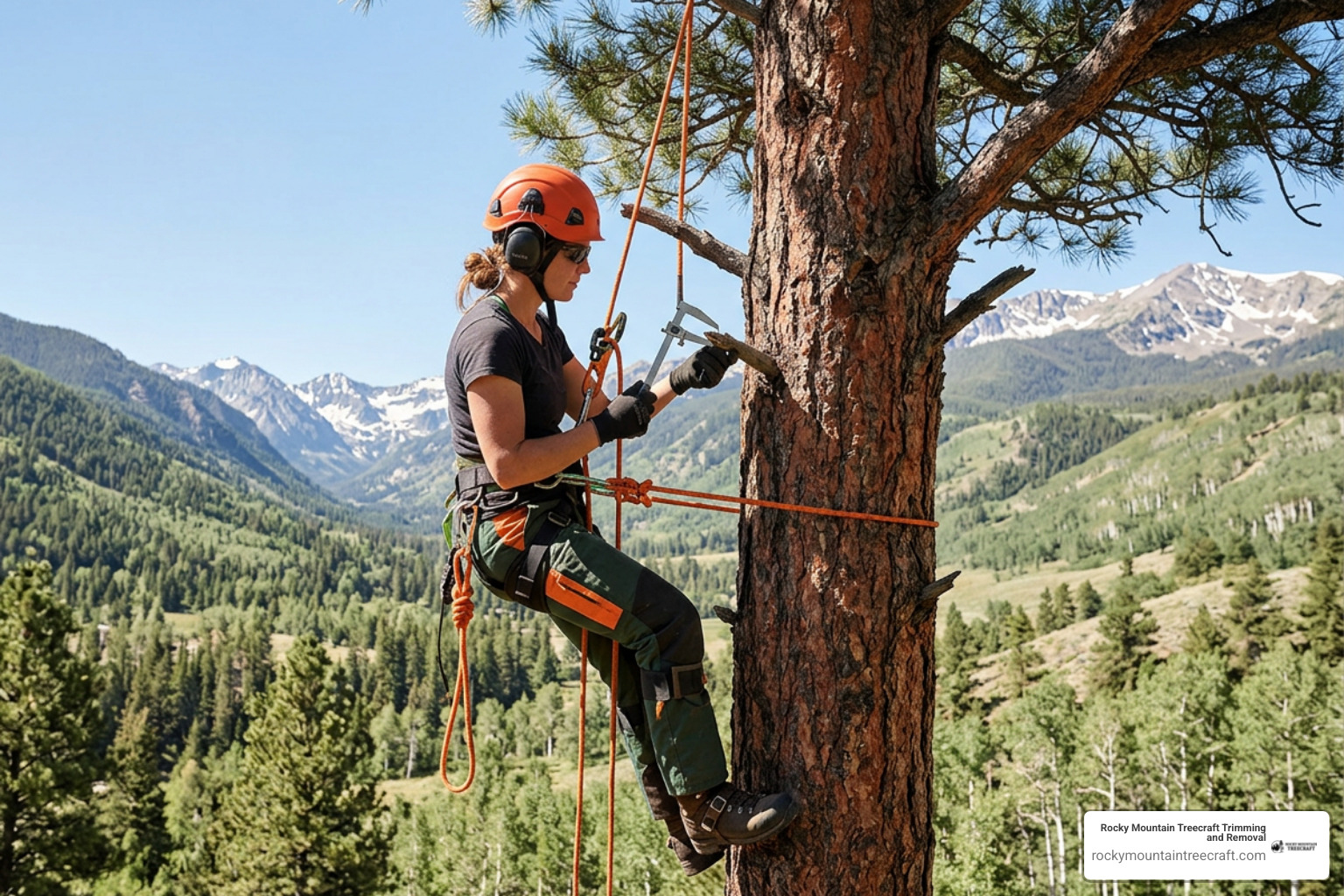
Investing time in an intermediate tree inspection course is one of the most effective ways for tree care workers, estate managers, and inspectors to sharpen their diagnostic skills. By understanding tree mechanics, fungal decay, and systematic hazard evaluation, professionals can deliver clear, defensible recommendations that keep properties safe while preserving valuable canopy trees.
Here in Heber City, Heber Valley, and across Wasatch County, our local landscape presents distinct structural challenges. Mountain weather—from heavy snow accumulation to sudden summer windstorms—puts constant stress on broadleaf trees like aspens and evergreens like pines, spruces, and firs. Proper structural trimming, seasonal hazard reduction, and proactive risk assessments are essential to maintaining safe, healthy landscapes.
At Rocky Mountain Treecraft, we bring local, hands-on expertise tailored to our region's specific climate and terrain. Whether you need an on-site health evaluation for a mature tree, routine structural pruning, fire mitigation work to reduce wildfire risks around your property, or storm damage cleanup, our local team is ready to help.
To learn more about professional tree care or to discover educational resources, check out our selection of Tree Courses. If you have concerns about a hazardous or compromised tree on your property, contact Rocky Mountain Treecraft today to schedule a professional assessment or request a free estimate!