
The Best Way to Prune Your Trees and Shrubs
Why Proper Tree & Shrub Pruning Can Save Your Property — and Your Plants
Tree & shrub pruning is one of the most powerful things you can do to protect your home, your landscape, and your trees' long-term health.
Quick answer — what you need to know about pruning trees and shrubs:
Best time to prune: Late winter to early spring (late dormant season) works for most trees and shrubs
How much to remove: Never take more than 25-30% of the canopy in a single year
Spring-flowering shrubs (lilac, forsythia): Prune right after they bloom
Summer-flowering shrubs (crape myrtle, spirea): Prune in late winter or early spring
Key technique: Always cut just outside the branch collar — never flush with the trunk
What to avoid: Never top trees, never over-shear shrubs — both cause serious long-term damage
When to call a pro: Any time branches are near power lines, over your roof, or show signs of decay
If you're a Heber City homeowner looking at storm-damaged limbs, overgrown shrubs crowding your fence, or a big tree leaning a little too close to your house — you're not alone. And the good news is that most of these problems can be prevented or corrected with the right pruning approach.
Pruning isn't just about looks. As University of Minnesota Extension puts it, pruning "changes the form and growth of a plant and can be considered preventive maintenance for both insect and disease damage." Done right, it keeps your trees structurally sound, your shrubs full and healthy, and your property safer through every season.
Done wrong — topping trees, over-shearing shrubs, cutting at the wrong time — it can cause damage that takes years to undo, or can't be undone at all.
This guide walks you through exactly how to prune your trees and shrubs the right way: the best timing, the right tools, the correct cuts, and when to step back and call a certified arborist.
The Core Principles of Tree & Shrub Pruning
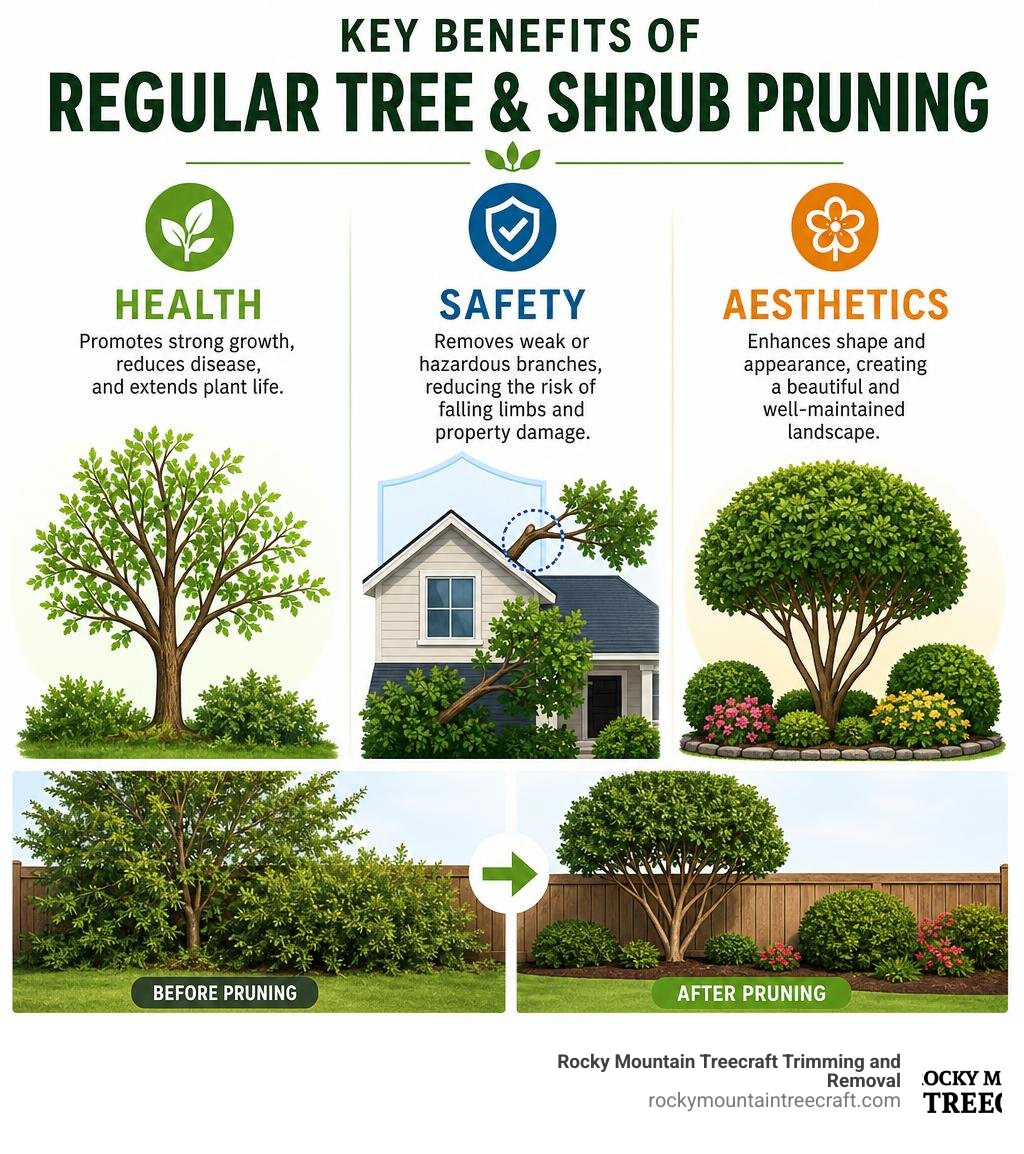
Before you pick up a pair of shears, it is helpful to understand what pruning actually does to a plant. When we prune, we aren't just shortening branches; we are directing the plant's future growth, managing its energy reserves, and performing essential preventive maintenance.
Every cut you make sends a physiological signal to the plant. By selectively removing certain limbs, we can improve structural integrity, increase flower and fruit production, and prevent pests and diseases from taking hold. Think of it as proactive healthcare for your landscape.

Why Tree & Shrub Pruning Is Essential for Landscape Health
In our beautiful mountain environment here in Wasatch County, Utah, our trees and shrubs face intense weather—from heavy winter snow loads to dry summer heat. Proper tree & shrub pruning is critical for helping them withstand these elements.
Disease Prevention: Dense, tangled branches trap moisture, creating a perfect breeding ground for fungal diseases like powdery mildew or leaf spots. Opening up the canopy allows wind to blow through and dry the leaves quickly.
Pest Management: Weak, dead, or rubbing branches are open invitations for boring insects and other pests. Removing these weak points keeps the plant's natural defenses strong.
Sunlight Penetration: Leaves need sunlight to perform photosynthesis. If the outer canopy is too thick, the inner leaves starve, wither, and die, leaving you with a hollow, woody interior.
Safety and Structural Integrity: Removing heavy, weak, or dead limbs reduces the risk of branches snapping during summer storms or under heavy winter snow.
If you suspect your trees are struggling with disease or structural issues, getting a professional evaluation is a smart first step. You can learn more by reading our More info about tree health assessments.
Understanding Plant Responses and the 25-30% Canopy Rule
One of the most vital rules of tree care is the pruning dose. Removing live branches decreases a tree’s energy reserves and its ability to feed itself through photosynthesis. Because of this, you should never remove more than 25-30% of the live canopy in any given year.
The specific tolerance of a plant often depends on its age and health:
Young trees: Can tolerate up to 50% foliage removal because they grow rapidly and recover quickly.
Medium-aged trees: Tolerate up to 25% foliage removal.
Mature trees: Should never have more than 10% of their live canopy removed at one time, as their ability to recover is much slower.
We also have to consider how plants grow. The growth at the very tip of a branch is controlled by the terminal bud. This bud produces a hormone called auxin, which suppresses the growth of lateral buds lower down on the stem. When you cut off the terminal bud (a heading cut), you stop that hormonal suppression, causing the lateral buds to burst into active growth.
To dive deeper into the science of how trees respond to cuts, check out the guide on Principles & Practices for Pruning Trees.
Essential Pruning Tools and Proper Cut Techniques
Using the right tool for the job makes your work easier and ensures clean cuts that seal quickly. Dull or improper tools crush plant tissue instead of slicing it, leaving jagged edges that invite decay.
Tool Type Recommended Branch Diameter Best Use Bypass Hand Shears Up to 3/4 inch Small twigs, spent flowers, and soft green stems Lopping Shears 3/4 inch to 1.5 inches Medium-sized shrub branches and low tree limbs Pruning Saws 1.5 inches to 4 inches Thick tree branches; features special tri-cut teeth Chainsaws / Pole Saws Over 4 inches Large limbs (best handled with extreme safety precautions)
When pruning, always make your cuts just outside the branch collar (the swollen area of trunk tissue at the base of the branch) and the branch bark ridge (the line of rough bark in the branch-trunk crotch). This area is rich in active cells that quickly seal the wound. Never make a flush cut that removes the branch collar, as this creates a massive wound that cannot close properly, exposing the trunk to rot.
The Three-Cut Method for Large Branches
When you are removing a heavy limb (anything over 1 inch in diameter), gravity is your enemy. If you try to cut through a heavy branch from the top in a single pass, the weight of the branch will cause it to snap and tear a long strip of bark down the side of the trunk. This creates a devastating wound.
To prevent this, always use the three-cut method:
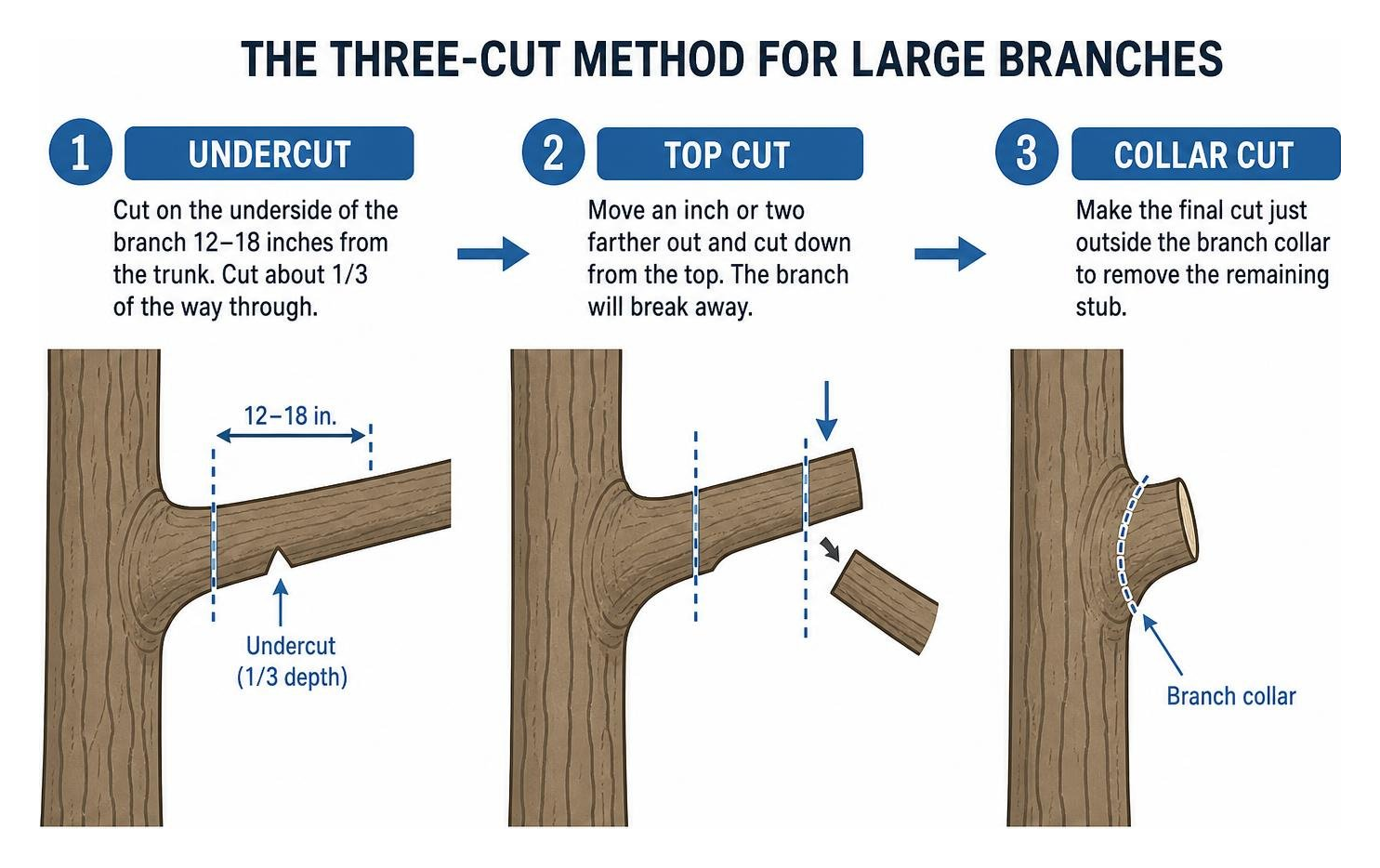
The Undercut: Make a cut on the underside of the branch about 12 to 18 inches away from the trunk. Cut about one-third of the way through the branch. This acts as a stopper so that if the branch falls, the bark tear stops at this cut.
The Top Cut: Move an inch or two further out along the branch and cut down from the top. The branch will snap cleanly between the two cuts and fall away safely, leaving a short stub.
The Collar Cut: Now that the heavy weight is gone, make your final clean cut just outside the branch collar to remove the remaining stub.
For a detailed breakdown of this technique and other structural pruning concepts, refer to Tree Pruning Essentials.
Tool Maintenance and Sanitization
Dirty tools spread plant diseases just like dirty surgical instruments spread infections. If you prune a diseased branch and then move to a healthy plant, you can easily transmit pathogens.
Always sanitize your blades between plants—and even between cuts if you are dealing with a known disease like fireblight. The easiest method is to wipe or spray your tools with 70% isopropyl alcohol (rubbing alcohol). Ensure your tools are sharp so they make clean, swift cuts, and oil them at the end of every season to prevent rust.
Timing Your Cuts: When to Prune for Maximum Plant Health
Timing is everything. For the vast majority of trees and shrubs in Utah, the late dormant season (late winter to early spring) is the absolute best time to prune.
Pruning while the plant is dormant is highly beneficial because:
The plant is not actively growing, meaning it loses minimal energy reserves.
Without leaves, the branch structure is fully visible, making it much easier to spot rubbing, crossing, or damaged limbs.
Disease pathogens and insects are also dormant, drastically reducing the risk of infection.

Some trees (like maples, birches, and walnuts) "bleed" heavy amounts of sap if pruned in late winter. While this sap flow looks alarming, it is generally harmless to the tree. However, if you want to avoid the mess, you can prune these species in mid-summer after their leaves are fully expanded.
Seasonal Guidelines for Deciduous and Flowering Species
Flowering plants require a bit of strategy. If you prune them at the wrong time, you might accidentally cut off all of this year's flower buds!
Spring-Flowering Shrubs (e.g., Lilacs, Forsythia): These plants develop their flower buds during the previous summer and fall (blooming on "old wood"). If you prune them in the winter, you will cut off all of spring's blossoms. Prune them immediately after their flowers fade in the spring.
Summer-Flowering Shrubs (e.g., Spirea, Hydrangeas): These species bloom on "new wood" that grows in the current spring. Prune them in late winter or early spring before new growth begins.
A Critical Warning for Oaks: In Utah and surrounding regions, never prune oak trees from April to October. Doing so leaves open wounds that attract the beetles that spread oak wilt, a devastating fungal disease. Only prune oaks during the deep winter months.
For a complete seasonal calendar tailored to ornamental species, check out Pruning Ornamental Trees and Shrubs.
Best Practices for Evergreen Tree & Shrub Pruning
Evergreens require a completely different approach than deciduous plants. Most conifers cannot grow new shoots from old, needleless wood. If you cut them back past the green foliage, that branch will remain a bare stub forever.
Pines: Pines grow in annual flushes. To make them denser, pinch the soft new spring growth (called "candles") in half by hand when they are about 2 inches long. Avoid using shears, which slice the needles and cause the tips to turn brown.
Spruces, Firs, and Douglas-Firs: These trees have lateral buds on their twigs. You can prune them in late winter or early spring by cutting back to a lateral bud or branch.
Arborvitae, Junipers, and Yews: These are continuous growers. They can be lightly pruned or sheared throughout the spring and summer, but avoid cutting deep into the woody interior.
Advanced Methods: Shearing vs. Selective Pruning
Many homeowners confuse shearing with pruning, but they are entirely different techniques with very different impacts on plant health.
Shearing: Uses hedge clippers to cut all branch tips to a uniform length, creating a smooth, geometric surface.
Selective Pruning: Uses hand pruners or lopping shears to remove individual branches back to a lateral bud, side branch, or the main trunk.
While shearing is fast and creates a very formal look, selective pruning is vastly superior for plant health. Selective pruning preserves the natural shape of the plant, allows sunlight to reach the inner leaves, and stimulates balanced growth throughout the entire branch structure instead of just on the very tip.
Avoiding Hollow Shrub Syndrome and Topping Damage
Over-reliance on shearing often leads to hollow shrub syndrome. When you repeatedly shear the outside of a shrub, it produces a thick, dense shell of leaves on the very exterior. This outer shell blocks all sunlight from reaching the interior. As a result, the inner leaves die, and the shrub becomes a hollow framework of bare, woody branches. If you ever have to cut a sheared shrub back, you will be left with an ugly, dead-looking skeleton.
For trees, the most damaging practice is topping (the indiscriminate cutting of large, mature limbs back to stubs).
Topping is incredibly harmful because:
It removes the majority of the tree's leafy canopy, starving the root system.
It leaves massive, open wounds that cannot seal, inviting decay and wood-boring insects.
The tree responds by rapidly producing hundreds of weak, vertical shoots called water sprouts. These sprouts grow incredibly fast but are weakly attached to the decaying stub, making them highly prone to snapping in high winds.
To learn more about proper canopy management and why topping should always be avoided, read the guide on Pruning trees and shrubs | UMN Extension.
Rejuvenation and Renewal Pruning for Overgrown Plants
If you have old, woody, overgrown shrubs that have lost their shape, you don't necessarily have to dig them up. You can often restore them using one of two methods:
Renewal Pruning: A gradual process where you remove about one-third of the oldest, thickest stems right at ground level each year over a three-year period. By year three, you have a completely renewed, highly productive plant.
Rejuvenation Pruning: A drastic measure for fast-growing shrubs (like dogwoods, lilacs, or spireas). In late winter, you cut the entire plant down to within 6 to 12 inches of the ground. It will flush out with vigorous, fresh, beautiful new growth in the spring.
If you have large, overgrown trees or shrubs that need professional shaping or structural restoration, we can help. Discover More info about professional tree trimming.
When to Call a Professional Arborist
While homeowners can easily handle basic pruning on small shrubs and low tree branches, large-scale pruning can quickly become dangerous. Climbing ladders with chainsaws is a recipe for disaster.
You should always step back and hire a certified professional arborist if you notice any of the following:
Branches interfering with overhead utility lines or power lines.
Large deadwood, decayed wood, or hollow trunks.
Cracked trunks or limbs that pose an immediate safety hazard.
Girdling roots (roots wrapping around the base of the trunk, choking the tree).
Branches hanging directly over your roof, garage, or neighbor's property.
Handling large, heavy, or structurally compromised trees requires specialized rigging equipment and extensive training. If you have a tree that looks unstable or dangerous, do not wait for the next storm. Read More info about hazardous tree removal to see how we safely handle these high-risk situations.
Frequently Asked Questions about Tree and Shrub Care
What is the difference between shearing and selective pruning?
Shearing cuts all stems at a uniform length along the outer edge of the plant, which creates a formal, geometric shape but blocks light from the interior. Selective pruning removes specific branches back to a bud or main stem. This allows sunlight and air to reach the inner structure, supporting photosynthesis and maintaining the plant's natural shape and long-term health.
Why is topping trees considered a harmful practice?
Topping removes too much of the tree's food-producing canopy, leaving large, flat wounds that cannot heal. This invites rot, decay, and pests. The tree reacts by producing weak, fast-growing "water sprouts" that are poorly attached and highly dangerous, all while permanently disfiguring the tree and slashing your property value.
When is the best time to prune spring-flowering shrubs?
Spring-blooming shrubs (like lilacs, forsythia, and serviceberry) should be pruned immediately after they finish flowering in the spring. Because they develop their flower buds for the following year during the summer, pruning them in the winter or early spring would cut off all of their upcoming blossoms.
Conclusion
At Rocky Mountain Treecraft Trimming and Removal, we love our local Utah landscapes. From the historic streets of Midway and Charleston to the mountain properties of Park City, Kamas, and Hideout, we know exactly how our high-altitude climate, heavy snows, and unique soils affect your trees and shrubs.
Proper pruning is an investment in your home's safety, beauty, and value. Whether you need a structural prune on a mature oak, fire mitigation around your property, or help restoring overgrown shrubs, our local team is ready to bring fast, reliable, and expert care to your yard.
Don't leave your trees' health to chance. Reach out to us today to Schedule a professional tree trimming service and keep your landscape thriving for years to come.