
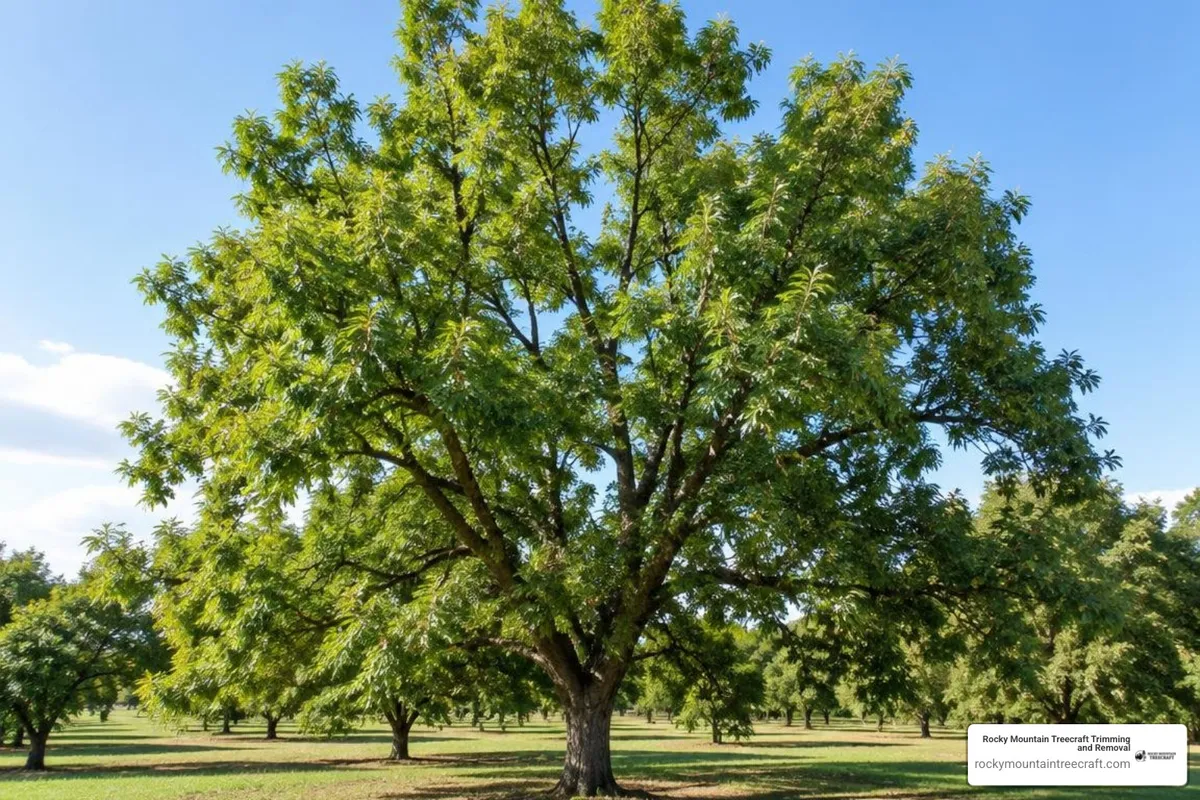
How to Trim Pecan Trees Without Over-Pruning
Optimal Seasonal Timing for Trimming Pecan Trees
Trim pecan trees while they are dormant, usually in late winter before buds open. Start with dead, broken, or crossing branches. Then remove only the live limbs needed to fix a clear problem. Cut just outside the branch collar, and never remove more than 25% of the live canopy in one year. Leave a hazardous broken limb for prompt removal rather than waiting for winter.
A pecan can live for centuries, but topping or stripping its inner branches can weaken its structure and reduce nut production. For a large tree or limbs near a home or power line, have a qualified tree-care professional assess the work.
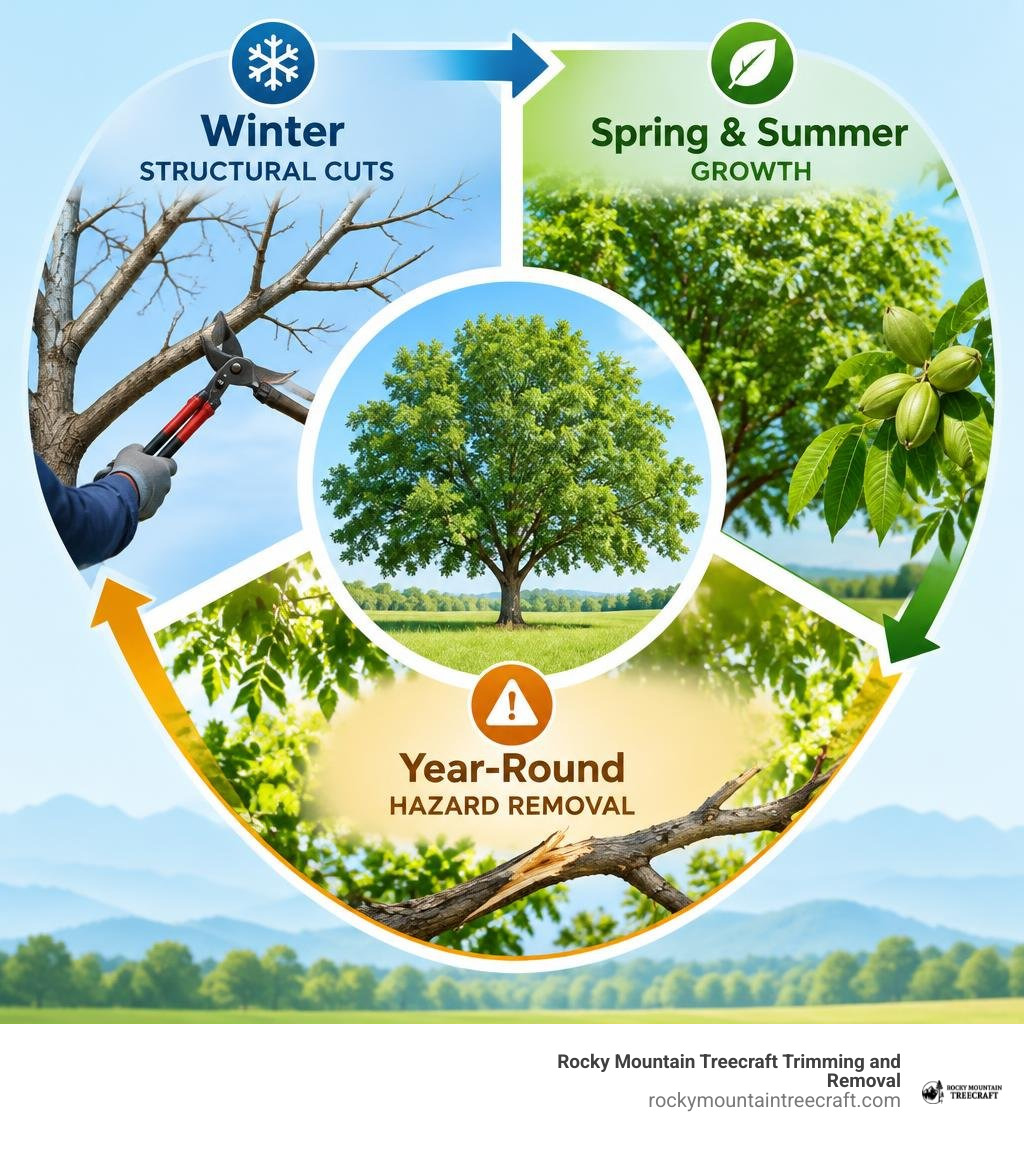
Timing is the single most critical factor when planning tree maintenance. For pecan trees (Carya illinoensis), the optimal pruning window falls during the dormant season in late winter. In cold mountain valleys, such as Heber Valley and throughout Wasatch County, performing cuts in late January through mid-February protects the tree while it is completely at rest.
Pruning during dormancy minimizes sap loss and allows you to clearly evaluate the tree architecture without dense foliage blocking your view. Because dormant trees store their primary energy reserves below ground in root systems, winter cuts cause less physiological stress. When warm weather arrives, energy surges directly into the remaining, well-spaced branches, accelerating natural wound closure before pests become active.
Proper seasonal timing is fundamental to the general pruning of trees. Following university research, such as the Extension guide on training pecan trees, ensures you prune in alignment with the natural growth habits of the species rather than disrupting seasonal growth cycles.

Risks of Pruning During Active Growing Seasons
Trimming during active spring growth or mid-summer carries severe penalties for pecan trees. Once bud break occurs in spring, the tree expends stored carbohydrate reserves to produce new leaves and shoots. Heavy pruning during this stage strips away active foliage, starving the root system and stunting development.
Pruning in late spring or summer often triggers an explosion of water sprouts. These vigorous, vertical shoots crowd the interior canopy, sap energy from nut production, and create weak structural attachments. For practical advice on seasonal maintenance, reviewing dependable tree care tips helps avoid untimely cuts that compromise vitality.
Emergency Limb Removal and Deadwood Exceptions
While live branches require strict seasonal scheduling, dead, diseased, or hazardous limbs do not follow the calendar. Storm events, heavy snow loads, or sudden summer failures can leave cracked limbs dangling over buildings, driveways, or walkways.
You should remove hazardous branches, storm-damaged wood, and fully dead limbs immediately, regardless of the season. Removing deadwood carries minimal risk of pest attraction because the tissue is non-functional, and eliminating broken limbs protects your family and property from unexpected structural failures.
Structural Training and the Central Leader System
A pecan tree requires careful structural management early in life to establish a durable framework. The central leader system is the gold standard for training young pecans. In this architecture, one dominant vertical stem forms the central trunk, supporting well-spaced horizontal scaffold limbs arranged evenly around the perimeter.
Without early training, pecan trees naturally develop multiple competing leaders with narrow, V-shaped crotches. As the tree matures, these tight angles trap bark within the junction, creating severe structural weaknesses prone to splitting under wind gusts or heavy nut loads.
Feature | Young Pecan Trees (Years 1 to 5) | Mature Pecan Trees (6+ Years) |
|---|---|---|
Primary Goal | Establish central leader and scaffold limbs | Maintain canopy health and reduce weight |
Pruning Frequency | Annually during late winter | Every 2 to 3 years |
Live Canopy Limit | Up to 30% reduction on young whips | Maximum 25% live canopy removal |
Primary Focus | Correcting narrow crotches and crow's feet | Removing deadwood, crossing limbs, and sprouts |
Growth Habit | Rapid vertical shoot extension | Canopy expansion and nut development |
Year-by-Year Guide to Trimming Pecan Trees for Structure
The first five years of growth dictate the structural strength of a pecan tree for decades to come. When planting bare-root or container whips, pruning balances the above-ground canopy with the newly disturbed root system.
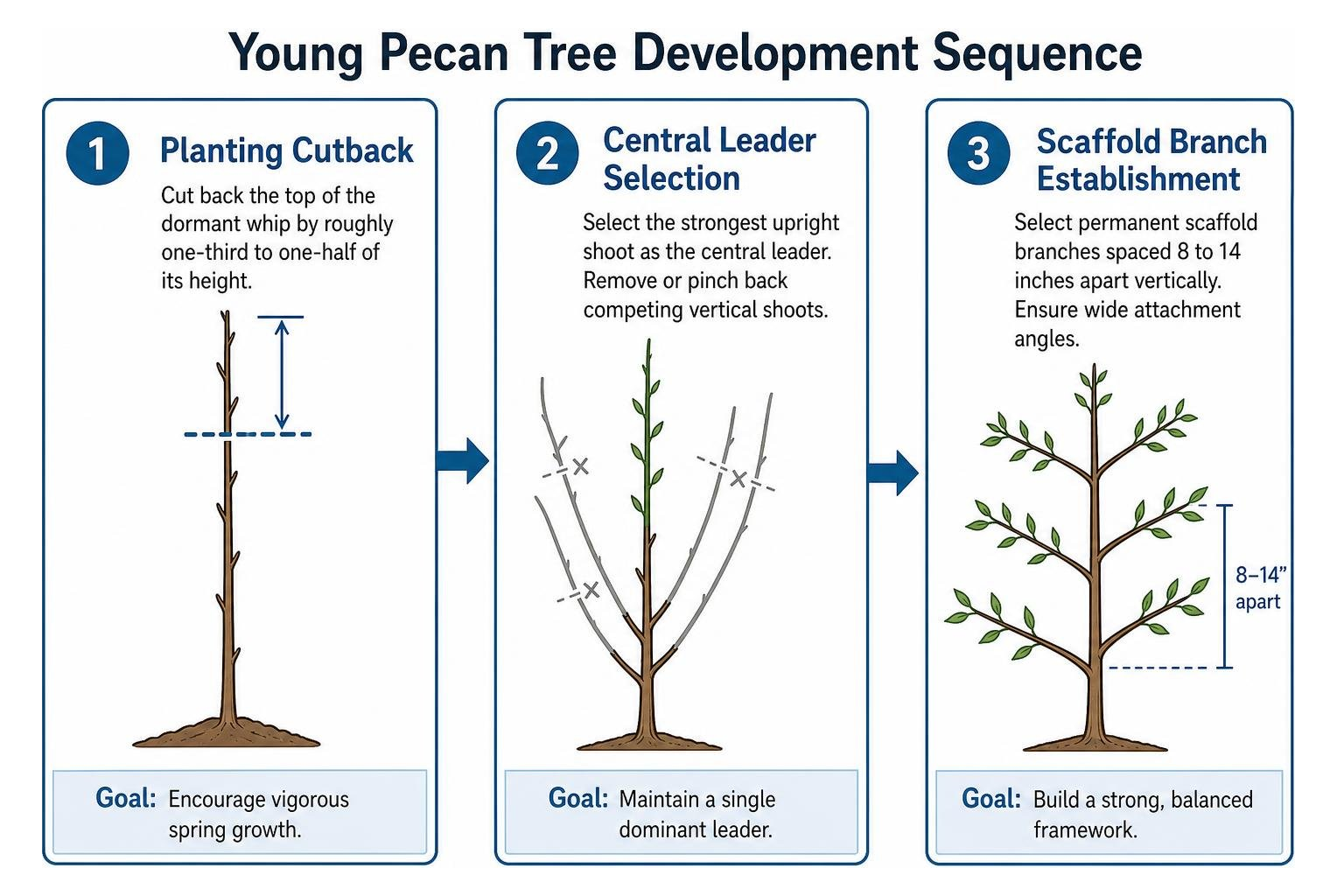
Year 1 (Planting): Cut back the top of the dormant whip by roughly one-third to one-half of its height. This heading cut encourages vigorous spring growth and prevents the young root system from becoming overtaxed. During the growing season, select the strongest upright shoot as your central leader and gently pinch back competing lateral shoots.
Year 2 (First Dormant Season): Maintain the single central leader by removing competing vertical shoots. Thin out clusters of multiple shoots originating from a single point, often called "crow's feet," leaving only the most vigorous shoot intact.
Year 3 to 5 (Scaffold Establishment): Select permanent scaffold branches spaced 8 to 14 inches apart vertically along the trunk, radiating outward in a balanced spiral pattern. Ensure these limbs have wide attachment angles.
Preserving the branch bark collar during every cut ensures natural wound sealing, as outlined in detailed botanical research on (Gilman et al., 2018).
Developing Strong Scaffold Branches and Canopy Light
Permanent scaffold limbs should emerge from the central trunk at angles between 60 and 80 degrees. Wide attachment angles allow strong wood fibers to knit securely to the trunk, supporting heavy crops and winter snow loads. Narrow branch angles under 45 degrees create weak points that split easily under stress.
Thinning congested interior shoots allows ample sunlight into the inner canopy while encouraging air circulation. Good airflow keeps foliage dry, which suppresses fungal development and helps maintain consistent nut yields on interior fruiting wood.
Pruning Mature Pecans: Methods and Canopy Thresholds
Mature pecan trees aged six years and older do not need aggressive shaping. Instead, maintenance pruning every two to three years keeps the canopy balanced and healthy. The most important rule for mature specimens is moderation: never remove more than 25% of the live canopy in a single year.

When trimming mature trees, focus your work on specific branch categories:
Dead, dying, or diseased limbs that harbor wood-boring insects.
Crossing or rubbing branches that create friction wounds in the bark.
Low-hanging branches that obstruct pathways, driveways, or structures.
Vigorous water sprouts growing straight up through the interior canopy.
Proper technique matters as much as timing. Make clean cuts just outside the branch collar and branch bark ridge without gouging the trunk. For comprehensive canopy management, routine tree shrub pruning preserves natural growth patterns and prevents stress.
The Dangers of Topping vs. Crown Reduction Cuts
Topping involves cutting large upper limbs back to arbitrary stubs between nodes. This harmful practice should never be used on pecan trees. Topping destroys the natural canopy architecture, exposes heartwood to internal rot, and triggers a dense ring of weakly attached epicormic shoots. These fast-growing sprouts break away easily in moderate winds, increasing long-term property hazards.
When you need to reduce branch length or manage clearance around utility lines, use selective crown reduction cuts instead. Crown reduction shortens a limb by pruning it back to a lateral branch that is at least one-third the diameter of the stem being removed. This lateral drop-crotch method preserves the branch collar, maintains energy flow, and allows the tree to seal the wound naturally without producing weak shoots.
Managing Nut Production and Summer Limb Drop
Pecan wood is naturally brittle. During summer, heavy nut clusters combined with heat and moisture fluctuations can cause sudden summer limb drop, where large, horizontal limbs snap without warning on calm days.
Targeted weight reduction pruning during late winter helps mitigate this risk. By thinning end-heavy branches and removing redundant lateral stems, you reduce leverage on long horizontal limbs. Balancing the canopy also evens out alternate-bearing cycles, helping the tree produce steady nut crops rather than swinging between overproduction and crop failure.
Critical Mistakes to Avoid and Professional Care
Proper execution prevents long-term health problems. Two of the most damaging mechanical errors are flush cuts and branch stubs. A flush cut removes the branch collar, slicing into trunk tissue and destroying the specialized cells needed to compartmentalize decay. A branch stub leaves too much wood beyond the collar, preventing wound wood from closing over the cut and creating an entry point for rot.
Always use sharp, disinfected pruning tools to make clean cuts. Dull equipment crushes and tears pecan wood fibers, leaving jagged wounds that take longer to close. If you notice signs of decline, such as canopy dieback or poor leaf development, scheduling a professional tree health assessment will help diagnose underlying issues before pruning.
Mistakes to Avoid When Trimming Pecan Trees
Beyond improper cuts, several common practices harm mature pecans:
Lion-tailing: Stripping all interior foliage and leaving small tufts of leaves at branch tips. This shifts weight to the ends of limbs, increasing breakage and exposing interior bark to sunscald.
Applying wound sealants: Petroleum-based tree paints and tar products trap moisture against open wood, accelerating internal fungal decay. Pecans seal wounds effectively through natural chemical compartmentalization.
Misdiagnosing nutrient issues: Stunted, clustered foliage at branch tips, known as rosetting, indicates a zinc deficiency common in alkaline soils rather than a pruning issue. Pruning cannot correct soil nutrient imbalances.
When to Call a Professional Tree Service
While young pecans can be managed from the ground with pole pruners, mature trees frequently reach 70 to 100 feet tall with massive branch spreads. Pruning mature pecans involves considerable risk and technical complexity.
You should hire a professional tree service when:
Limbs grow within 10 feet of high-voltage power lines.
Work requires climbing, aerial lifts, or complex lowering rigging over roofs.
Large, heavy limbs over 4 inches in diameter require reduction.
Storm damage has created hanging or structurally unstable branches under tension.
Our team at Rocky Mountain Treecraft provides dedicated residential tree services to evaluate tree health, manage canopy density, and eliminate hazardous limbs safely.
Frequently Asked Questions About Pecan Pruning
How much of a pecan tree canopy can be safely removed at once?
You should never remove more than 25% of the live canopy in a single growing season. Removing excess foliage depletes the tree's photosynthetic capacity, forcing it into a survival state where it expends stored root reserves to produce weak water sprouts. Removing less live wood preserves tree health and maintains balanced growth.
Does heavy pruning improve or hurt pecan nut production?
Heavy pruning harms nut production. Pecans produce nuts on terminal shoots of one-year-old wood. Over-pruning removes productive fruiting wood and shifts tree energy into vigorous, vegetative shoot growth rather than nut development. Moderate thinning that allows sunlight to reach interior fruiting shoots supports consistent annual yields.
Should you seal pruning cuts on pecan trees?
No, you should not apply wound sealers, asphalt sprays, or tar compounds to pruning cuts. These products trap moisture and fungal spores against the exposed wood, promoting rot. The only helpful surface treatment is applying diluted white latex paint to large, exposed cuts on the south or west sides of young trees to prevent sunscald while the wound closes naturally.
Keep Your Pecan Trees Strong with Rocky Mountain Treecraft
Trimming pecan trees properly requires balancing seasonal timing, structural training, and conservative canopy management. By focusing on late winter dormancy, maintaining a strong central leader, and avoiding over-pruning, you protect your property and help your trees thrive for generations.
If you have large pecan trees that need structural pruning, hazardous limb clearance, or a comprehensive health evaluation, Rocky Mountain Treecraft is here to help. We provide property-focused care tailored to the terrain and mountain climate of Heber Valley and Wasatch County. Contact us today to schedule your on-site tree-health assessment or request a free estimate for our professional tree trimming services.
References
Edward Gilman, Dennis Watson, Ryan W. Klein, Andrew K. Koeser, Deborah R. Hilbert, Drew C. McLean. "Carya illinoensis: Pecan." EDIS, 2018. DOI 10.32473/edis-st122-1993.