
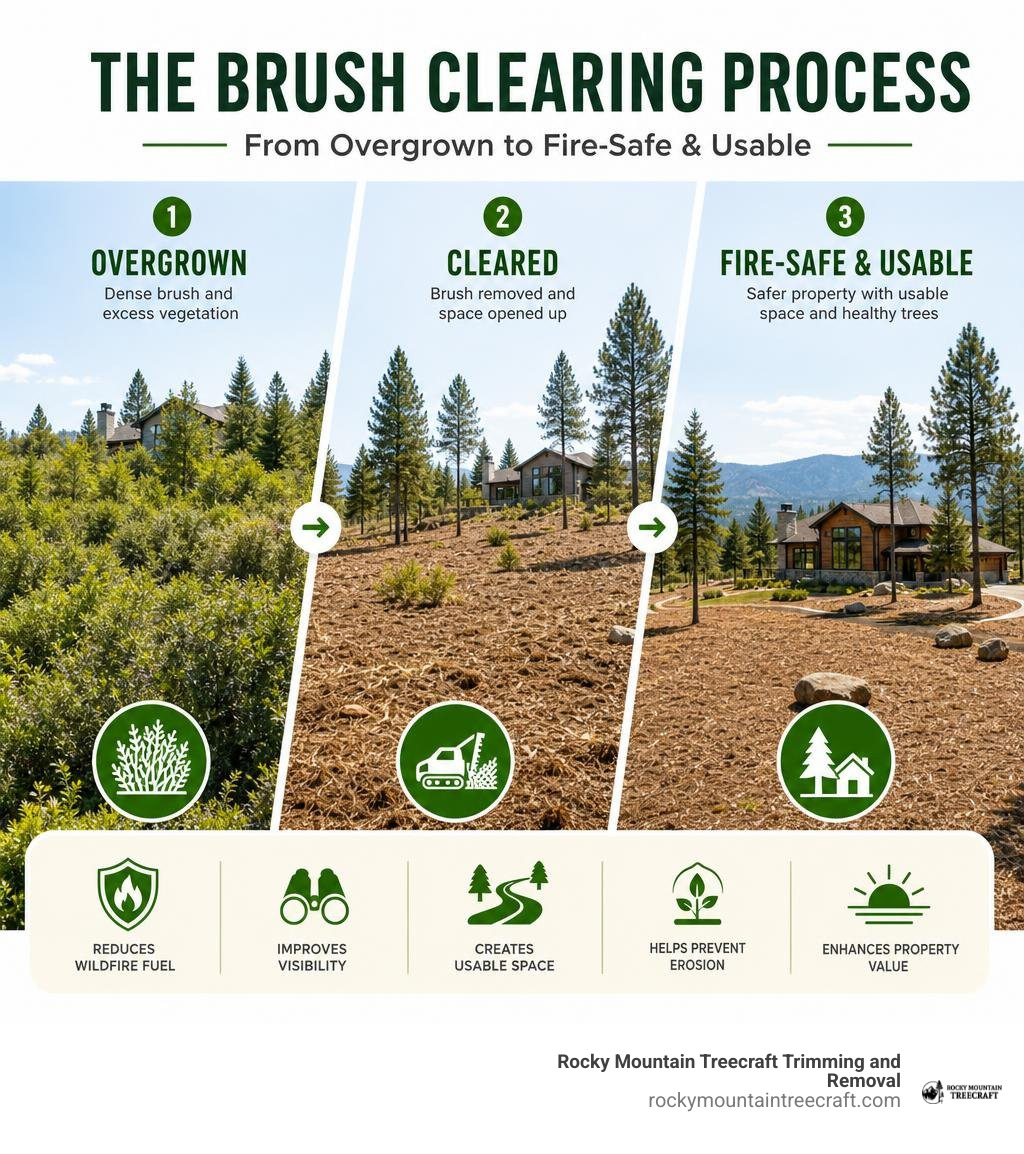
Brush Clearing Services Demystified
Why Brush Clearing Matters for Heber Valley Properties
Brush clearing removes dense shrubs, small trees, dead growth, and invasive vegetation to make a property safer, easier to use, and easier to maintain. For many Heber City and Wasatch County properties, the goal is not to strip the land bare. It is to open up overgrown areas while preserving healthy, desirable trees.
A professional can selectively clear brush around homes, fence lines, trails, and wooded areas. This reduces dry vegetation that can act as wildfire fuel, improves visibility, and creates usable outdoor space. In mountain terrain, the right method also matters: forestry mulching processes brush in place and leaves a ground-cover layer that can help limit erosion and retain soil moisture.
Rocky Mountain Treecraft Trimming and Removal helps property owners assess whether selective brush removal, underbrush management, or more complete lot clearing fits their plans. The best choice depends on vegetation density, slope, access, and the trees worth keeping.
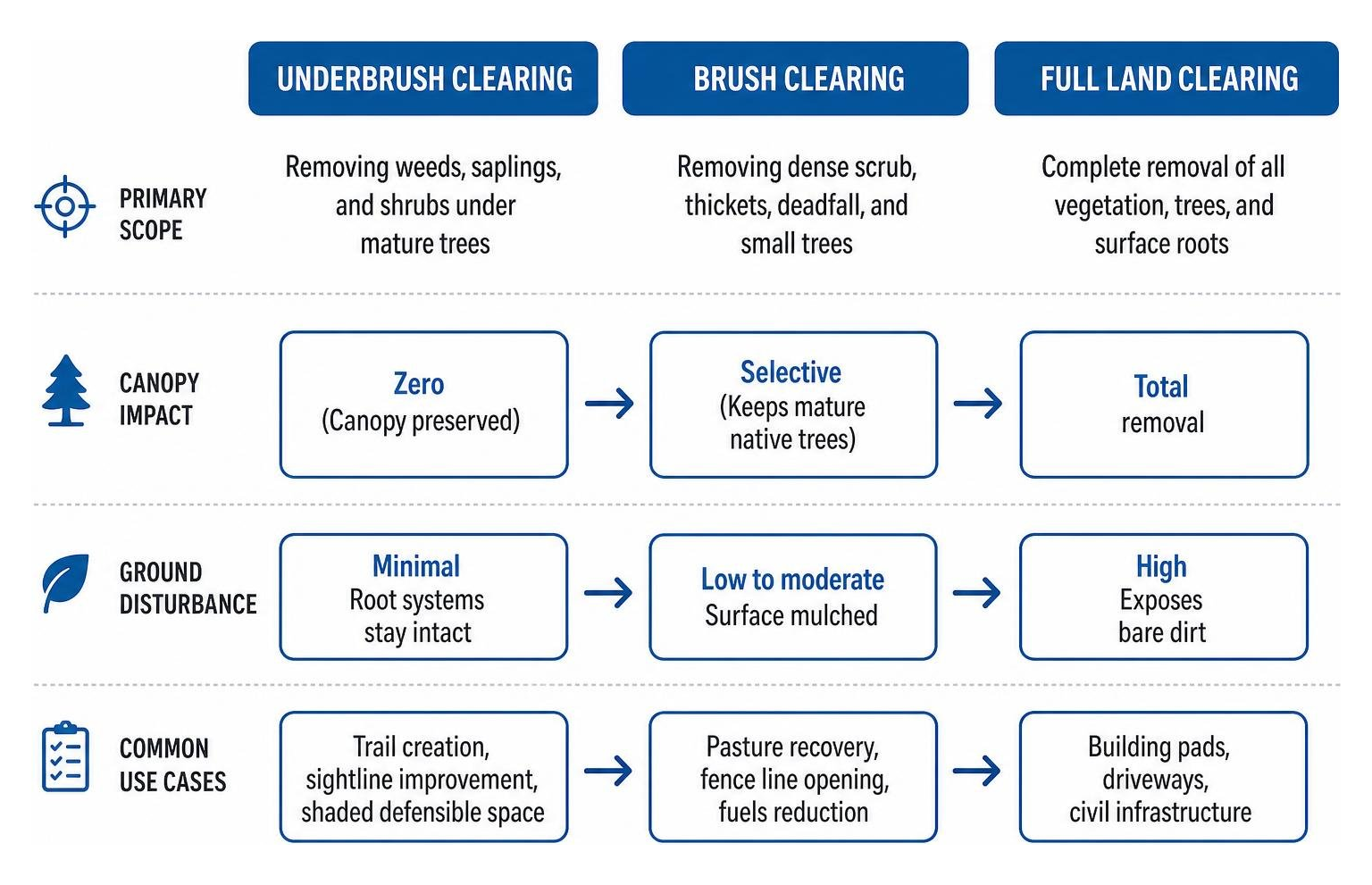
Brush Clearing vs. Underbrush Clearing and Full Land Clearing
Understanding the scope of your project helps you choose the right approach for your property. Property owners often use terms like brush clearing, underbrush clearing, and land clearing interchangeably, but they describe very different levels of intervention.
Service Type | Primary Scope | Canopy Impact | Ground Disturbance | Common Use Cases |
|---|---|---|---|---|
Underbrush Clearing | Removing weeds, saplings, and shrubs under mature trees | Zero (Canopy preserved) | Minimal; root systems stay intact | Trail creation, sightline improvement, shaded defensible space |
Brush Clearing | Removing dense scrub, thickets, deadfall, and small trees | Selective; keeps mature native trees | Low to moderate; surface mulched | Pasture recovery, fence line opening, fuels reduction |
Full Land Clearing | Complete removal of all vegetation, trees, and surface roots | Total removal | High; exposes bare dirt | Building pads, driveways, civil infrastructure |
Choosing between selective removal and total clearing depends entirely on your end goals. When preparing a site for foundation work or utility installations, property owners often turn to land clearing and excavation to strip all organic growth. However, for acreage management and scenic residential lots, complete stripping is often counterproductive and unnecessarily expensive.
Understory Management vs. Total Clearing
Understory management focuses on removing the intermediate vegetation layer while leaving the upper forest canopy intact. Dense oak brush, chokecherry thickets, and dead fallen timber compete with mature aspen, spruce, and pine trees for limited mountain moisture. Thinning this understory lets sunlight reach the forest floor, promotes healthy native grasses, and relieves drought stress on established trees.
In contrast, total clearing strips the ground of all vegetation down to the mineral soil. If you want a deeper look at total site preparation, our lot clearing complete guide 2026 explains heavy stripping methods. For day-to-day property stewardship in Wasatch County, understory management preserves the root structure of mature trees, maintaining soil stability against runoff.
Key Environmental Benefits of Forestry Mulching
Traditional clearing methods rely on bulldozing vegetation into large piles to burn or haul away in dump trailers. Forestry mulching provides an eco-friendly alternative by using high-speed rotary drums equipped with carbide teeth to shred standing vegetation directly where it stands.
Erosion Mitigation: The shredded organic material forms a protective blanket over the soil, shielding steep slopes from rain impact and snowmelt runoff.
Moisture Retention: A natural layer of mulch prevents rapid evaporation, keeping mountain soil damp during hot, dry summer months.
Topsoil Enrichment: As the wood chips break down, they return organic matter and vital nutrients directly into the topsoil.
Zero Haul-Off: Processing brush in place eliminates the need for heavy haul trucks, reducing neighborhood traffic and landfill tipping fees.
Understanding Equipment and Terrain Dynamics
Mountain terrain in northern Utah requires specialized machinery. Standard residential mowers and light farm tractors cannot handle rocky hillsides, thick Gambel oak, or steep canyon approaches.
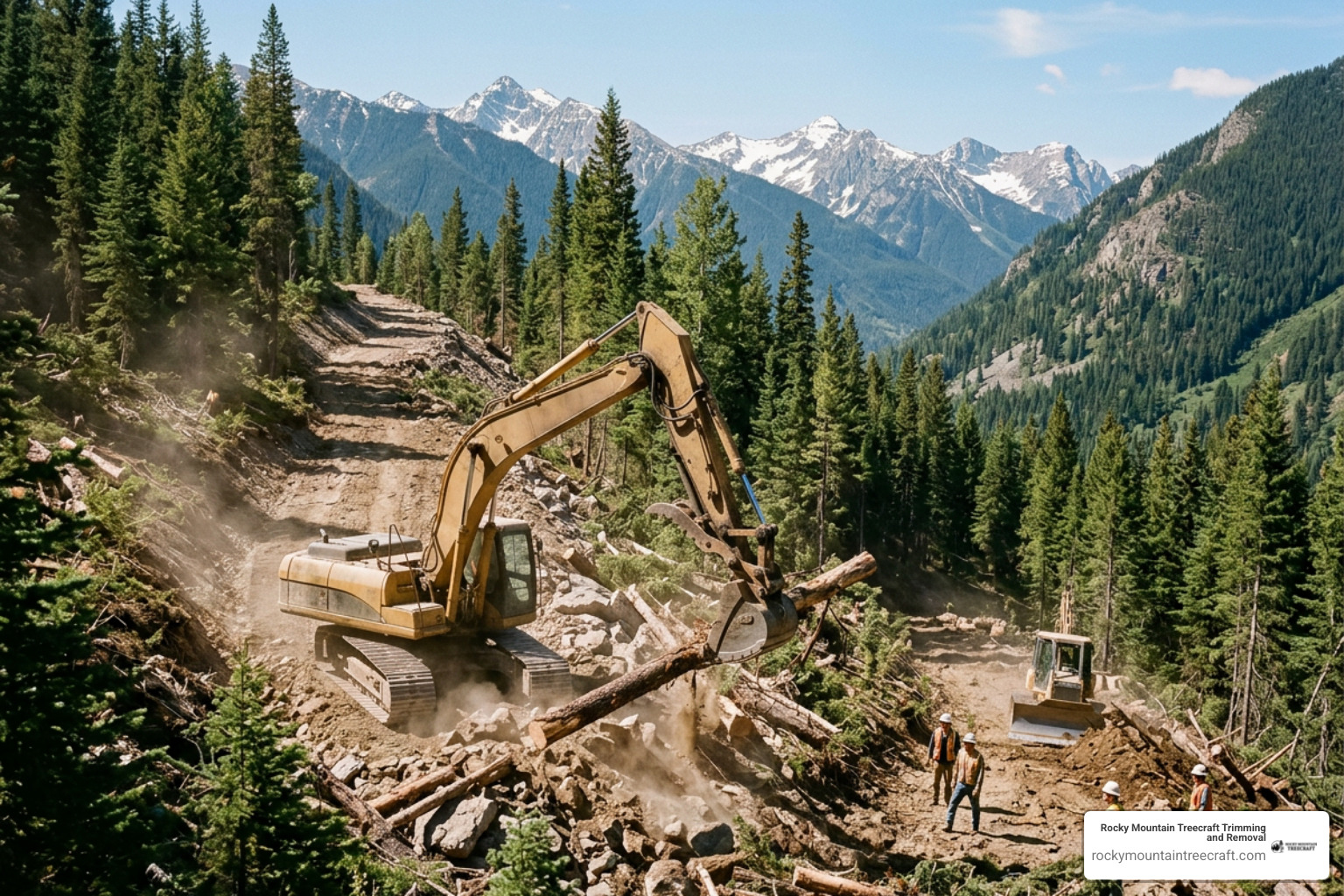
High-torque machines cut woody vegetation flush with the ground while navigating variable grades. For steep hillsides, operators often utilize heavy-duty commercial slope mowers designed to tackle inclines up to 32 degrees without losing traction or risking rollover.
Matching Machinery to Vegetation Density
Different vegetative densities demand different mechanical tools:
Compact Track Loaders (CTLs): Equipped with front-mounted forestry mulchers, these tracked machines exert low ground pressure, making them ideal for residential acreage and sensitive soil.
Excavator Mulchers: An excavator fitted with a boom-mounted cutting head can reach down steep embankments, over ditches, and between tight tree stands without driving directly onto fragile slopes.
Mechanical Grabbing Tools: For small acreage with scattered shrubs, landowners sometimes use vehicle-mounted clump grubbers attached to utility vehicles to pull shallow root systems out individually.
Rotary Brush Cutters: Best suited for open pastures with light woody stalks and tall weeds before heavy woody thickets develop.
Managing Steep Slopes and Mountain Access
Wasatch County topography presents distinct challenges, including narrow private lanes, rocky outcrops, and steep drainage draws. Dedicated mulching equipment features wide rubber tracks that distribute machine weight, preventing deep rutting.
Operating on slopes requires balanced weight distribution, low center-of-gravity engineering, and careful operator technique. Navigating around granite boulders and irrigation ditches ensures that the productive topsoil remains intact while unwanted brush is eliminated.
Critical Long-Term Advantages for Property Owners
Investing in regular brush management provides immediate aesthetic benefits and protects your real estate investment over time.
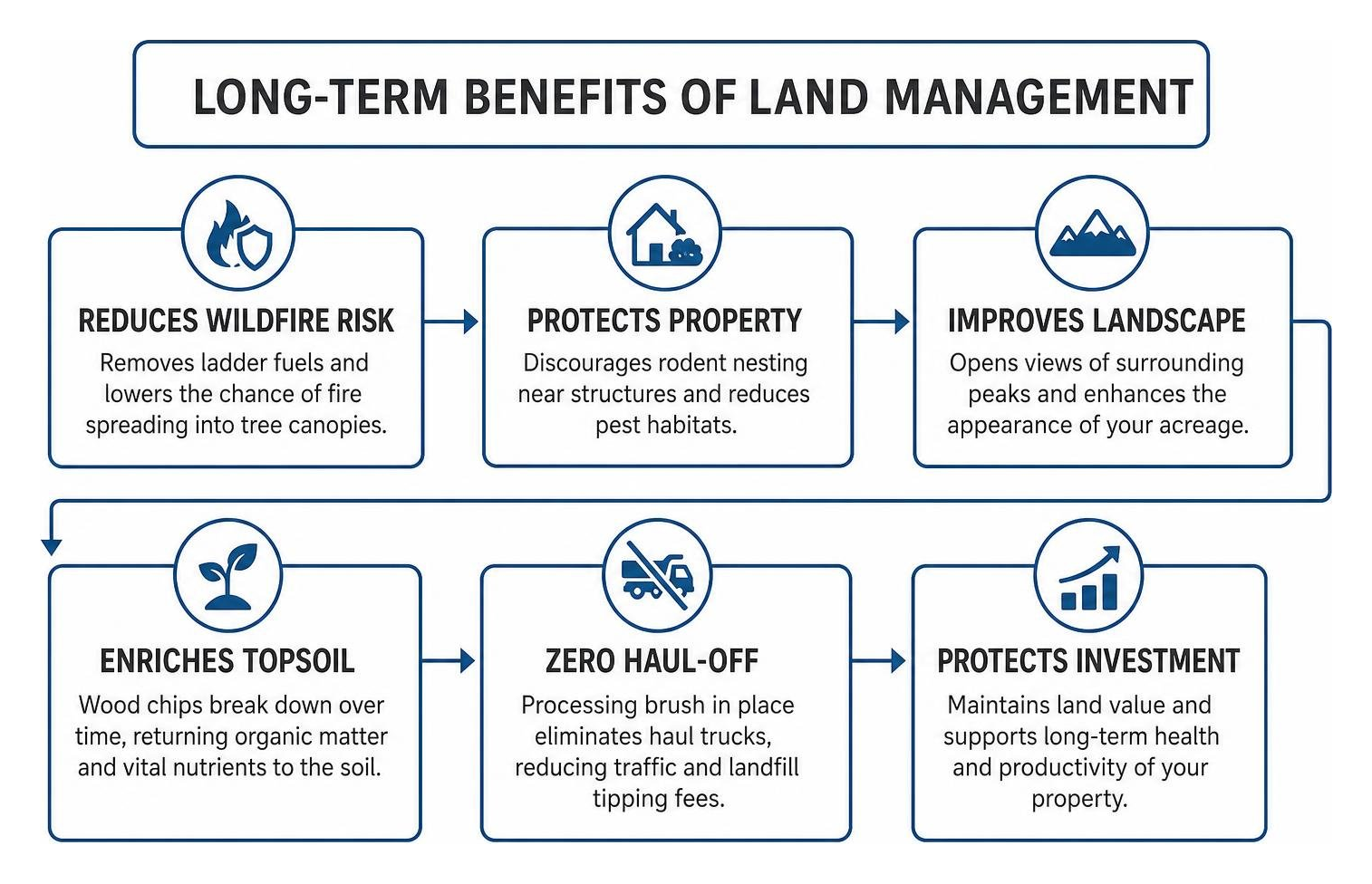
Beyond opening up views of the surrounding peaks, systematic clearing reduces pest habitats, discourages rodent nesting near structures, and drastically lowers fire hazards. To maintain long-term protection, property owners incorporate brush clearing into their overall plan for fire mitigation across their acreage.
Wildfire Prevention in Heber Valley
The wildland-urban interface across Heber Valley, Midway, and surrounding mountain communities faces seasonal wildfire threats during dry late-summer periods. Dense brush acts as "ladder fuel," allowing low-intensity surface fires to climb into the upper canopies of spruce, fir, and pine trees.
Proper fuel reduction breaks this chain:
Zone 1 (0–30 feet from structures): Remove all flammable brush, dry weeds, and deadwood. Keep this space clean and well-irrigated.
Zone 2 (30–100 feet): Thin dense scrub thickets, prune lower tree branches up to 6 to 10 feet from the ground, and create open space between tree crowns.
Zone 3 (100+ feet): Selectively mulch deadfall and heavy underbrush along property lines and access driveways to give emergency response vehicles clear passage.
While fuel mitigation significantly reduces risk and creates defensible space, no clearing method can guarantee complete wildfire survival under extreme weather conditions.
Enhancing Usability for Residential and Commercial Properties
Dense scrub oak and invasive weeds can turn acres of private land into unusable space. Reclaiming overgrown ground allows you to install boundary fencing, build recreational trails, and create functional pasture.
For homeowners, our residential tree services pair selective clearing with canopy pruning to enhance curb appeal and safety. Commercial managers, open spaces, and utility corridors benefit from commercial tree services that maintain required line-of-sight clearances, protect perimeter fences, and manage liability across shared land parcels.
Cost Breakdown and Project Factors
The investment required for land management depends on the size of the parcel, terrain complexity, and vegetation thickness.
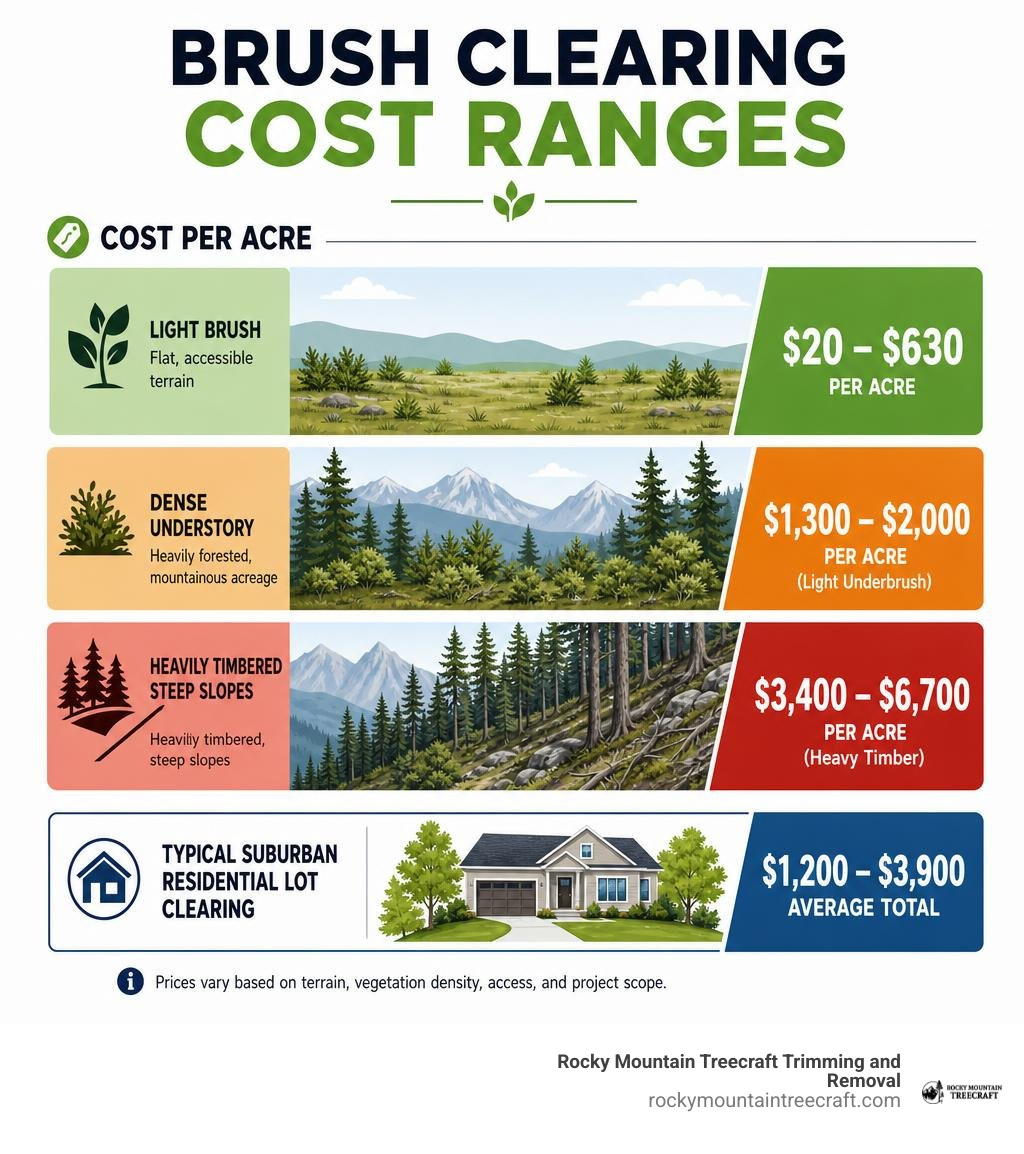
Light brush removal on relatively flat ground generally costs between $20 and $630 per acre. However, clearing dense understory across heavily forested, mountainous acreage typically ranges from $1,300 to $2,000 per acre for light underbrush, climbing to $3,400 to $6,700 per acre for heavily timbered, steep slopes. Typical suburban residential lot clearing projects usually average between $1,200 and $3,900 in total.
Factors Influencing Professional Brush Clearing Rates
Several variables determine the final estimate for your project:
Vegetation Density and Stem Diameter: Grinding 2-inch sagebrush is faster than processing 6-inch oak and juniper stems, which require higher machine horsepower.
Terrain Slope and Rockiness: Steep hillsides and rocky ground slow down equipment travel and cause faster wear on cutting teeth, increasing hourly or daily rates.
Acreage Scale: Mobilizing heavy machinery involves transport costs. Larger multi-acre jobs often enjoy lower per-acre rates compared to single-acre residential projects.
Property Access: Restricted access gates, narrow switchback driveways, or overhead power lines require smaller, specialized equipment or manual hand-felling crews.
What to Expect in a Professional Service Scope
A detailed contractor estimate clarifies what is included in the project scope:
Selective Thinning and Mulching: Grinding targeted underbrush, saplings, and deadwood into a uniform mulch layer.
Tree Pruning and Hazard Evaluation: Raising lower tree limbs and identifying structurally compromised trees that need professional assessment.
Stump Processing: Cutting stumps flush with the soil surface (note that below-grade stump grinding is typically an add-on service).
Debris Management: Shredding material on-site to eliminate hauling and dump disposal fees.
DIY Approaches vs. Professional Execution
Landowners often wonder whether renting a small brush mower or using hand tools makes more financial sense than hiring a contractor.

Tackling the work yourself can be rewarding for light maintenance, but large thickets and mountain slopes quickly present safety and physical challenges.
When DIY Brush Clearing Is Feasible
DIY clearing makes practical sense when:
The ground is flat with few rocks or hidden drop-offs.
Vegetation consists of light weeds, tall grass, and soft saplings under 1 inch in diameter.
The total area is under a quarter-acre.
You have access to a reliable chainsaw, string trimmer with a brush blade, and proper safety gear (chaps, eye protection, helmet).
If your property features dense Gambel oak, multi-stem thickets, or steep inclines, DIY attempts can quickly lead to equipment damage, excessive physical fatigue, or injury. Commercial slope mowers and dedicated mulchers process in two hours what would take days of manual labor.
Project Timelines: Residential Lots vs. Large Acreage
Professional mulching equipment operates at high production speeds. A commercial slope mower can clear up to 1.25 acres per hour in light brush, while a high-horsepower forestry mulcher can process 2 to 4 acres of mixed mountain undergrowth in a single day.
Most suburban residential lots in Wasatch County take one full day to complete. Multi-acre parcels, horse pastures, or large commercial buffers generally require two to four machine days depending on access and terrain difficulty.
Frequently Asked Questions About Land Management
Do I need permits for vegetation removal on my Utah parcel?
In most residential and agricultural zones within Wasatch County, routine brush removal, weed abatement, and fuels reduction on private parcels do not require a specific permit. However, permits may be necessary if your property falls within a designated wetland corridor, a critical stream buffer, or a steep slope conservation overlay. Homeowners associations (HOAs) in mountain developments also have specific architectural and forestry guidelines regarding which native scrub oak or evergreen trees must be preserved. Always check your local municipal codes and neighborhood covenants before clearing large areas.
Does unwanted scrub grow back after being mulched?
Forestry mulching grinds vegetation down to ground level and leaves a dense organic blanket that suppresses weed seed germination. However, hardy native species such as scrub oak, chokecherry, and certain willows have vigorous root systems that naturally push up new sapling shoots over time. To keep your land open, plan for periodic light maintenance passes every few years with a standard brush mower or targeted spot treatments.
Is stump removal included in a standard clearing quote?
Standard brush clearing and forestry mulching cut trees and woody stems flush with the surrounding grade. This leaves the root systems in place to prevent soil erosion on hillsides. Grinding stumps below grade is generally treated as a separate, itemized service because it requires different tooling and site considerations. If you plan to build a structure, pave a driveway, or plant a formal lawn, let your contractor know so stump grinding can be added to your estimate.
Transform Your Land with Rocky Mountain Treecraft
Managing thick brush and overgrown understory protects your property from seasonal fire hazards, opens up scenic mountain views, and expands your usable outdoor space. Whether you need to clear defensible space around your home or reclaim overgrown acreage, working with local professionals ensures the job is done safely, efficiently, and with respect for the natural landscape.
Rocky Mountain Treecraft Trimming and Removal delivers fast, reliable, locally based tree and vegetation management tailored to the unique terrain and climate of Heber Valley and Wasatch County. Contact us today to schedule an on-site property assessment and request a free estimate for our professional brush clearing service.