
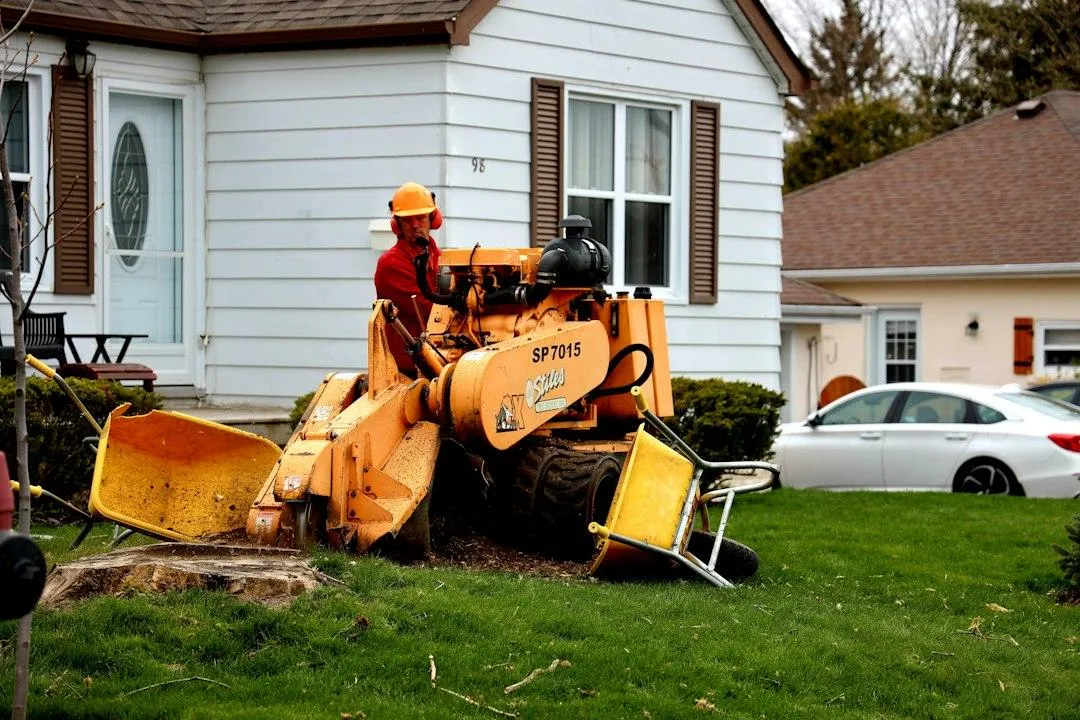
Compare Stump Grinding Costs: A Step-by-Step Guide
What Does Stump Grinding Cost in 2026?
Stump grinding cost usually falls between $100 and $400 for one stump, with many homeowners paying about $200 for a straightforward job. National per-inch rates often run $2 to $5 per inch, but a minimum service fee of roughly $100 to $150 is common because the crew must transport and set up specialized equipment.
In Heber City and across Wasatch County, the final price can vary more than an online average suggests. Mountain terrain, rocky soil, narrow yard access, stump depth, and hard wood species can all affect the quote.
Quick pricing guide | Typical 2026 cost |
|---|---|
Small stump, under 12 inches | $75-$150 |
Medium stump, 12-24 inches | $150-$300 |
Large stump, over 24 inches | $300-$700 |
Basic per-inch pricing | $2-$5 per inch |
Typical minimum service fee | $100-$150 |
The key detail is how the stump is measured. Professionals generally price from the widest point at ground level, including the flared base, not just the narrower cut surface on top. That is why two stumps that look similar can receive very different estimates.
Rocky Mountain Treecraft Trimming and Removal helps Heber City property owners compare the real drivers behind a stump-grinding quote, so they can plan the next step for a safer, cleaner yard.
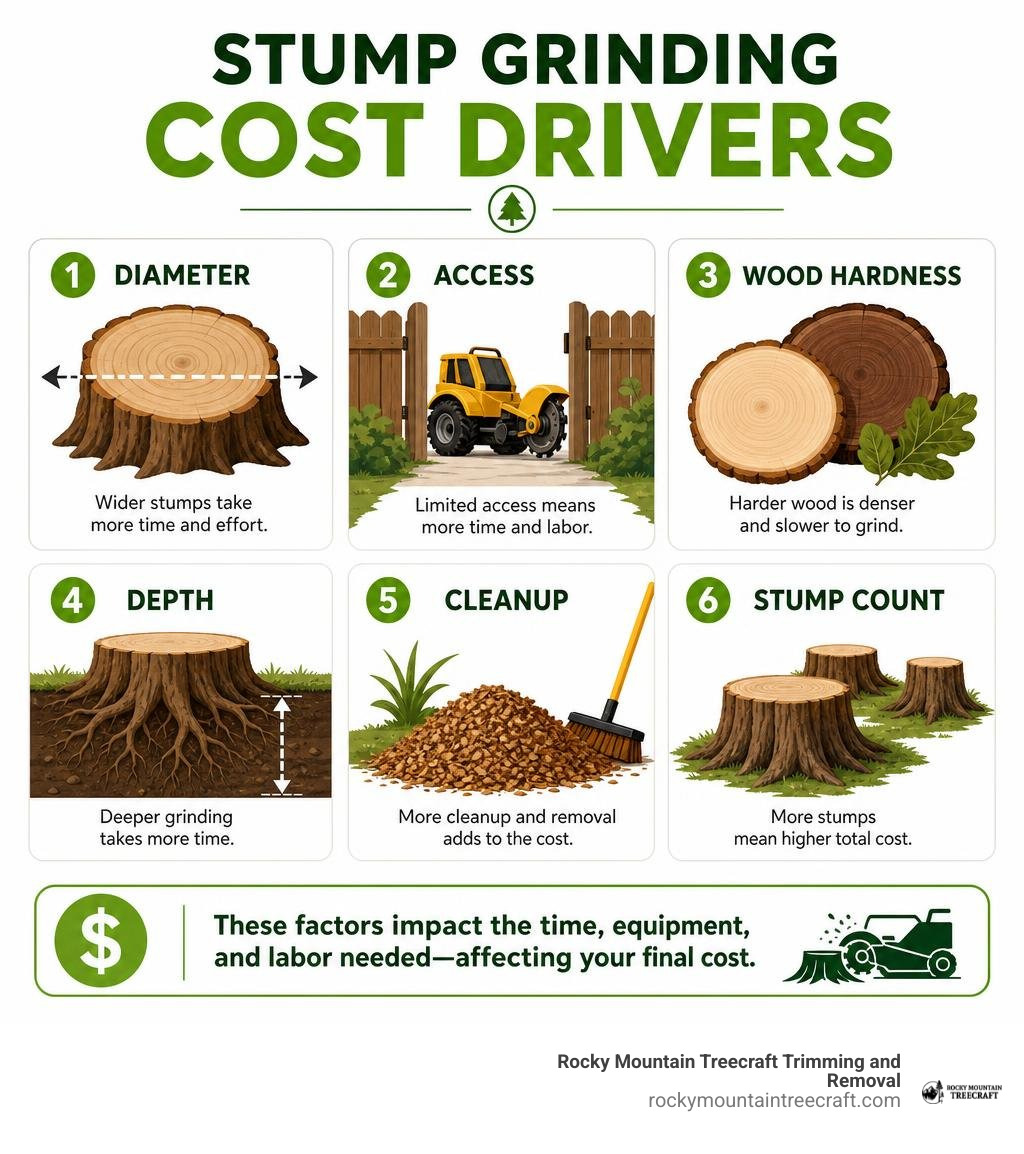
Average Stump Grinding Cost Factors in 2026
When evaluating stump grinding cost estimates, understanding how contractors build their quotes helps you spot fair value instantly. Across the United States, project costs span a wide spectrum—from $131 to $438 on average, with single larger stumps reaching up to $700 or more.
Why is there such a wide range? Stump grinding is not a one-size-fits-all service. Pricing depends on physical dimensions, timber density, yard geography, and specialized machine operator time. Understanding these primary variables prevents surprise add-ons when the crew arrives on site.
Average Stump Grinding Cost Per Inch and Diameter Measurements
Per-inch diameter pricing is the most widely used industry standard for calculating stump grinding charges. Across standard market benchmarks, basic grinding rates range between $2.00 and $7.00 per diameter inch.
However, many homeowners experience "quote shock" because of where the measurement is taken. If you run a tape measure across the flat, saw-cut top of an oak trunk, you might measure 14 inches. But tree roots naturally flare outwards at soil level to anchor the tree against wind and snow loads. Professional tree care technicians measure across the widest point of the root flare at soil level. That same 14-inch trunk cut can easily expand to a 22-inch or 28-inch root flare where the grinding wheel must actually operate.
To calculate your estimated base price accurately:
Place a flexible tape measure on the ground at the outermost visible edge of the root flare.
Measure directly across the widest flare point to the opposite side.
Multiply those total inches by the local per-inch rate (typically $3.00 to $7.00 depending on depth and wood hardness).
For specialized situations requiring deep sub-surface grinding, or when planning lawn restoration, relying on dedicated Stump Grinding Service options ensures the entire root flare is thoroughly addressed down to grade.
Minimum Fees and Additional Stump Discounts
A critical component in pricing is the contractor's minimum callout fee. Mobilizing heavy commercial machinery requires fuel, towing trailers, securing tiedowns, and spending drive time in mountain transit. As a result, standard industry minimum fees baseline between $100 and $225 per site visit, regardless of whether a stump is four inches or ten inches wide.
The good news for landowners with multiple remnants is that bulk pricing offers steep savings per unit. Because the transport and setup overhead is already absorbed by the first stump's minimum fee, contractors routinely offer 25% to 50% discounts on each additional stump cleared during the same appointment.
For instance, clearing one isolated 18-inch stump might incur a flat $180 minimum charge. Adding three additional medium stumps during that same visit might only add $40 to $70 per extra stump. Whenever you clear unwanted timber or perform hazardous tree maintenance on your property, scheduling all stump work together delivers the lowest average cost per stump.
Stump Grinding vs. Stump Removal Cost Comparison
Homeowners frequently use the terms "stump grinding" and "stump removal" interchangeably, but in arboriculture, they represent two completely different processes with vastly different price tags.
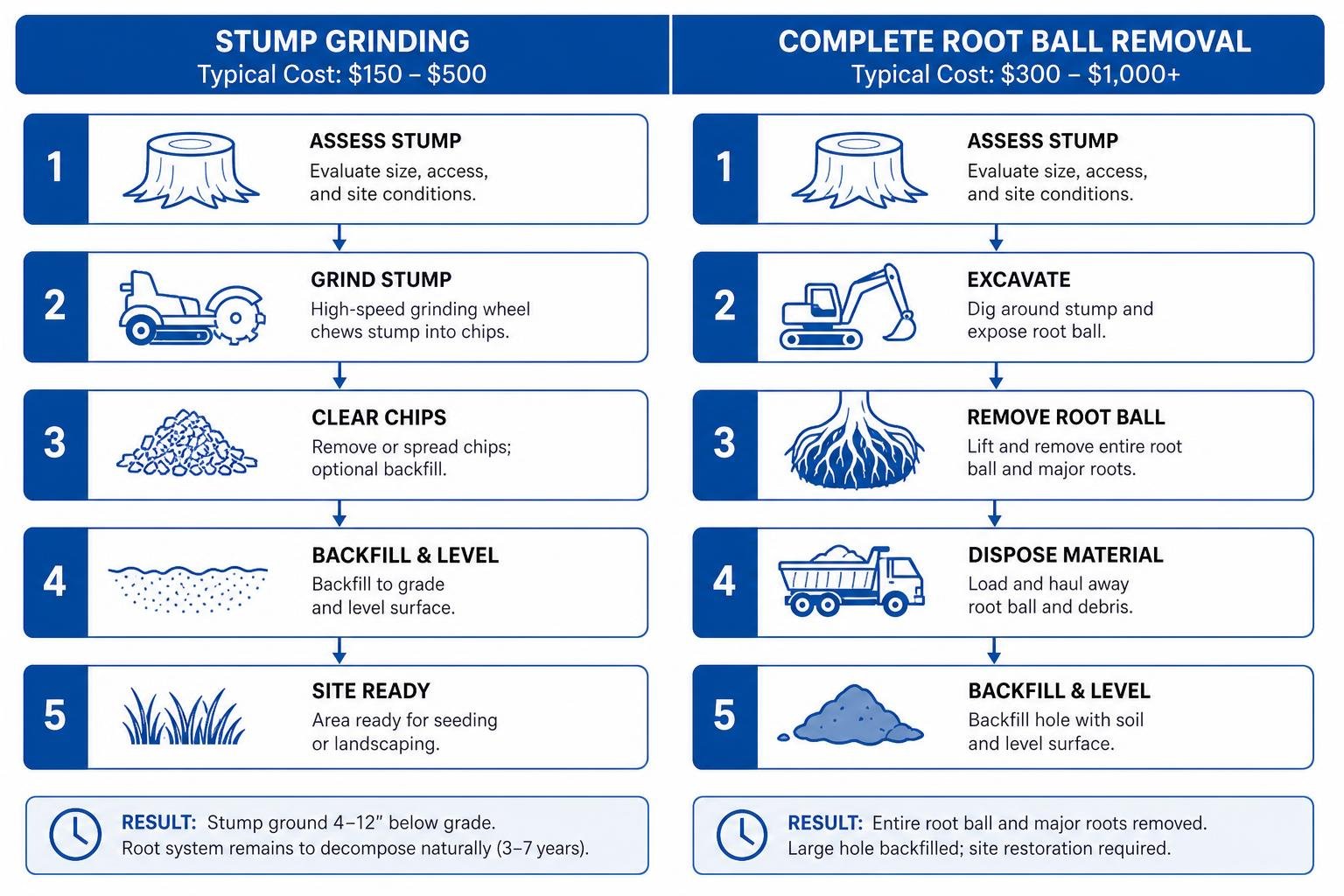
Stump Grinding: A self-propelled, high-horsepower machine uses a rotating steel wheel fitted with carbide-tipped teeth to chew the stump into fine wood chips. It grinds the trunk 4 to 12 inches below ground level, leaving the deeply buried main root system in place to decompose naturally over 3 to 7 years. Grinding typically costs $150 to $500.
Full Stump Removal (Root Ball Excavation): Heavy equipment like backhoes or excavators physically digs out the entire central root ball and major taproots. This creates a massive hole in the landscape, damages surrounding lawn structures, and demands extensive soil backfilling and waste disposal. Complete excavation usually ranges between $300 and $1,000+.
Feature / Metric | Professional Stump Grinding | Complete Root Ball Removal |
|---|---|---|
Average Cost Range | $150 – $500 | $300 – $1,000+ |
Machinery Used | Track or walk-behind grinder | Excavator, backhoe, tow cables |
Lawn & Soil Impact | Low to moderate (contained wood chips) | High (large excavation crater) |
Root Ball Handling | Ground into mulch below grade | Completely dug up and hauled away |
Best Used For | Standard lawns, replanting grass, garden beds | Structural foundation prep, driveways, utility pipes |
Completion Time | 20 to 60 minutes per stump | 2 to 5 hours per stump |
For nearly 90% of residential yards, stump grinding provides the ideal, budget-friendly solution without tearing up lawns or leaving gaping earth craters.
How Depth and Terrain Affect Your Overall Stump Grinding Cost
Grinding depth plays a major role in labor time and blade wear:
Standard Lawn Grinding (4 to 8 inches below grade): Perfect if you plan to cover the area with topsoil and sow grass seed or lay turf. This requires minimal machine runtime and keeps prices at standard baseline rates.
Deep Grinding (12 to 20 inches below grade): Necessary if you plan to install concrete patios, build home additions, or construct retaining walls over the space. Deep grinding incurs an extra fee of $2.50 to $5.00 per diameter inch because the wheel must chew through rocks and soil deep underground.
Terrain challenges also influence project quotes. In mountain valleys with steep side-slopes, rocky alluvial soil, or narrow access gates under 36 inches wide, operating commercial machinery demands specialized compact track equipment and extra manual labor. Clearing buried boulders away from the stump perimeter before grinding prevents tooth breakage, adding approximately $50 to $100 per hour in site prep costs.
If you are exploring the Easiest Way to Remove a Stump on challenging grades, balancing machine power with site access is crucial.
Tree Species Density and Wood Hardness Impact
Not all tree trunks grind at the same speed. Dense hardwoods cause significantly higher mechanical resistance, rapid tooth wear, and extended runtime compared to softwoods.
Softwood Species (Pine, Spruce, Fir): Soft timber grinds quickly and cleanly. A commercial unit can process a 20-inch pine stump in 15 to 20 minutes, keeping your total bill on the lower end of the pricing scale.
Hardwood Species (Oak, Maple, Walnut, Elm): Dense wood fibers require slow, methodical passes. Hardwoods create high friction and increase fuel burn and tooth dulness. Expect a 10% to 30% surcharge (roughly $50 to $150 extra) when grinding mature hardwoods.
In our local mountain ecosystem, evergreen softwoods like blue spruce or lodgepole pine grind rapidly, whereas native Gambel oak or dense cottonwood roots demand extra machine horsepower and care.
Additional Fees, Cleanup Costs, and Utility Safety Steps
When comparing quotes from various tree services, pay close attention to what is included in the base rate. Some estimates cover only the physical grinding process, leaving wood chip disposal, backfilling, and soil restoration as extra line items.
Debris Cleanup and Topsoil Add-Ons
A 24-inch tree stump does not simply vanish into thin air; it expands into a pile of combined sawdust, wood chips, and soil that can easily fill a pickup truck bed!
Leaving Wood Chips On-Site (Default Option): Most standard base quotes include mounding the freshly ground wood chips back into the hole. Over time, these chips settle as they decompose. You can also shovel the excess wood chips into flowerbeds to serve as free garden mulch.
Debris Haul-Away Service: If you want the entire pile removed from your property, contractors typically charge $1.00 to $5.00 per diameter inch (or a flat $50 to $150 haul-away fee) to cover loading, labor, and local green-waste dumping fees.
Topsoil Backfill & Seeding: Filling the remaining depression with rich topsoil and applying lawn seed or sod usually costs an additional $50 to $200 depending on hole dimensions.
Pro tip for lawn restoration: Decomposing wood chips consume nitrogen from surrounding soil. If you plan to grass over the area immediately after grinding, apply a high-nitrogen fertilizer (such as 30-0-0) to ensure quick, green turf establishment.
Utility Locates (811 Call) and Local Permits
Safety precautions must always precede mechanical grinding. Because stump grinder teeth penetrate 6 to 18 inches into the soil, striking hidden underground infrastructure can cause costly utility outages or safety hazards.
Calling 811 (the national free utility location service) is mandatory before starting any grinding work. Utility technicians visit the property to mark public natural gas lines, power cables, fiber optic internet, and water mains with colored spray paint.
While public utilities locate lines leading to the meter, homeowners are responsible for identifying private lines—such as underground sprinkler pipes, drip lines, invisible dog fences, or low-voltage garden lighting. Make sure to flag these private lines prior to the crew's arrival.
For standard residential property grinding in Wasatch County, municipal permits are rarely required unless the tree stands in a public right-of-way or designated historical conservation district.
How to Save Money: Professional Services vs. DIY
Faced with a nuisance stump, many property owners consider renting a walk-behind unit from a local hardware center. However, when you break down the true costs, DIY grinding rarely delivers financial savings—and brings significant physical effort and risk.
Rental Equipment vs. Hiring Professionals
Renting a small tow-behind or walk-behind stump grinder at a tool rental yard typically costs $150 to $350 per day. Once you add delivery fees ($25 to $75), fuel costs, trailer hitches, and security deposits, your total DIY outlay often reaches $250 to $450.
Factor | DIY Equipment Rental | Professional Tree Service |
|---|---|---|
Out-of-Pocket Expense | $250 – $450 (rental, fuel, transport) | $150 – $400 (all-inclusive for single stump) |
Equipment Power | 9 to 13 HP (small walk-behind) | 35 to 75+ HP (commercial hydraulic/tracked) |
Time Required | 3 to 6 hours of heavy physical labor | 20 to 40 minutes of automated grinding |
Safety Risks | High (flying debris, kickback hazards) | Covered by professional liability insurance |
Hardwood Performance | Very slow; struggles on large flares | Effortless cutting through hard timber |
Success Rate | High rate of incomplete jobs | 100% ground to specified depth |
Small 9 HP rental units struggle against tough mountain root flares and hardwood timber. Operating a rental grinder involves intense physical exertion as you push and swing the machine against a solid wooden mass. In fact, field surveys indicate over 87% of homeowners who rent grinders for large stumps ultimately call a professional service to finish the task after spending money on rental fees.
Smart Strategies to Reduce Expenses
If you want to keep your stump grinding cost as low as possible while securing professional results, use these practical money-saving strategies:
Bundle Multiple Tree Services: If you are planning a winter or spring yard cleanup, combine stump grinding with routine trimming, hazard reduction, or Tree Removal Service. Combining tasks onto a single service ticket eliminates duplicate mobilization fees.
Clear the Work Area Yourself: Save contractor prep time by removing decorative landscape rocks, clearing away lawn furniture, and trimming long grass surrounding the stump base before the crew arrives.
Keep the Wood Chips: Instead of paying extra haul-away fees, retain the ground wood chips to mulch around trees, line garden walkways, or build up compost piles.
Schedule in the Off-Season: Late fall and winter months often bring off-season availability and discounts of 10% to 20% compared to summer landscaping rushes. Frozen soil actually provides sturdy traction for track-mounted grinding machinery!
Frequently Asked Questions About Stump Removal
How is stump diameter measured for pricing?
To get an accurate measurement, measure the stump at ground level across its widest point, including the flared root base extending into the turf. Do not simply measure across the narrow flat surface where the tree was cut down. Measuring from outer root edge to outer root edge gives you the precise diameter inch count used in quote calculations.
Do I need to call 811 before grinding a stump?
Yes, calling 811 is a crucial safety step before performing any grinding work. Dialing 811 notifies public utility companies to send locator technicians to mark buried gas lines, power cables, and communication lines for free. Always submit your 811 ticket at least two to three business days before your scheduled grinding appointment.
Is stump grinding covered by home insurance?
Standard homeowners insurance policies generally do not cover routine stump grinding or tree care maintenance. Insurance will only cover stump removal if a tree fell during a covered peril (such as a severe windstorm) and damaged a insured structure (like your house or garage), or if the stump directly blocks emergency repairs to insured utility pipes.
Restoring Your Outdoor Space

A lingering tree stump does more than detract from your home's curb appeal—it creates a mowing hazard, harbors wood-boring insects, and prevents you from enjoying a safe, smooth lawn. Understanding how diameter flare, accessibility, grinding depth, and wood density influence the total stump grinding cost allows you to make informed decisions for your property budget.
At Rocky Mountain Treecraft Trimming and Removal, we take pride in offering straightforward, dependable tree care tailored to the distinct climate, soil, and high-altitude terrain of Heber City, Heber Valley, and all of Wasatch County. Whether you need single stump grinding, hazard evaluation, or comprehensive defensible space fuel reduction for wildfire safety, our team delivers reliable local expertise.
Ready to clear your yard and reclaim your outdoor landscape? Contact Rocky Mountain Treecraft today to request a free, upfront estimate for Professional Stump Grinding Services!