
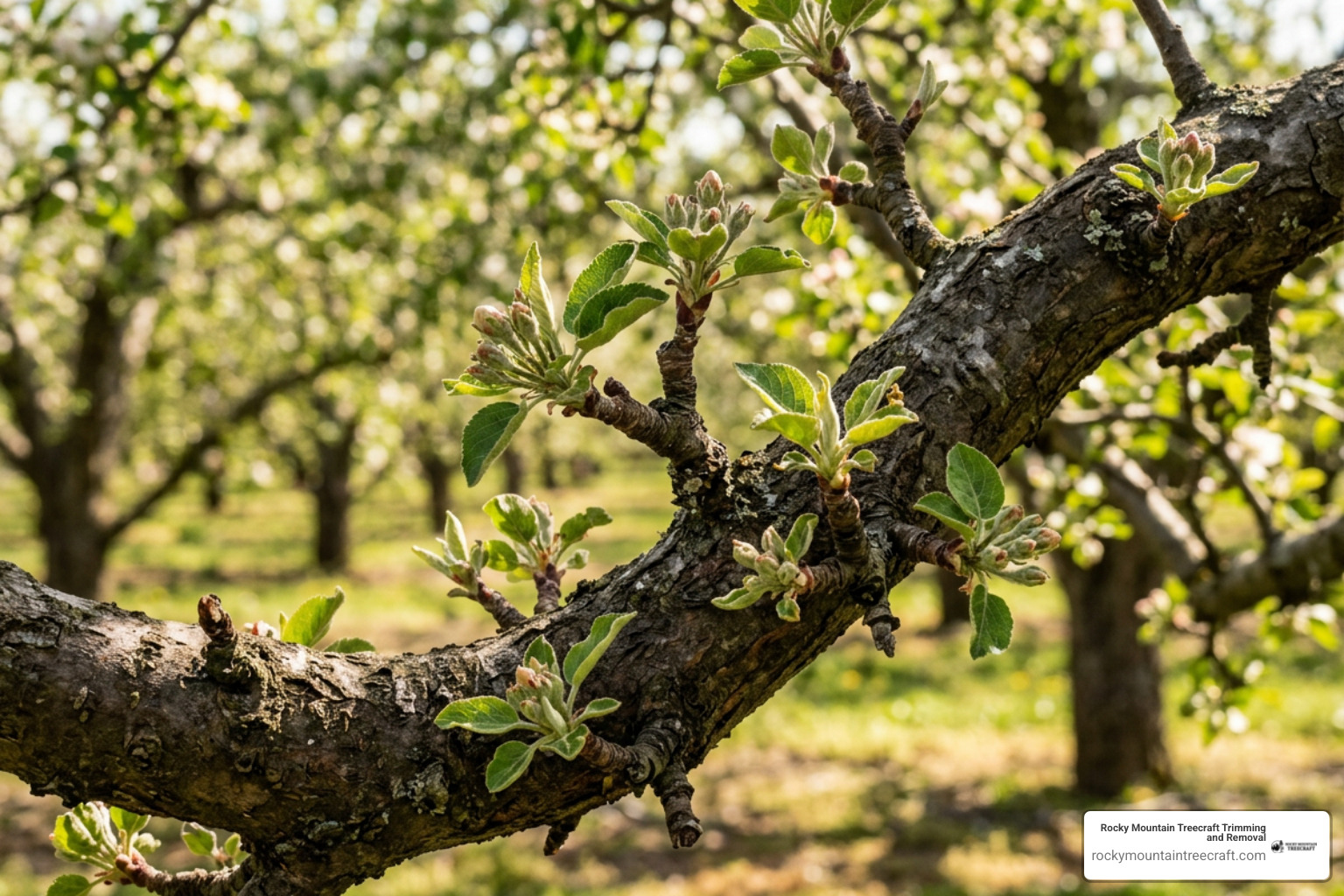
The Easiest Way to Learn How to Prune Apple Trees
Understanding Apple Tree Biology and Growth Habits
To prune apple trees effectively, prune during late winter dormancy using thinning cuts to remove dead or diseased branches, eliminate crossing limbs, open light channels into the canopy, and renew aging fruiting wood. Pruning requires working with the natural growth habits of the tree. Apple trees produce fruit on specific types of wood depending on their cultivar and rootstock. When you understand these growth patterns, you avoid cutting off next season's crop.
Most backyard apple varieties are spur-bearing. Spurs are short, stubby shoots that develop on wood that is two years old or older. These spurs produce flower clusters and bear fruit year after year. While an individual spur can live for 15 to 20 years, Illinois Extension research on fruit tree pruning techniques shows that their peak productive lifespan is roughly 8 to 10 years. After a decade, older spurs decline in vigor and produce smaller, lower-quality fruit, meaning you must gradually renew lateral branches over time.
Tip-bearing and partial tip-bearing cultivars behave differently. These varieties set flower buds primarily at the tips of shoots produced during the previous growing season. If you give a tip-bearing tree an aggressive haircut by heading back branch tips across the canopy, you will shear off the majority of your fruit buds for the coming year.
Cultivar Type Fruiting Location Typical Varieties Pruning Focus Spur-Bearing Short, stubby spurs on wood 2+ years old Honeycrisp, Gala, McIntosh, Red Delicious Thin crowded spurs to 6-8 inches apart; renew scaffold limbs every 8-10 years Tip-Bearing Tips of long shoots grown the previous year Cortland, Rome Beauty, Granny Smith Avoid shortening branch tips; use thinning cuts to manage density Partial Tip-Bearing Both short spurs and lateral shoot tips Jonathan, Fuji, Golden Delicious Balance spur spacing while retaining moderate terminal shoot growth
Sunlight interception directly drives both fruit quality and bud development. Foliage and developing fruit need at least 30 percent full sunlight to produce high sugar levels, strong color, and viable flower buds for the following season. Shaded interior zones quickly become barren wood.
Rootstock vigor also shapes your pruning strategy. Dwarf rootstocks (such as M.9 or G.41) produce trees that reach 8 to 10 feet tall, requiring minimal structural wood removal but needing permanent physical support. Semi-dwarf rootstocks (such as M.7 or MM.106) grow 12 to 16 feet high and balance manageable harvest heights with sturdy freestanding trunks. Standard rootstocks can easily surpass 20 to 30 feet, demanding wider spacing and more intensive ladder work to maintain light penetration throughout the inner canopy.
Optimal Pruning Timing, Tools, and Sanitation

Timing your cuts correctly protects trees from cold damage and disease pressure. In the Intermountain West, the ideal window for dormant pruning is late winter, typically from late February through late March. You want to prune when the coldest sub-zero winter temperatures have passed, but before buds swell and break dormancy in spring. Pruning during this window speeds wound closure as spring growth begins, while minimizing exposure to winter drying and freeze-thaw bark injury.
Using the right tool for the job ensures clean cuts that close smoothly without crushing wood fibers:
Bypass Hand Pruners: Ideal for small twigs and shoots up to 1/2 inch in diameter. Always use scissor-action bypass blades rather than anvil-style pruners, which crush tender bark.
Lopping Shears: Designed with 24-to-30-inch handles to provide leverage on branches between 1/2 inch and 1 inch thick.
Pull-Stroke Pruning Saws: Built with wide-set, razor-sharp teeth designed to cut live green wood on the pull stroke for branches exceeding 1 inch in diameter. Never substitute standard carpentry saws, which cut on the push stroke and bind in green wood.
Tool hygiene is critical when managing bacterial diseases such as fire blight (Erwinia amylovora). This pathogen enters through fresh wounds, flowers, and tender shoots during warm, wet spring weather. Because bacteria remain dormant when outdoor temperatures stay below 45 degrees Fahrenheit, winter pruning carries a very low transmission risk.
If you prune during early spring or remove summer strikes, sanitize your blades between cuts using 70 percent isopropyl alcohol or a 10 percent bleach solution. For broader orchard health guidelines, review these practical tree care tips.
Summer pruning serves a very specific, limited role. Use early summer to strip succulent water sprouts by hand while they are still green and under 6 inches long. Pulling them downward cleanly removes the basal latent buds, preventing the dense cluster of replacement sprouts that typically erupts when shoots are cut with shears during winter.
Essential Cutting Techniques and Step-by-Step Rules for How to Prune Apple Trees
Every pruning cut triggers a hormonal reaction in the tree. Terminal buds produce auxin, a growth hormone that travels downward to suppress dormant buds below. When you make a heading cut (chopping off the end of a shoot), you remove that auxin source, triggering three to five dormant buds immediately below the cut to erupt into vigorous, upright shoots. For this reason, heading cuts should be reserved almost entirely for young tree training.
Thinning cuts, on the other hand, remove an entire branch back to its point of origin on a parent limb or the trunk. Thinning cuts do not trigger localized shoot clusters, making them the preferred technique for roughly 80 percent of cuts on mature apple trees.
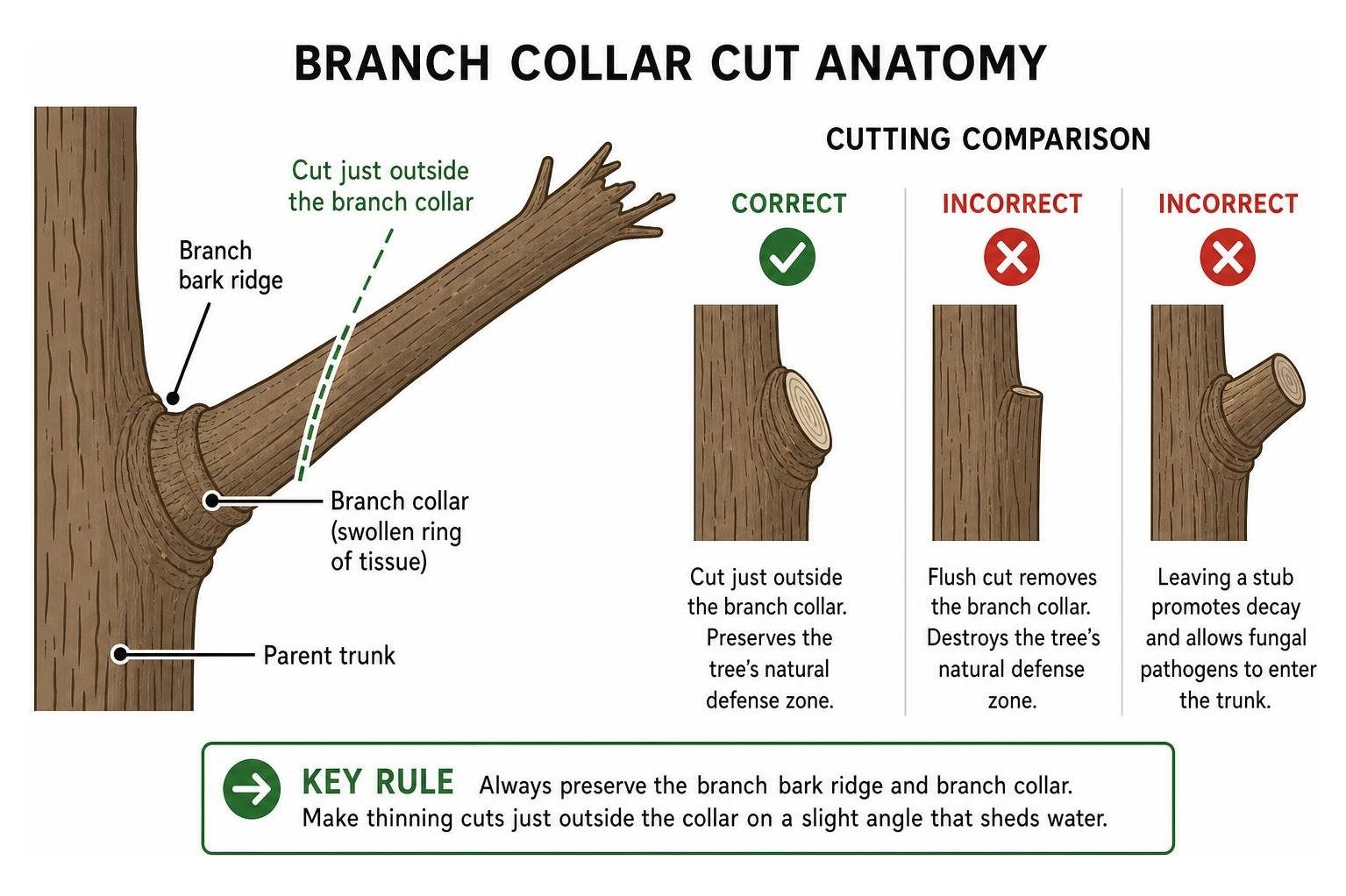
When making a thinning cut, always preserve the branch bark ridge and the branch collar, which is the swollen ring of specialized tissue at the base of the limb. Cut just outside the collar on a slight angle that sheds water. Avoid flush cuts that slice off the branch collar, as this destroys the tree's natural defense zone. Likewise, never leave protruding branch stubs, which decay and allow fungal pathogens to enter the trunk.
Branch orientation strongly dictates wood strength and fruiting capacity:
Vertical Branches (0 to 30 degrees): Direct energy into vegetative wood, produce minimal fruit, and create narrow crotches prone to bark inclusions and splitting under heavy snow or fruit loads.
Optimal Scaffold Branches (45 to 60 degrees): Provide strong mechanical support, slow vegetative growth, and stimulate steady flower bud initiation.
Horizontal or Downward Branches (90+ degrees): Produce weak vegetative growth, develop fruit that causes limbs to droop to the ground, and frequently trigger clusters of vertical water sprouts along their upper curve.
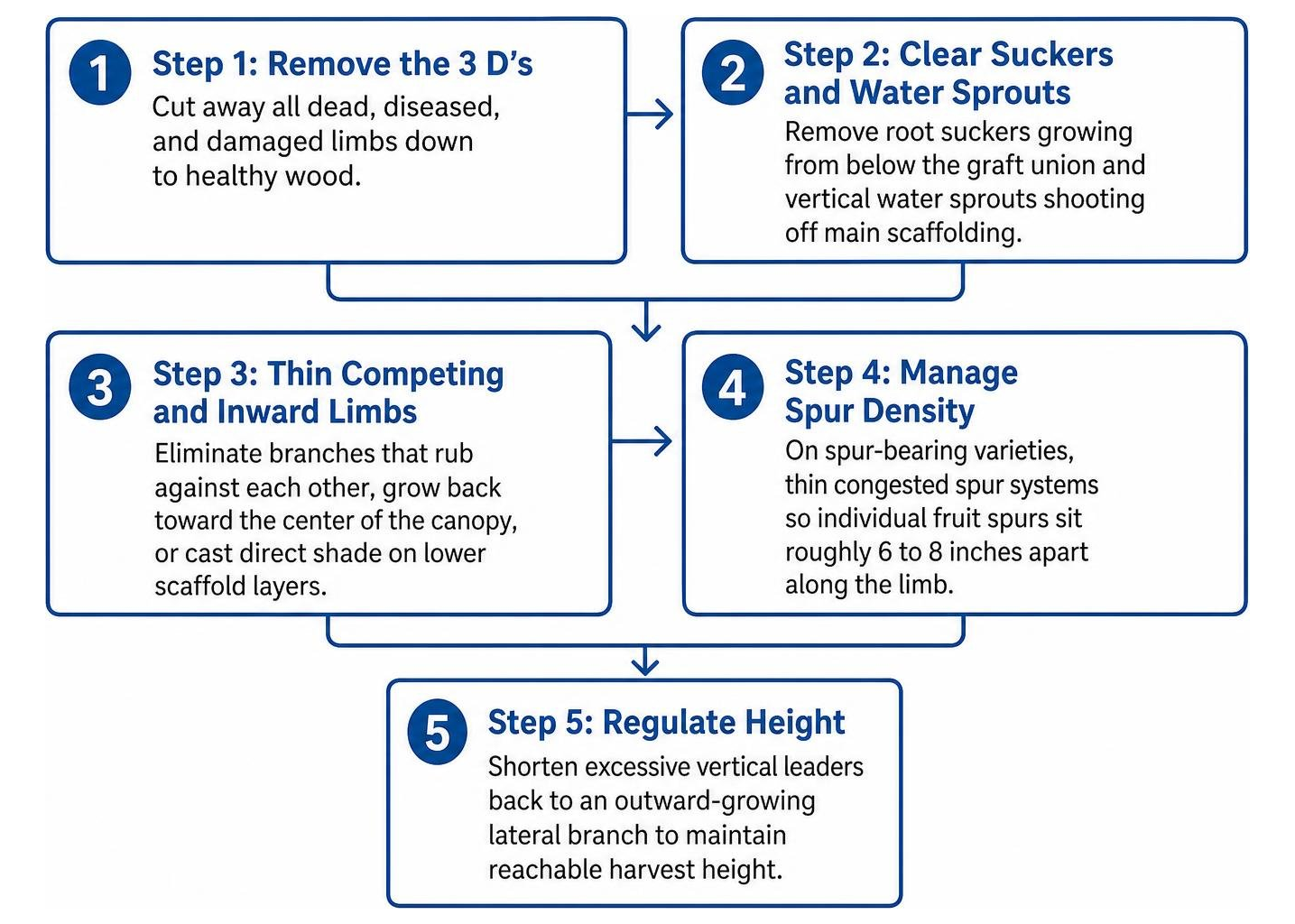
To maintain structural health, apply this reliable five-step sequence every dormant season:
Remove the 3 D's: Cut away all dead, diseased, and damaged limbs down to healthy wood.
Clear Suckers and Water Sprouts: Remove root suckers growing from below the graft union and vertical water sprouts shooting off main scaffolding.
Thin Competing and Inward Limbs: Eliminate branches that rub against each other, grow back toward the center of the canopy, or cast direct shade on lower scaffold layers.
Manage Spur Density: On spur-bearing varieties, thin congested spur systems so individual fruit spurs sit roughly 6 to 8 inches apart along the limb.
Regulate Height: Shorten excessive vertical leaders back to an outward-growing lateral branch to maintain reachable harvest height.
Detailed scientific practices are documented in Wisconsin Horticulture research on training apple trees.
How to Prune Apple Trees Using the Central Leader System
The central leader system trains an apple tree into a conical, pyramidal profile resembling a Christmas tree. This framework ensures maximum sunlight strikes both the upper and lower tiers of foliage.
When planting an unbranched whip, head the main stem back to 28 to 36 inches above the ground. This cut disrupts apical dominance and forces lateral buds to push shoots within the 18-to-24-inch zone below the cut, establishing your first layer of scaffold branches.
During the first growing season, select four or five well-spaced lateral shoots radiating outward around the trunk like spokes on a wheel. The lowest scaffold limb should clear the ground by at least 24 inches to accommodate maintenance and prevent fruit from touching soil. Lateral branches should have 4 to 6 inches of vertical space between them along the trunk.
Use spring-type wooden clothespins on tender green shoots under 6 inches long, or wooden spreader sticks on one-year-old wood, to guide these lateral branches into a 45-to-60-degree angle from the trunk. Defruit the central leader during years two through four; letting heavy fruit hang from the top stem bends the leader over, ruining the tree's structural symmetry.
In subsequent years, develop a second tier of scaffold branches 24 inches above the first tier. Keep upper branches shorter than lower limbs to prevent them from shading the bottom scaffolds. For regional training guidance, consult University of Minnesota Extension research on pruning and training apple trees.
Structural Maintenance for Bearing Apple Trees
Once an apple tree reaches maturity and begins bearing full crops, the focus transitions from shaping structural architecture to annual wood renewal and canopy maintenance. Lateral branches yield their highest volume and best quality fruit between their third and fifth years of growth. After five years, productivity declines.
Maintain a steady rotation of fruiting wood by pruning out older, declining lateral branches each year to make room for younger renewal shoots. Annual maintenance should remove 10 to 20 percent of the total canopy volume. Focus cuts on branches measuring 0.5 to 2 inches in diameter while preserving the conical outline of the tree. When trees grow beyond safe ladder height or develop structural hazards, property owners often benefit from expert tree trimming and pruning.
Canopy Management: Renovating Overgrown Trees and Preventing Biennial Bearing
Unmanaged apple trees develop dense, tangled canopies where outer shoots shade the interior, pushing all leaf and fruit production to the outer tips. Restoring these trees requires balanced canopy reduction to improve airflow and light penetration without sunburning exposed trunk bark.
Biennial bearing is another common issue, where a tree yields an enormous crop of tiny apples one year, followed by zero fruit the next. This cycle is driven by plant hormones: seeds in developing apples produce gibberellins, which travel into nearby buds and chemically suppress the formation of next year's flower buds.
To break this hormonal cycle, practice early fruit thinning:
Time the Thinning Window: Thin young apples within 20 to 40 days after full bloom, when fruitlets are marble-sized (typically June).
Identify the King Bloom: In each cluster of five blossoms, retain the large, central "king blossom" fruitlet and remove the weaker surrounding side fruitlets.
Establish Spacing: Thin individual apples along each branch until they sit 6 to 8 inches apart.
Proper fruit thinning prevents limb breakage under heavy harvest loads, maximizes individual apple size, and ensures consistent annual flower bud initiation. If you are unsure whether poor yield stems from nutrition, pests, or improper pruning, schedule a comprehensive tree health assessment.
How to Prune Apple Trees That Are Overgrown or Neglected

Restoring an overgrown or neglected apple tree requires patience. Never attempt to reclaim an old tree in a single afternoon. Removing too much wood in one year shocks the root system and triggers an explosion of thousands of vigorous, non-fruiting water sprouts throughout the canopy.
Spread the restoration over a disciplined three-year renovation plan:
Year One (Structure and Safety): Remove all dead, rotted, and broken limbs. Lower the overall tree height by making one or two strategic thinning cuts back to strong, outward-growing lateral limbs. Cap total canopy removal at 25 to 30 percent.
Year Two (Interior Light Penetration): Open the center of the tree by cutting out large competing branches that cast heavy shade. Remove downward-hanging wood and select strong, well-angled shoots to serve as future scaffold branches. Strip summer water sprouts while green.
Year Three (Fine-Tuning and Spur Spacing): Thin out congested spur clusters, space remaining branches, and establish a balanced, open framework that allows sunlight to reach the lower canopy.
When tackling mature, overgrown trees with heavy, compromised limbs, partnering with specialized residential tree services ensures large branches are lowered safely without damaging property or tearing trunk wood.
Frequently Asked Questions About Pruning Apple Trees
Can I prune apple trees in the autumn or early winter?
No. Avoid pruning apple trees during autumn or early winter. Autumn cuts stimulate lingering cambial activity and prevent the tree from entering full winter dormancy. Fresh pruning wounds exposed to early hard freezes can suffer cold injury and severe bark dieback around the cut. Always wait until late winter when the coldest freeze events have passed.
How much canopy wood can be safely removed in a single season?
On a healthy, well-maintained tree, aim to remove 10 to 20 percent of the canopy each year. On neglected or severely overgrown trees undergoing multi-year renovation, never exceed 25 to 30 percent (or roughly one-third) of total live canopy wood in a single season. Dead, diseased, and dry wood does not count toward this limit and can be removed at any time.
Do pruning cuts on apple trees need to be sealed with wound paint?
No. Modern arboricultural research confirms that wound sealants, tar, and pruning paints do not prevent decay or speed recovery. In fact, these products trap moisture and fungal spores against the raw wood, creating conditions that foster rot. Apple trees naturally seal wounds through compartmentalization (forming specialized boundary layers). Make clean cuts outside the branch collar and allow the tree to close naturally.
Keep Your Orchard Thriving with Local Tree Expertise
Pruning apple trees correctly balances structural strength, sunlight penetration, and fruiting wood renewal. By using late-winter thinning cuts, establishing sturdy 60-degree scaffold limbs, and thinning heavy spring fruit sets, your trees will yield bountiful, reachable harvests every year.
For homeowners and property managers throughout Heber City, the Heber Valley, and Wasatch County, managing mature trees, steep terrain, and winter storm recovery often requires professional care. Whether you need help diagnosing fruit tree health issues, managing canopy density, or handling hazardous limbs, we are here to support your landscape. Contact Rocky Mountain Treecraft today to request an estimate or schedule professional tree trimming.