
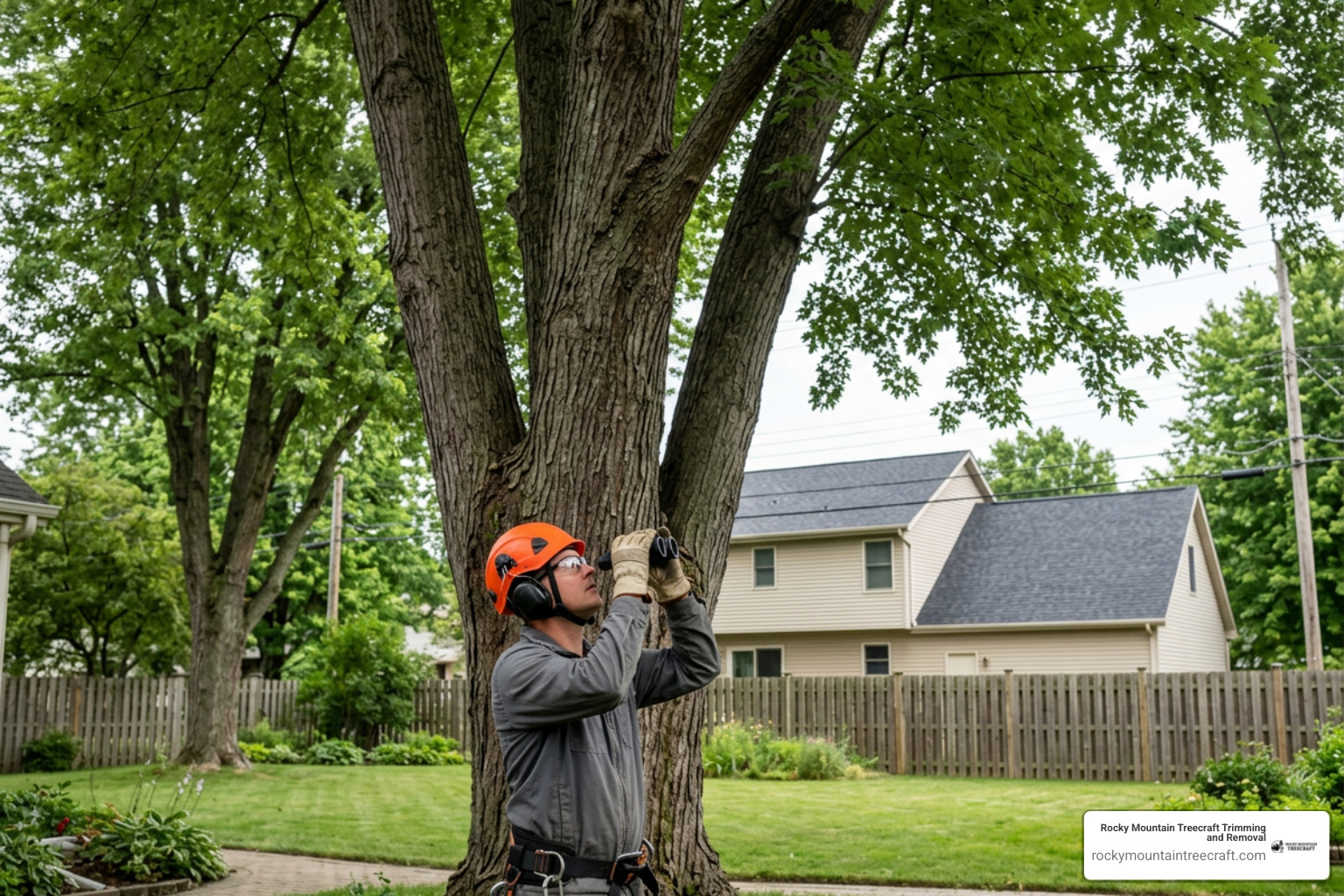
The Cheapest Ways to Assess Safety and Cost for Pruning Large Trees
Evaluating Safety and Cost Before Pruning Large Trees
When evaluating a mature tree on your property, taking time to review health, structure, and location factors prevents unnecessary expenses and keeps your yard safe. The primary cost drivers in pruning large trees include tree height, overall canopy density, proximity to structures, and special access requirements. A tree located on a gentle slope near a driveway requires much less specialized rigging than a tall pine nestled between a house and a power line on steep mountain terrain.
To evaluate safety and costs effectively, focus on these primary considerations:
Location and Clearance: Does the tree overhang home structures, utility lines, or neighboring properties?
Tree Size and Canopy Density: How tall is the tree, and how heavy are the branches that need trimming?
Structural Health: Are there signs of interior rot, hollow trunks, fungal growth, or split branch unions?
Equipment Access: Can aerial lifts or chippers reach the tree easily, or will manual climbing and drop zones be required?
Performing a regular Tree Health Assessment allows you to catch minor structural defects before they require high-cost technical operations or emergency hazard removal.
Essential Safety Factors for Pruning Large Trees
Working on large trees involves inherent risks that every homeowner must respect. Falling from heights, contact with overhead power lines, and unexpected limb movement cause serious injuries every year.
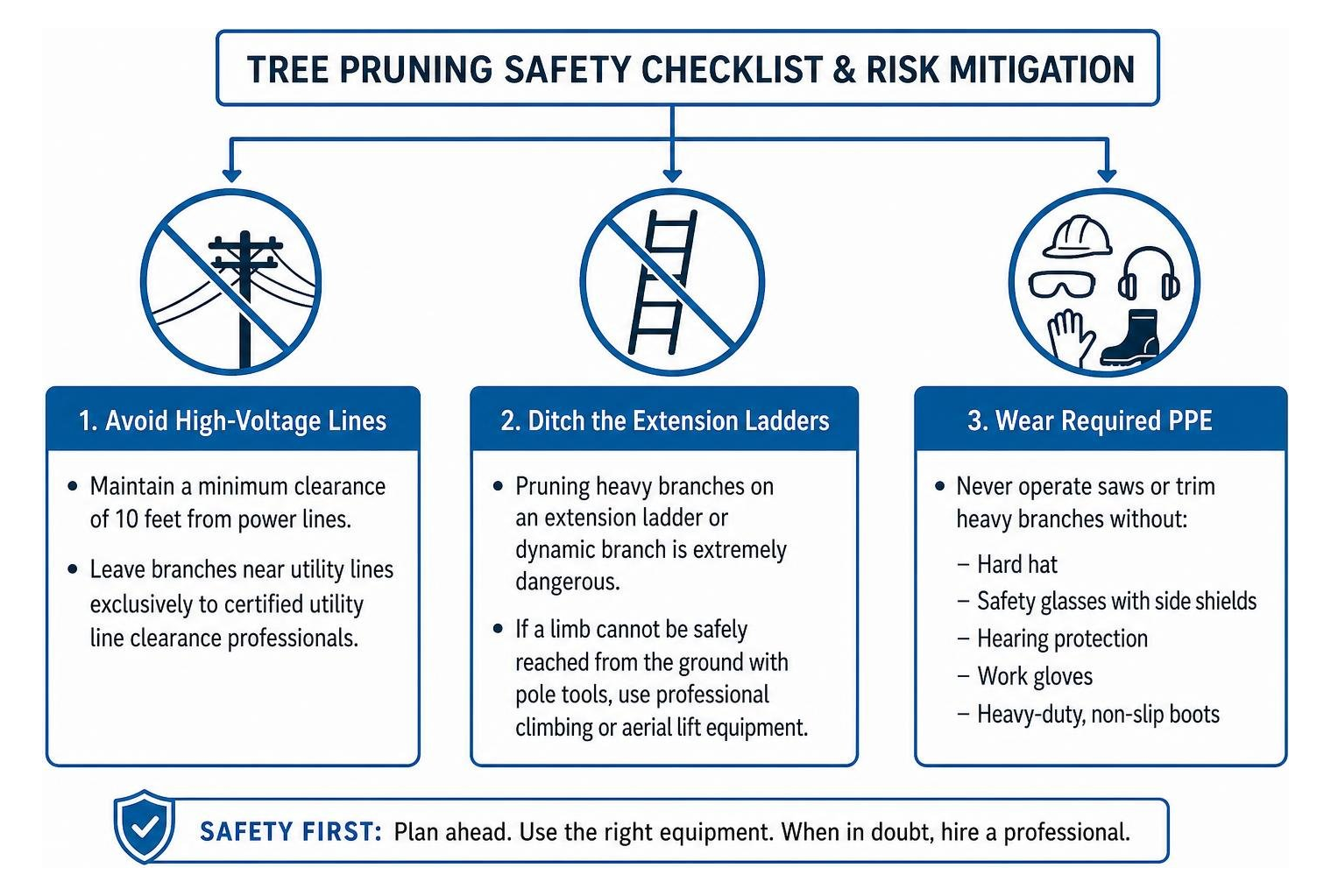
Safety must always come first. Review these essential safety rules before beginning any work:
Avoid High-Voltage Lines: Always maintain a minimum clearance of 10 feet from power lines. Leave branches near utility lines exclusively to certified utility line clearance professionals.
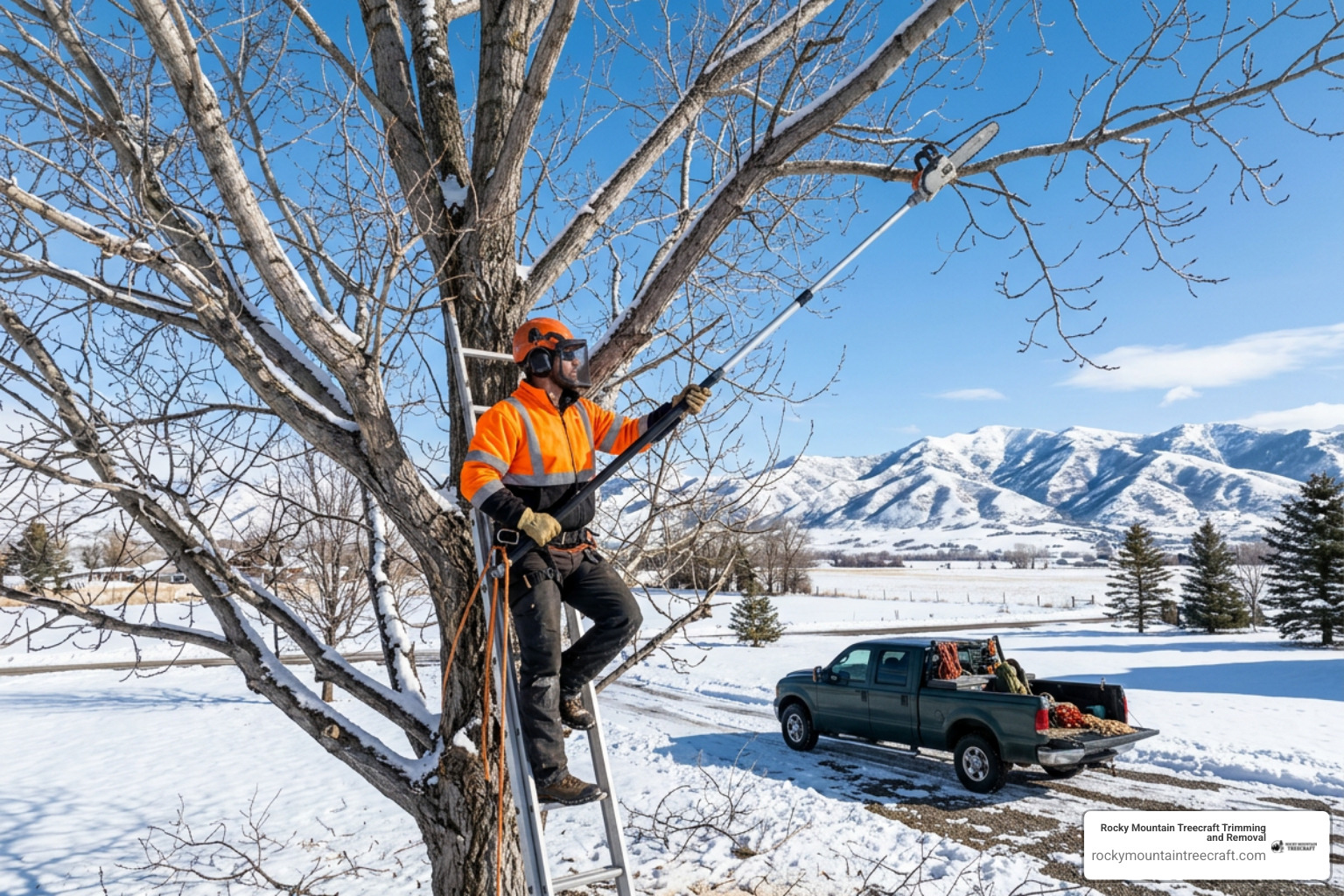
Ditch the Extension Ladders: Pruning heavy branches while standing on an extension ladder or dynamic branch is extremely dangerous. If a limb cannot be safely reached from the ground with pole tools, professional climbing or aerial lift equipment is required.
Wear Required Personal Protective Equipment (PPE): Never operate saws or trim heavy branches without a hard hat, safety glasses with side shields, hearing protection, work gloves, and heavy-duty, non-slip boots.
Establish a Drop Zone: Keep bystanders, pets, and vehicles well outside the drop radius of falling branches. Heavy limbs bounce and twist unpredictably upon impact.
Evaluating Canopy Health and When Pruning Is Unnecessary
A common misconception among property owners is that mature trees require routine, aggressive canopy thinning every year to "let the air blow through." In reality, healthy green leaves serve as the tree's sole solar panels, manufacturing energy and storing vital carbohydrate reserves needed for winter survival and root maintenance.
Routine canopy thinning is generally unnecessary and can actually starve a tree, triggering stress sprouts and exposing tender inner bark to sunscald. Deadwood that does not pose an active safety risk to people or structures can often be left untouched in natural or low-traffic areas, providing valuable habitat for nesting birds and local wildlife.
Ideal Timing and Seasonal Guidelines
Timing your pruning properly minimizes tree stress, reduces sap loss, and protects against destructive pests and fungal pathogens. For most deciduous trees in Wasatch County, the ideal window for major structural trimming opens during winter dormancy. Reviewing the USU Extension Landscape Tree Pruning Guide and establishing solid baseline Tree Care Tips will keep your landscape healthy through changing seasons.
Seasonal Rules for Pruning Large Trees
The natural cycle of a tree dictates when cuts heal fastest and cause the least amount of biological disruption.
Late Fall through Early Spring (Winter Dormancy): This is the ideal window for structural pruning. Trees are fully dormant, leaf canopy is clear so structural branch architecture is easy to inspect, and wound closure begins immediately when spring growth starts.
Late Summer (August and September): Avoid heavy pruning during late summer. Trimming at this time stimulates delicate late-season growth flushes that fail to harden off before early autumn freezes in Heber Valley.
Early Spring (Growth Flush): Avoid heavy live-foliage trimming right after spring bud break. The tree has just drawn down its stored carbohydrate reserves to produce new leaves and needs that foliage to rebuild energy.
Species Exceptions: Oaks, Elms, and Bleeder Trees
Certain tree species require strict seasonal adjustments due to infectious disease vectors or heavy sap movement.
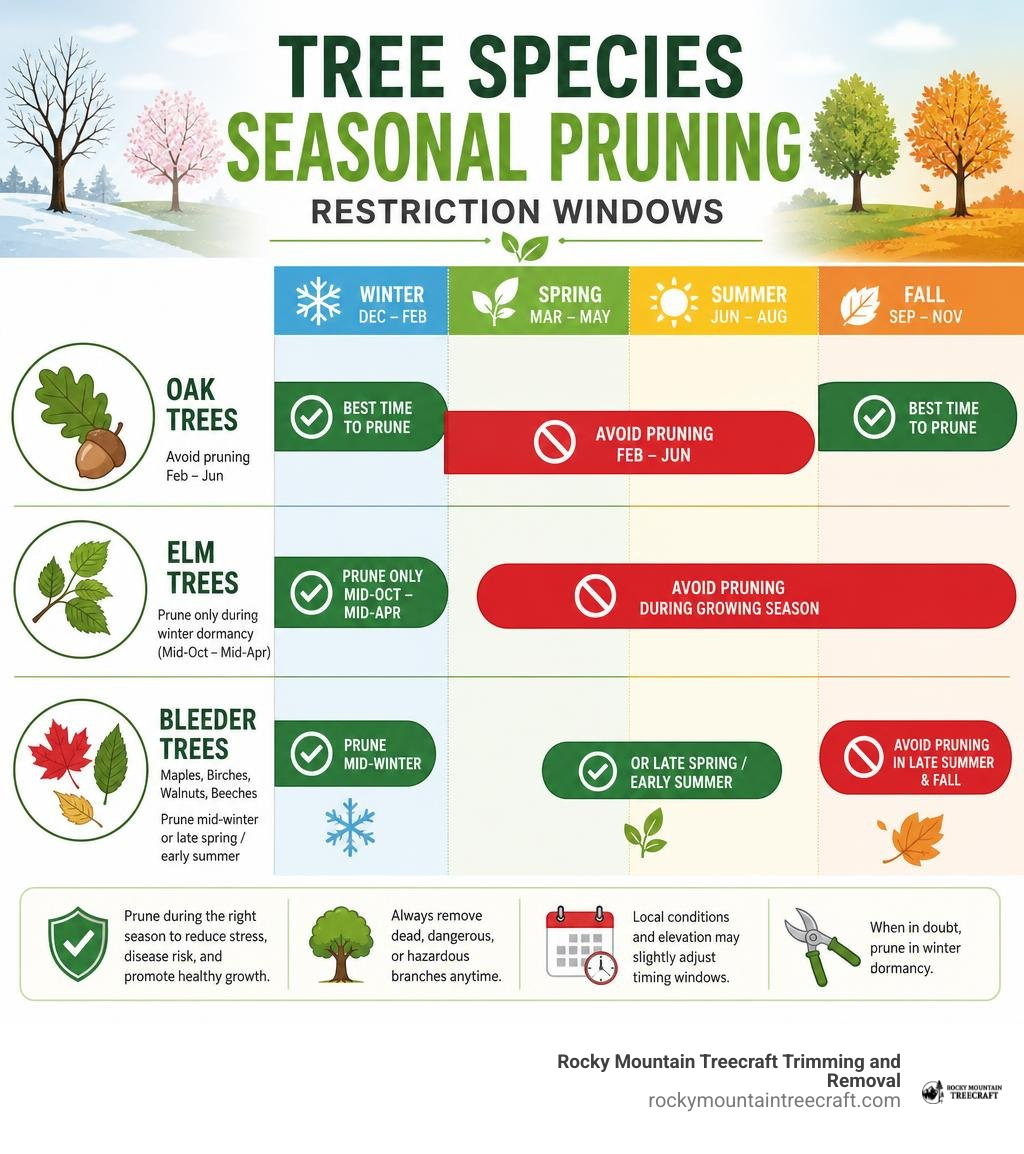
Oak Trees: Do not prune oak trees from February through June (and ideally keep oak trimming confined to late fall and winter). Fresh spring pruning cuts release chemical odors that attract beetle vectors carrying oak wilt, a fatal fungal pathogen.
Elm Trees: Elms should strictly be pruned during winter dormancy (traditionally between mid-October and mid-April). Open cuts during the growing season attract elm bark beetles, which transmit Dutch elm disease.
Bleeder Trees: Trees such as maples, birches, walnuts, and beeches experience heavy sap flow ("bleeding") if pruned in late winter or early spring. While sap flow is generally not fatal to the tree, it can look alarming. To minimize sap bleeding, prune these species in mid-winter or wait until late spring/early summer after their leaves have fully expanded.
Proper Cutting Techniques and Structural Corrections
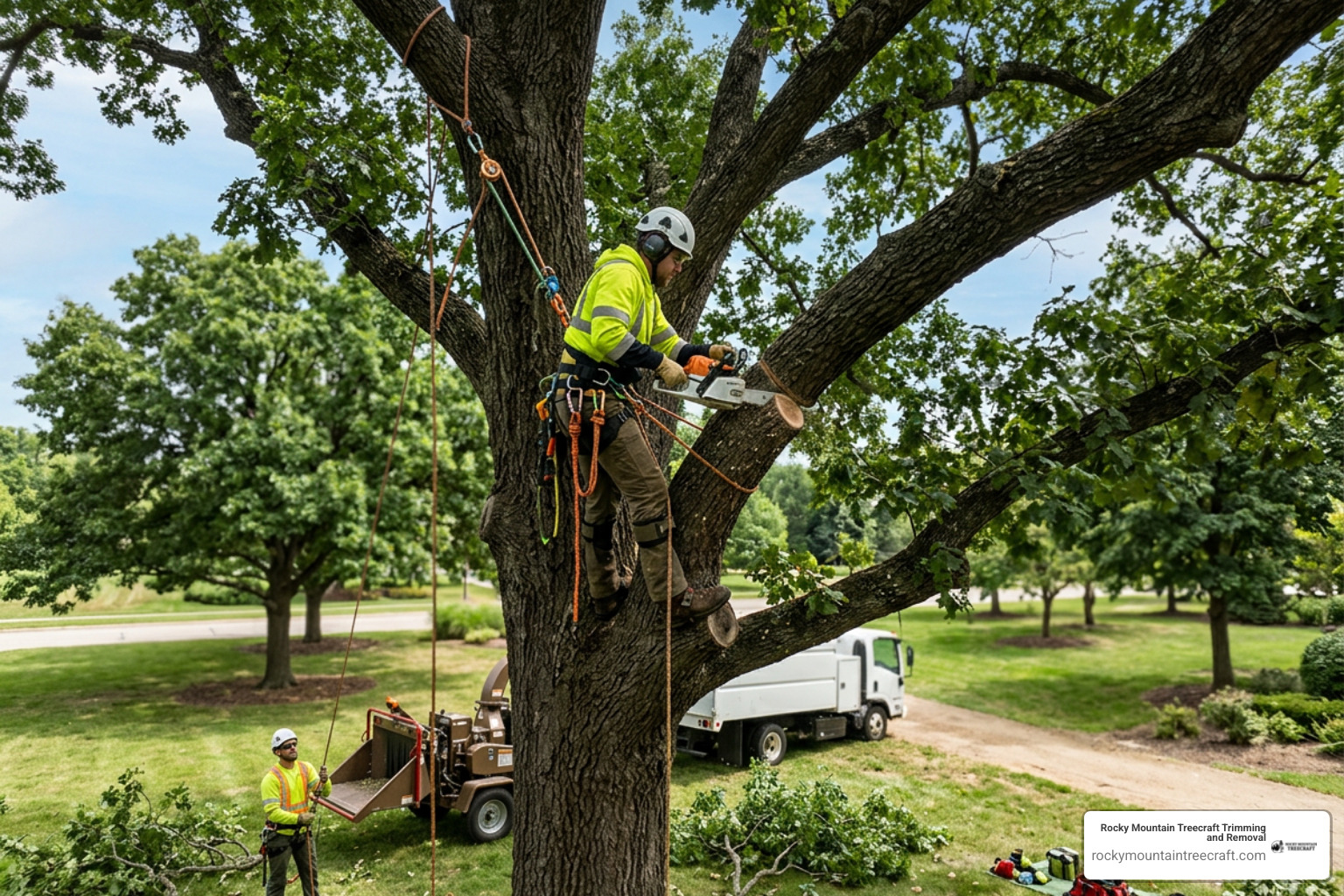
Executing proper pruning cuts preserves the tree's natural defense barriers and encourages rapid wound closure. Poorly executed flush cuts or stub cuts create entry points for wood decay fungi, leading to long-term structural weakness. For extensive structural care, rely on established Residential Tree Services to protect your property's long-term value.
The Three-Cut Method for Heavy Limb Removal
Removing a heavy tree branch with a single top cut almost always results in disaster. As the limb weakens, its weight causes the branch to snap and tear long strips of bark down the trunk, creating severe, unrecoverable trunk wounds.
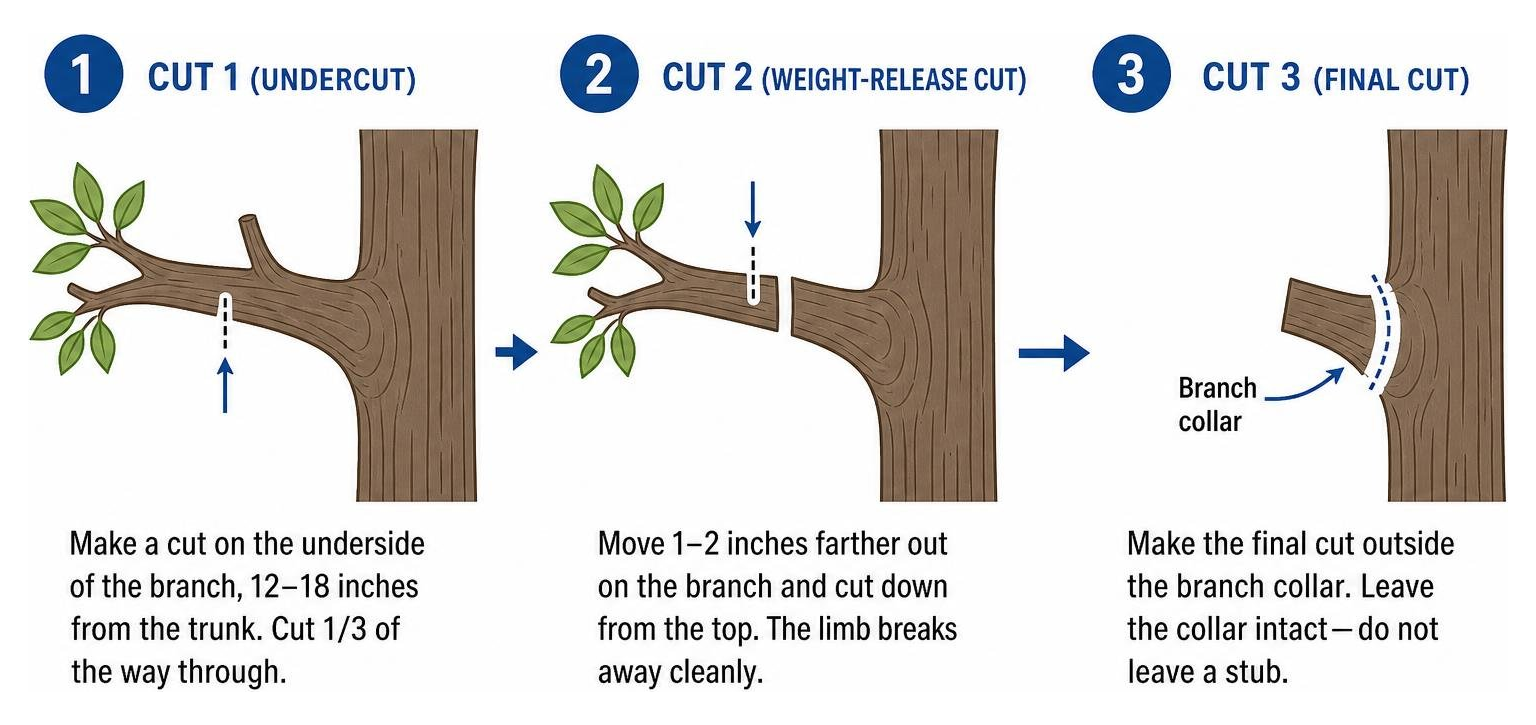
Always use the three-cut method whenever removing branches larger than one inch in diameter:
Cut 1 (Undercut): Make a clean cut on the underside of the branch, about 12 to 18 inches away from the trunk collar. Cut roughly one-third (1/3) of the way through the branch thickness.
Cut 2 (Weight-Release Cut): Move an inch or two further out on the branch away from the trunk and cut down from the top. As you cut, the limb's weight will cause it to snap cleanly between the two cuts without tearing bark down the main trunk.
Cut 3 (Final Cut): Locate the swollen branch collar—the raised ring of bark tissue where the limb joins the trunk. Make a clean final cut directly outside the branch collar, leaving the collar intact without creating a long stub.
Cut Type | Cut Location | Biological Impact | Wound Closure Speed |
|---|---|---|---|
Branch Collar Cut (Correct) | Just outside the natural swollen branch collar | Preserves trunk protection zone and defense chemicals | Rapid natural callus formation |
Flush Cut (Incorrect) | Flat against the main tree trunk | Destroys trunk defense barrier, causing internal trunk decay | Extremely slow, often leaves open hollows |
Stub Cut (Incorrect) | Inches away from branch collar leaving a long stub | Prevents callus growth, leaving dead wood for fungal entry | Fails to close until dead stub rots off |
Correcting Structural Faults, Topping Risks, and Lion's Tailing
Addressing structural faults in mature trees requires patience and accurate branch ratio management.
Codominant Stems and Included Bark
When a tree grows with two or more main stems of similar size arising from a single union, it forms "codominant stems." As these stems expand, bark becomes trapped between them (included bark), creating a weak, unstable point vulnerable to splitting during heavy winter snow or windstorms. Correcting codominant stems larger than 6 inches in diameter should never involve cutting off an entire leader in one single cut, as leaving a massive trunk wound invites decay. Instead, prune secondary lateral branches on one stem over several seasons to suppress its growth and allow the other stem to assume primary dominance. When a large, hazardous split or weak union exists in a mature shade tree, qualified tree-care professionals can evaluate whether install cables or braces can offer supplemental structural support without removing major canopy sections.
The 1/3 Lateral Branch Rule
When shortening a branch or leader, always cut back to a lateral branch that is at least one-third (1/3) the diameter of the branch being removed. This lateral branch must be large enough to assume terminal dominance and draw photosynthetic energy to sustain the remaining limb.
The Dangers of Tree Topping
Topping involves cutting major tree leaders back to arbitrary stubs. Topping is an obsolete, highly destructive practice that should never be performed. It starves the tree of energy reserves, opens massive wounds to wood decay organisms, and triggers a dense cluster of weakly attached sprouts (epicormic growth) that break off easily during high winds.
Hazards of Lion's Tailing
Lion's tailing is the improper practice of stripping inner leaves and lateral branches off a limb, leaving foliage only at the far branch tip. This shifts heavy leverage to the tip, making the long, bare limb prone to breaking under wind stress or snow loads.
Managing Canopy Limits, Storm Recovery, and Wound Dressings
Maintaining balance between canopy reduction and biological recovery ensures trees remain vigorous. If an emergency leaves a mature tree leaning, split, or hazardous, contact our team for Hazardous Tree Removal to secure your property safely.
Crown Reduction Limits and Wound Sealer Misconceptions
To prevent severe physiological stress, follow these strict limits on live canopy removal:
The 20–25% Crown Rule: Never remove more than 20% to 25% of a mature tree's total living canopy during a single pruning cycle. Excessive canopy removal starves root systems and forces the tree into emergency stress sprouting.
Wound Paints and Sealers: Decades of scientific research prove that traditional wound dressings, tree paints, and tar coatings are unnecessary and often harmful. They trap moisture against open cuts, creating ideal environments for fungal decay spores. Trees naturally heal through a process called compartmentalization, forming protective callus tissue over clean cuts. The only exception is applying wound paint immediately after emergency cutting on oak trees during high-risk spring months to prevent oak wilt beetle attraction.
Restoring Storm-Damaged Trees
Heavy mountain snow loads and sudden freeze-thaw events in Wasatch County often snap large leaders and break branch attachments.
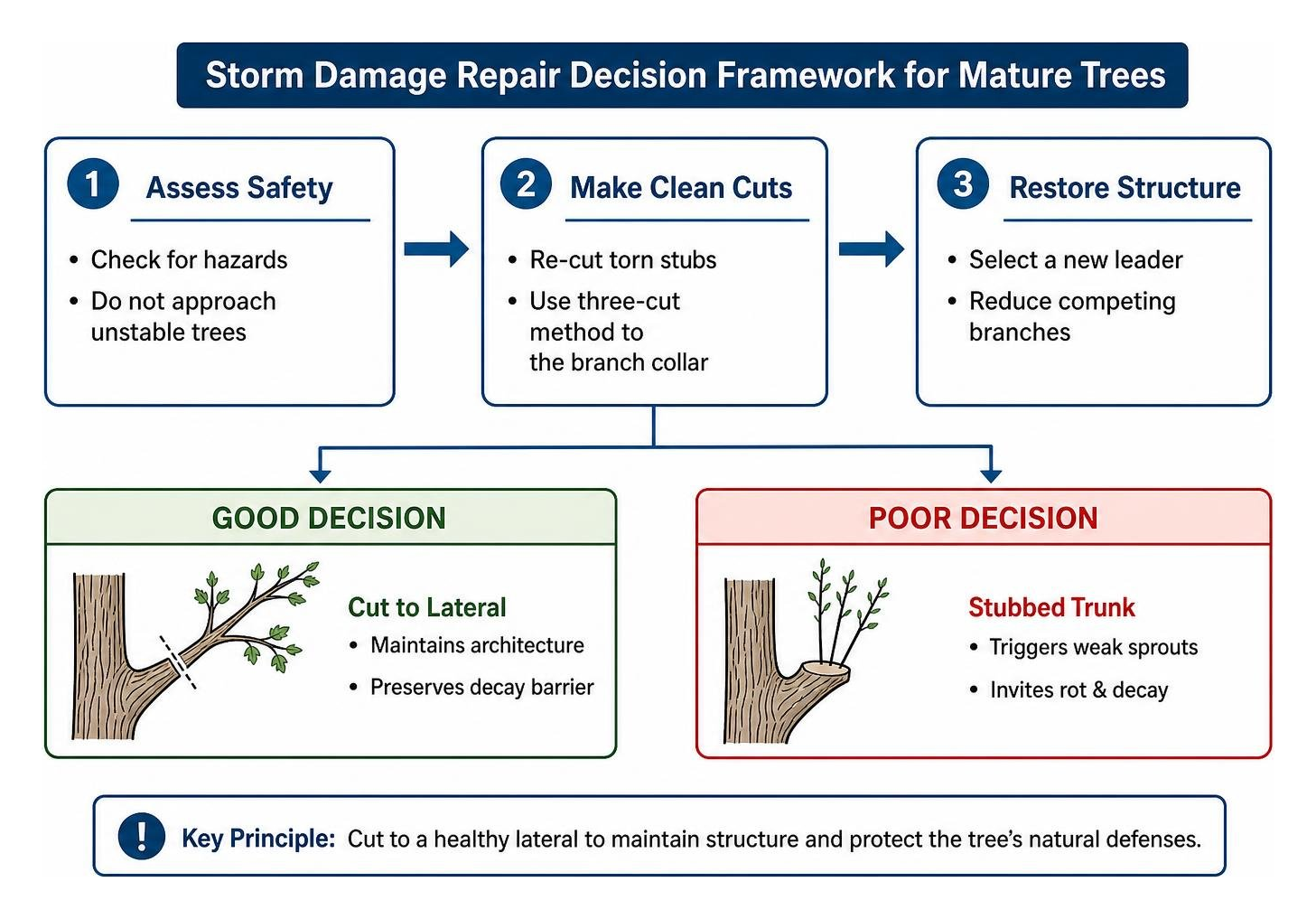
When restoring storm-damaged mature trees, follow these recovery steps:
Safety First: Never approach partially uprooted trees, suspended limbs ("hangers"), or trees touching power lines. Have a professional tree-care company evaluate structural hazards on-site.
Clean up Torn Bark: Cleanly re-cut jagged, broken branch stubs back to the nearest branch collar using the three-cut method to stop decay from spreading into healthy wood.
Preserve Main Leaders: If a main top leader snaps, select an upright lateral branch to serve as the new dominant leader, trimming competing surrounding branches back slightly to favor its growth.
Plan Multi-Year Recovery: Never attempt to fix severe storm damage in a single aggressive pruning session. Spread structural pruning cuts across two to three years to avoid depleting stored energy reserves.
DIY Safety Limits vs. Professional Arborist Services
Knowing your equipment limits saves money and prevents serious structural accidents. Homeowners can comfortably perform light maintenance trimming from the ground using bypass hand pruners for twigs under 1 inch, pole saws for limbs up to 4 inches, and sharp hand saws.
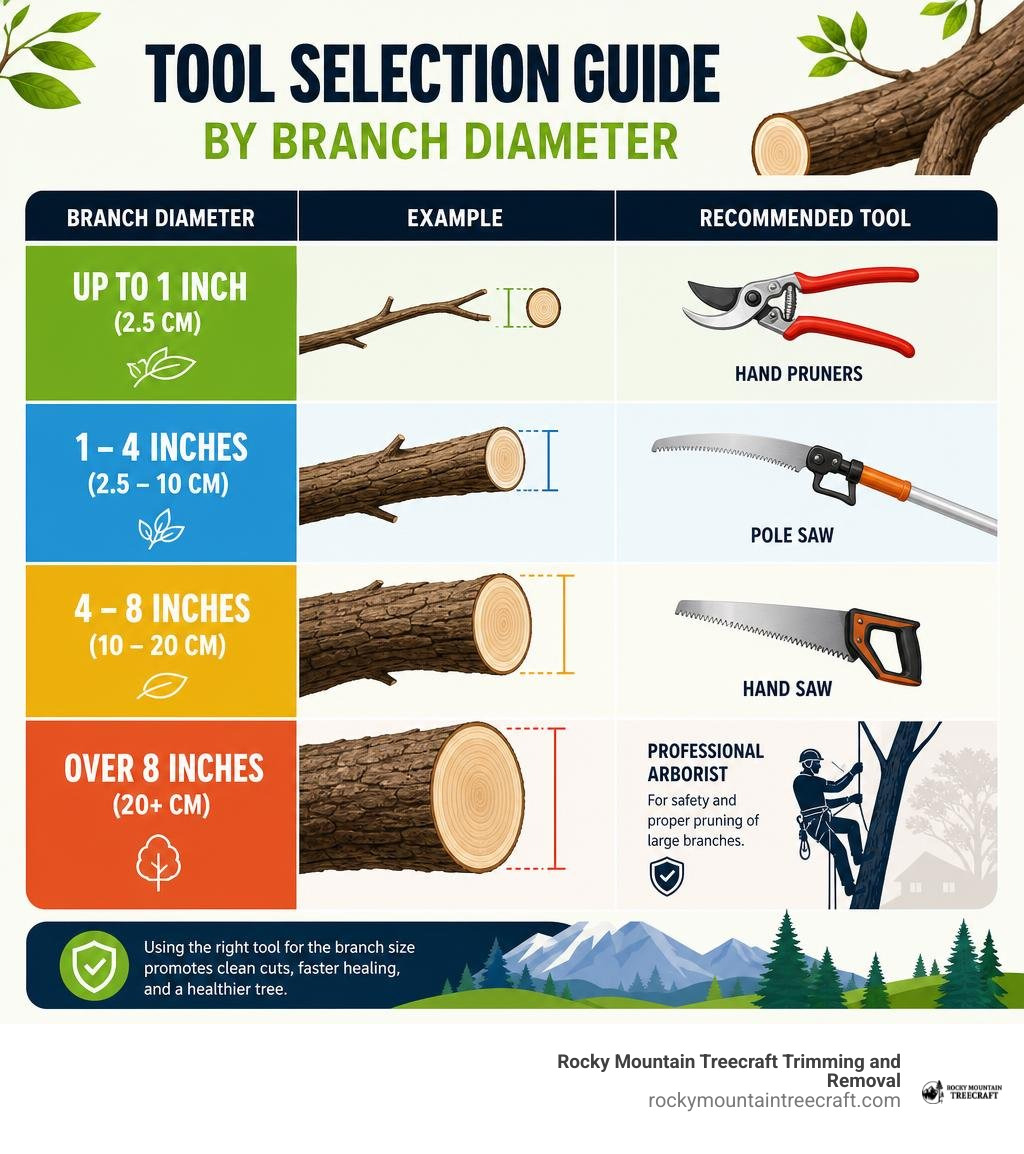
However, when pruning large trees requires climbing off the ground, operating heavy power equipment overhead, or working near property structures, hiring a professional service is the safest, most cost-effective choice.
Call a professional tree service when:
Branches are directly adjacent to high-voltage utility cables or power lines.
Large branches extend over roofs, decks, garage structures, or public walkways.
The tree shows extensive trunk hollows, large vertical cracks, or fungal fruiting bodies.
Heavy rigging, ropes, aerial lifts, or commercial chainsaws are needed to drop large limbs safely.
At Rocky Mountain Treecraft Trimming and Removal, we offer comprehensive options tailored to property needs, ranging from routine structural trimming to full Commercial Tree Services.
Frequently Asked Questions
How much does it cost to prune a mature tree safely?
Costs vary widely depending on tree height, location access, limb density, and proximity to buildings or power lines. Small ground-based trimming jobs cost significantly less, while large, technical pruning projects requiring aerial equipment or rigging fall into higher price ranges. Requesting a professional evaluation provides an accurate, site-specific estimate.
When is the best time of year to trim large landscape trees?
For most deciduous landscape trees in Utah, the dormant winter season (late fall through early spring) is ideal. Winter trimming allows clear visibility of structural branch unions, minimizes sap loss, and promotes rapid wound closure when spring growth arrives.
Why should you avoid painting or sealing pruning cuts?
Pruning sealers and paints trap moisture inside the wood, accelerating decay and fungal growth. Trees heal naturally by expanding protective callus tissue over cleanly cut branch collars. Except for emergency spring cuts on oak trees to guard against oak wilt, leave pruning cuts open to heal naturally.
Restoring Safety and Health to Your Mature Trees
Pruning large trees safely requires understanding tree biology, practicing correct three-cut techniques, and recognizing personal equipment limits. By performing selective pruning during winter dormancy, respecting canopy limits, and avoiding harmful practices like topping or flush cutting, you can preserve your landscape trees for decades to come.
When tree projects involve high overhead limbs, mountain terrain access, or structural hazard risks in Heber City, Heber Valley, or Wasatch County, our locally-based team at Rocky Mountain Treecraft Trimming and Removal is ready to help. Explore our full range of professional services on our Tree Trimming page, or contact us today to schedule an on-site health assessment and request a free project estimate!