
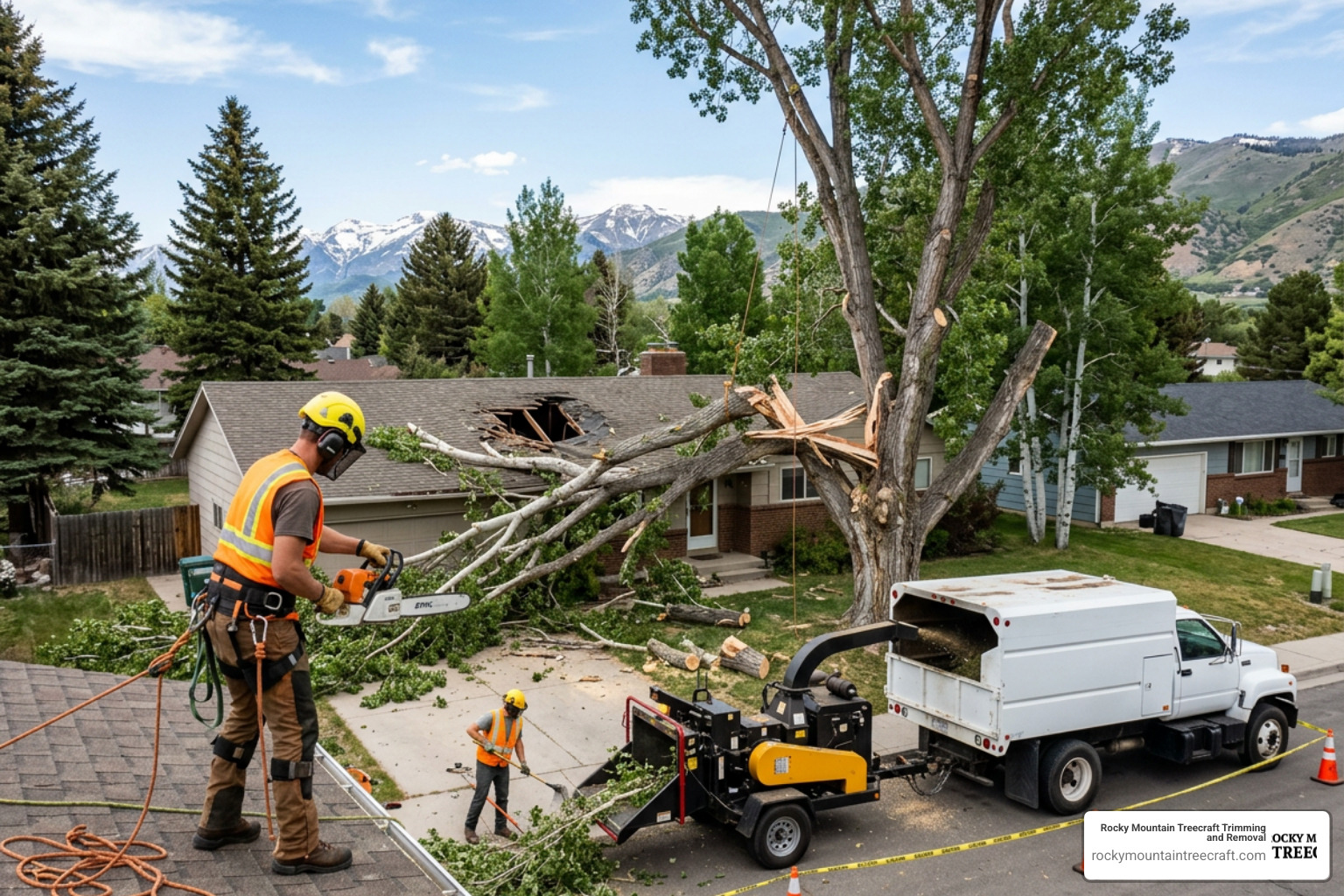
Fast and Reliable Storm Damage Tree Removal in Heber City and Beyond
When a Storm Hits Hideout, UT — Here's What You Need to Know
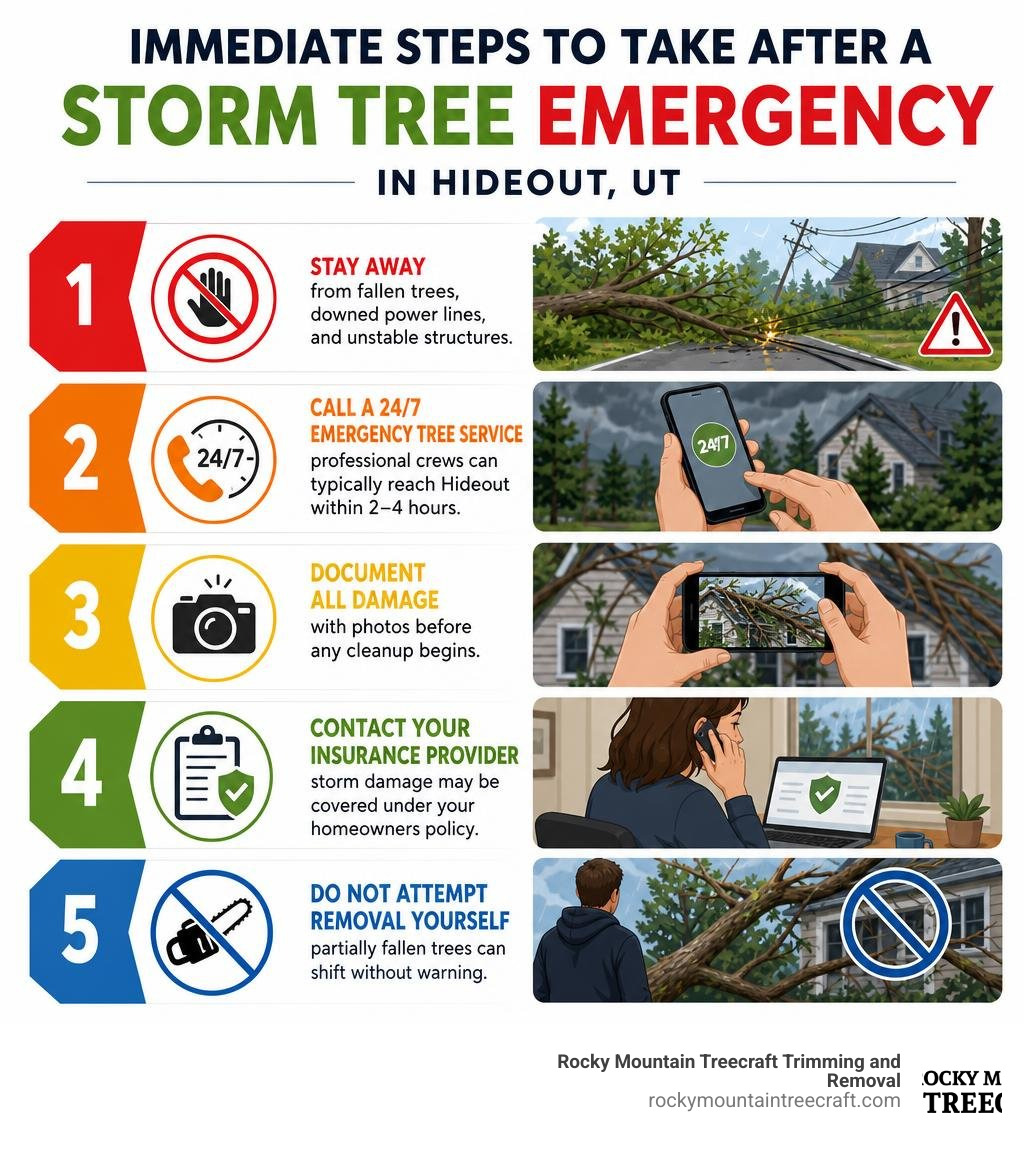
If you need emergency tree service in Hideout UT, here are the most important things to do right now:
Stay away from fallen trees, downed power lines, and unstable structures
Call a 24/7 emergency tree service — professional crews can typically reach Hideout within 2–4 hours
Document all damage with photos before any cleanup begins
Contact your insurance provider — storm damage may be covered under your homeowners policy
Do not attempt removal yourself — partially fallen trees can shift without warning
Hideout, UT sits in the heart of Wasatch County, where the weather doesn't play nice. Heavy winter snowpack, ice storms, and sudden summer windstorms put serious stress on trees year-round. When a large limb cracks or a whole tree comes down, it can happen fast — and the consequences for your home, your family, and your property can be severe.
The danger doesn't always wait for business hours.
That's why knowing who to call — and what to do in the first few minutes — can make a real difference. Whether a storm just rolled through or you've spotted a tree that looks like it's about to go, this guide walks you through exactly what to do and what to expect from a professional emergency response.
When to Call an Emergency Tree Service Hideout UT

Knowing when a situation transitions from a "we should take care of that next spring" chore to an absolute "call right now" crisis is key to protecting your household. A true tree emergency is defined as any situation where a tree or its components pose an immediate, verifiable threat to human life, personal property, public infrastructure, or essential utilities.
If a massive Douglas fir is resting on your roofline, or a mature box elder has split down the middle and is hovering over your driveway, you are looking at an active emergency. These situations require rapid hazard assessment and immediate intervention to prevent structural failure or severe injury.
To help you quickly evaluate your property, we have put together a comparison table of hazardous versus non-hazardous tree conditions:
Condition / Part Active Emergency (Call Us Immediately!) Non-Emergency (Schedule Regular Maintenance) Trunk Stability Tree is actively uprooting, soil is lifting at the base, or the trunk has fresh, deep splits. Tree has a slight, historical lean but the root plate is completely stable and undisturbed. Power Line Proximity Broken limbs are resting directly on power lines or spark-inducing branches. Branches are growing near lines but not touching them (requires standard pruning). Branch Integrity Large, heavy limbs have cracked and are hanging precariously over high-traffic areas. Dead branches are present in the inner canopy but are not structurally cracked or hanging. Structural Failures The tree is structurally compromised, leaning heavily on a home, garage, or vehicle. The tree has lost some leaves due to seasonal changes or minor, non-structural storm debris.
If you spot any of the conditions in the "Active Emergency" column, do not wait. You should immediately reach out to our team for a professional Emergency Tree Service to secure your property.
Warning Signs of an Imminent Tree Failure
Sometimes, trees give us subtle (and not-so-subtle) hints that they are about to give up. As we move through 2026, keeping an eye on these warning signs can prevent catastrophic property damage before the next big storm sweeps through Wasatch County.
Deep Decay and Fungal Growth: If you notice large mushrooms or shelf-like conks growing around the base of the trunk or on major root flares, it is a sign of internal rot. The structural wood inside the tree may be turning to mush, leaving the tree highly vulnerable to falling.
Deep Bark Splits and Cracks: A superficial scratch in the bark is normal, but deep, opposing cracks that penetrate into the wood of the trunk indicate that the tree's structural integrity is failing.
Severe Root Damage: Construction, trenching, or landscaping too close to a tree can sever critical anchor roots. Without a strong root system, a heavy Utah pine or oak can easily tip over during high winds.
A Suddenly Leaning Trunk: If a tree has always grown at an angle, it has likely adapted. However, if a tree suddenly develops a lean, or if you notice the soil on the opposite side of the lean is cracking and lifting, the tree is actively failing.
If you observe any of these red flags, it is time to bring in the pros for a Hazardous Tree Removal before the weather makes the decision for you.
Weather-Related Tree Emergencies in Wasatch County
Our local climate in the Wasatch Back is beautiful, but it can be incredibly tough on trees. We experience distinct weather patterns across the seasons that trigger unique tree emergencies:
Winter Storms and Ice Loads: Heavy, wet snow and thick ice coatings place immense physical weight on tree canopies. Evergreen species like pines and spruces retain their needles year-round, catching snow like a sail and putting extreme leverage on their branches.
Summer Windstorms: Sudden, violent canyon winds can sweep through Hideout and Park City, tearing off large limbs and putting immense lateral pressure on tall, mature trees.
Soil Saturation: During the spring snowmelt, the ground becomes completely saturated. This loose, muddy soil provides very little grip for tree roots, making it easy for high winds to uproot entire trees.
When these local weather events strike, having a locally-based team that understands the specific wood density and structural behavior of Utah's native trees is invaluable. Our team is fully equipped to handle these climate challenges and protect your property year-round.
5 Critical Steps to Take Immediately After a Tree Emergency

When a tree fails or a massive limb crashes down on your property, it is easy to panic. However, taking a deep breath and following a structured, step-by-step plan will keep your family safe and streamline the recovery process. For broader severe weather preparation and safety guidance, Hideout residents can also review Ready.gov's severe weather resources.
Step 1: Assess the Danger and Contact an Emergency Tree Service Hideout UT
Your absolute first priority is safety. Do not run outside to inspect the damage up close. Instead, look out from a safe window or stand well back from the impacted zone. Once you have established a safe distance, call for professional help.
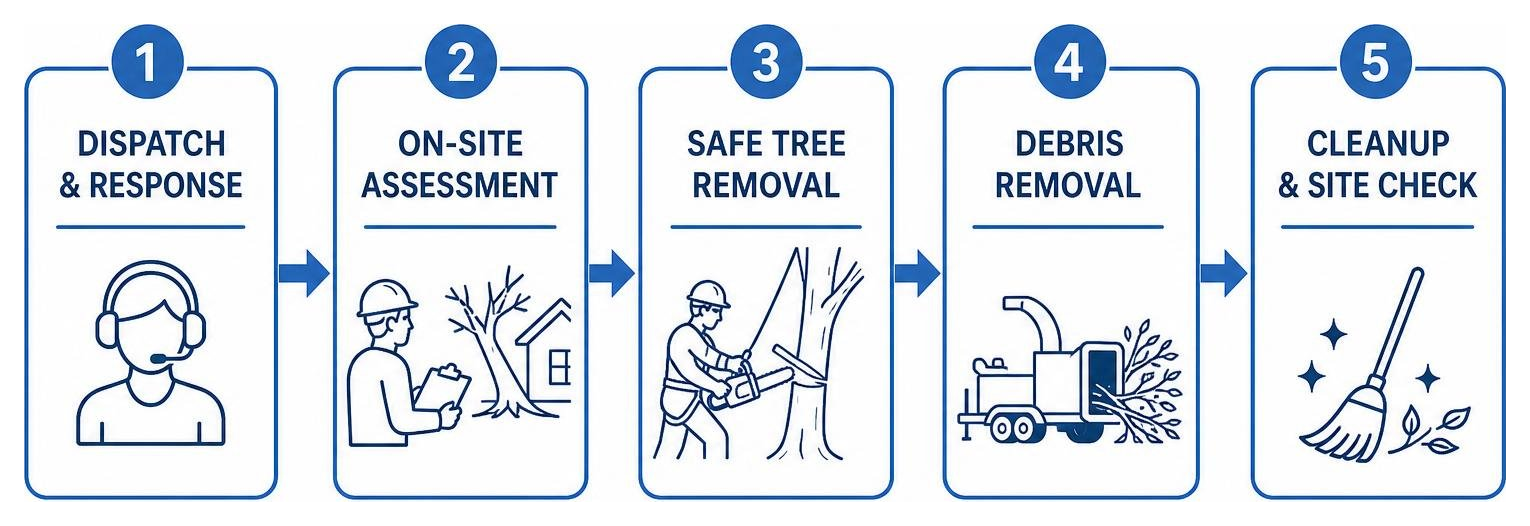
We operate a rapid response system designed to deploy crews quickly across our mountain communities. Our team is available 24/7 because we know that tree emergencies don't respect regular business hours. When you contact us, we immediately mobilize the nearest crew to secure your home. You can view our full coverage area on our Areas Served Tree Service Hideout UT page.
Crucial Emergency Contacts for Hideout, UT Residents:
Rocky Mountain Treecraft: (Contact us directly for rapid tree stabilization and removal)
Rocky Mountain Power: 1-877-509-3059 (For downed power lines or electrical emergencies)
Dominion Energy: 1-800-767-1689 (If you suspect a gas line has been damaged by uprooting roots)
Emergency Services: 911 (If there is an immediate threat to life or safety)
Step 2: Stay Clear of Downed Power Lines and Unstable Structures
Never, under any circumstances, approach a tree that is touching or near utility lines. Even if you do not see sparks, the tree, the ground, or surrounding fences could be energized with lethal electrical currents.
Our team works in close coordination with local utility companies to safely shut down power and clear electrical hazards before we begin our precision cutting and rigging. Let the professionals handle the hazard mitigation.
Step 3: Document the Damage for Insurance Claims
Before our ground crews begin cutting up the fallen tree, you need to document the scene thoroughly for your insurance adjuster.
Take high-quality, clear photographs and videos of the damage from multiple angles. Capture the fallen tree, the specific damage to your home, deck, or vehicles, and the surrounding area. We will assist you by providing detailed professional arborist reports and written assessments to make the insurance claims process as smooth and painless as possible.
Step 4: Establish a Safety Perimeter
Keep children, family members, and pets indoors and away from the affected area. A partially fallen tree or a limb caught in the canopy (often called a "widowmaker") can shift, snap, or drop without warning, even hours after a storm has passed.
Step 5: Contact Your Insurance Provider
Call your homeowners insurance agent to report the incident. Let them know that you have contacted a professional tree service to mitigate the immediate hazard. Most policies cover the cost of removing trees that have fallen on covered structures, and having your documentation ready will speed up your claim approval.
How Professional Crews Handle Storm Damage and Hazardous Removals
When our professional crews arrive at a storm-damaged property in Hideout, we don't just start starting up chainsaws. We approach every emergency with a careful, strategic plan to prevent further damage to your home and landscaping.
First, we perform a comprehensive site hazard assessment. We evaluate the stability of the tree, the tension on the fallen limbs, and any nearby obstacles like power lines, roofs, or neighboring structures. Once a plan is in place, we execute a controlled, sectional removal. By removing the tree piece-by-piece using advanced rigging, we protect your property and ensure our ground crew remains safe throughout the process.
After the immediate hazard is cleared, we perform a thorough debris cleanup, chipping branches and hauling away heavy logs. If desired, we can also perform stump grinding to restore your yard to its original, beautiful condition. You can read more about our long-term care options on our Tree Removal page.
Advanced Equipment Used by Emergency Tree Service Hideout UT Crews
Handling massive, unstable trees in tight residential spaces requires highly specialized, cutting-edge tools. We don't rely on guesswork; we use advanced machinery to ensure precision and safety:
Cranes and Aerial Lifts: These allow us to lift heavy tree sections vertically away from your roof or driveway without letting them crash to the ground.
Log Loaders and Heavy Chippers: These machines allow us to process tons of storm debris quickly, clearing your driveway and yard in a fraction of the time it would take with manual labor.
High-Capacity Rigging Systems: Using heavy-duty blocks, pulleys, and high-tensile ropes, we can safely lower massive limbs from tight spaces with absolute control.
We are proud to extend our professional tree care services to neighboring communities throughout the Wasatch Back, ensuring that residents in Midway, Charleston, and surrounding areas have access to the same high-quality, reliable emergency response when severe weather strikes.
Local Regulations and Permit Requirements in Hideout
Removing a tree in Hideout, UT isn't always as simple as cutting it down. Local municipal codes and homeowners association (HOA) guidelines often protect specific native tree species or require permits for removals, especially in scenic or ecologically sensitive zones.
During an active emergency — such as when a tree has fallen onto a house or is blocking a public road — public safety always takes priority, and immediate removal is permitted. However, for non-emergency removals of hazardous or dying trees, we handle all the permit research and application processes for our clients. This ensures your project remains fully compliant with local ordinances and prevents any unexpected fines.
Frequently Asked Questions About Emergency Tree Services
How quickly can emergency tree services respond to Hideout, UT?
Our emergency dispatch system is built for speed. Because we are locally based right here in the Wasatch Back, our emergency response teams can typically reach properties in Hideout within 2 to 4 hours of your call. We prioritize active, life-threatening hazards and work around the clock during major storm events to keep our neighbors safe.
Does homeowners insurance cover emergency tree removal and what are the typical costs?
In most cases, yes! If a tree falls due to a storm or wind and damages a covered structure (like your home, garage, or fence), your homeowners insurance policy will typically cover the cost of the tree removal and the structural repairs.
If the tree falls in an open yard without damaging any structures, coverage may vary. Standard residential tree removals in Hideout typically range from $500 to $3,000, depending on the size, location, and complexity of the job. We always provide clear, upfront pricing with no hidden surprises, and we work directly with your insurance adjuster to facilitate a smooth claims process.
What can I do to prevent future tree emergencies on my property?
The single best way to handle a tree emergency is to prevent it from happening in the first place! We highly recommend taking these proactive steps:
Regular Pruning: Schedule professional pruning every 3 to 5 years to remove weak, dead, or overgrown branches and reduce wind resistance.
Tree Health Assessments: Have a certified arborist inspect your trees annually to identify pests, diseases, or structural decay before they weaken the tree.
Defensible Space: In Utah, creating defensible space around your home is crucial for wildfire protection. Removing dead vegetation and thin, low-hanging limbs helps protect your home from both winter storms and summer wildfires.
Conclusion
When a tree emergency strikes, you don't have to face it alone. At Rocky Mountain Treecraft, we bring fast, reliable, and locally-based expertise tailored to Wasatch County's unique climate and mountain terrain. From emergency storm damage cleanup to routine maintenance, our licensed and insured professionals are here to protect your property and give you peace of mind.
Don't wait for a dangerous limb to become a costly disaster. Schedule your emergency tree service assessment today and let our team keep your Hideout property safe, clean, and beautiful!