
The Cost of Paradise: Average Cost to Trim Palm Trees
What You'll Pay to Trim a Palm Tree (And Why It Matters)
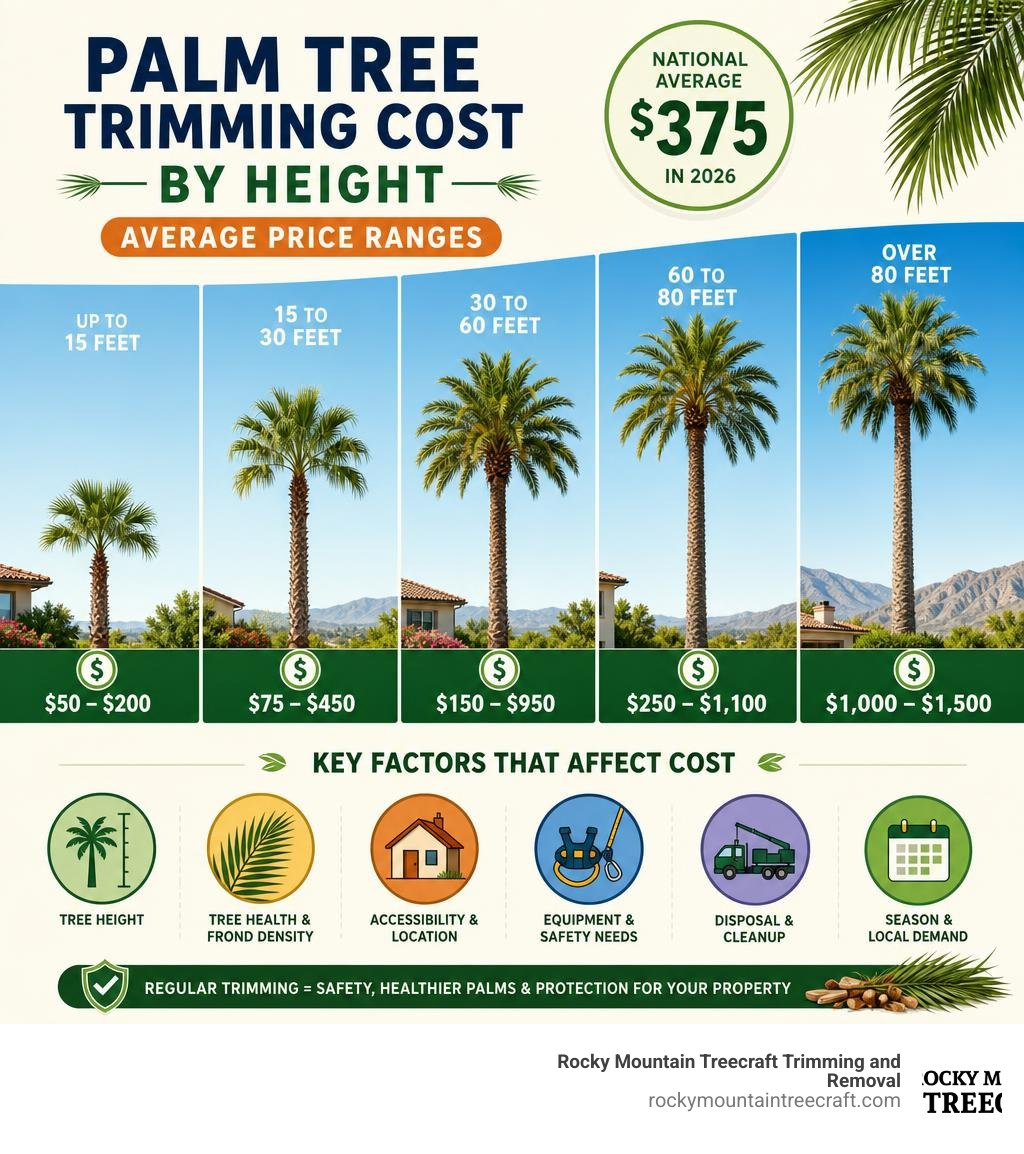
The average cost to trim palm trees runs between $125 and $800, with most homeowners paying around $375 nationally in 2026. What you actually pay depends mainly on how tall your tree is.
Here's a quick breakdown by height:
Palm Tree Height Typical Cost Range Up to 15 feet $50 – $200 15 to 30 feet $75 – $450 30 to 60 feet $150 – $950 60 to 80 feet $250 – $1,100 Over 80 feet $1,000 – $1,500
These numbers come from aggregated data across thousands of real quotes from homeowners across the U.S.
Palm trees look like low-maintenance landscaping. But dead fronds are heavy. They fall without warning. They're a fire hazard. And when they're hanging over a roof, a car, or a walkway, they become a genuine safety risk — not just an eyesore.
Trimming isn't optional. It's property protection.
Whether you own a warm-weather vacation home or manage a property with mature palms, knowing what you should pay keeps you from overpaying — or hiring the wrong crew.
What Is the Average Cost to Trim Palm Trees in 2026?
When budgeting for seasonal landscape maintenance, understanding the baseline rates prevents unexpected financial surprises. According to the 2026 Palm Tree Trimming Cost | Average Prices by Height , the typical national cost to trim a palm tree rests at a comfortable average of $375, though the complete pricing spectrum ranges from as low as $50 for tiny species to over $1,500 for towering giants.
Unlike standard deciduous trees that require intricate canopy thinning, palm tree trimming is highly focused on removing dead or decaying fronds, slicing away heavy seed pods, and occasionally smoothing out the trunk. Because these trees grow from a single terminal bud at the very top, improper pruning doesn't just look bad—it can actually introduce fatal diseases or permanently stunt the tree's growth.
To give you a clearer picture of how these costs stack up, we have compiled a comparison table detailing how height and specific species influence your final invoice:
Palm Species Typical Height Range Pruning Complexity Average Trimming Cost (per tree) Pygmy Date Palm 10 – 12 feet Low (Watch out for sharp spines!) $50 – $120 Sabal Palm 15 – 30 feet Low to Medium $50 – $150 Queen Palm 15 – 30 feet Medium (Fast growth rate) $75 – $225 Mexican Fan Palm 30 – 80+ feet High (Requires specialized lifts) $150 – $900 Canary Island Date Palm 40 – 60 feet Extremely High (Dense canopy & heavy seed pods) $250 – $1,000+
How Height Affects the Average Cost to Trim Palm Trees
In the tree service industry, height is the ultimate pricing driver. As a palm tree climbs higher, the safety risks multiply, requiring specialized equipment and advanced crew training to handle the job without incident.
Under 15 Feet (Small Palms): Trimming these shorter varieties typically costs between $50 and $200. Because they can be easily reached from the ground using basic pole saws or short ladders, the labor is straightforward and quick.
15 to 30 Feet (Medium Palms): Expect to pay $75 to $450. At this height, crews often need larger ladders or climbing gear, and the volume of heavy debris increases.
30 to 60 Feet (Tall Palms): Prices jump to $150 to $900. This height range represents a major logistical transition. Arborists must utilize bucket trucks, cherry pickers, or complex climbing harness rigs to reach the crown safely.
Over 60 Feet (Very Tall Palms): These towering giants command rates of $250 to $1,500+. Renting a bucket truck can cost a company $400 to $700 per day, a cost that is naturally reflected in your estimate.
If you are trying to calculate a quick manual estimate for your property, you can use the Palm Tree Trimming Cost Calculator: Free Estimates for 2026 . A great trick to estimate your palm's height without a giant tape measure is using your home's roofline as a visual guide: a standard single-story home is about 12 to 15 feet tall, while a two-story home reaches approximately 25 to 28 feet.
Cost Breakdown by Palm Tree Species
Every palm species has its own unique growth habits, structural quirks, and maintenance demands that directly impact labor time.
Mexican Fan Palm: Known for its iconic towering silhouette, this species grows incredibly fast. It leaves behind a thick "shag carpet" of dead, drooping fronds along its trunk. Removing this heavy buildup from heights of 50 to 80 feet requires serious physical endurance and specialized rigging, keeping trimming costs on the higher end.
Queen Palm: A highly popular residential choice, Queen Palms require trimming once or twice a year. While they are relatively easy to access, they produce messy, heavy fruit and seed pods that must be cut away to prevent property damage and pest infestations.
Canary Island Date Palm: These are the heavyweights of the palm world. They feature massive, wide crowns with hundreds of dense, thick fronds. To make things more challenging, their frond bases are armed with long, needle-sharp spines that can easily pierce standard work gloves. Trimming these takes twice as long as other species, pushing costs well past $250 per tree.
Sabal Palm: As a highly resilient and slower-growing species, Sabal palms are simpler to maintain, often costing only $50 to $75 for a basic seasonal cleanup.
Pygmy Date Palm: These ornamental dwarf palms rarely exceed 12 feet. While they are cheap to trim, their sharp spines require careful precision, meaning crews must still take their time to avoid painful skin punctures.
Key Factors That Influence Palm Trimming Prices
Arborists don't just look at a tree's height and species when writing a quote. They evaluate the entire environment surrounding the tree to calculate the total labor hours and risks involved.
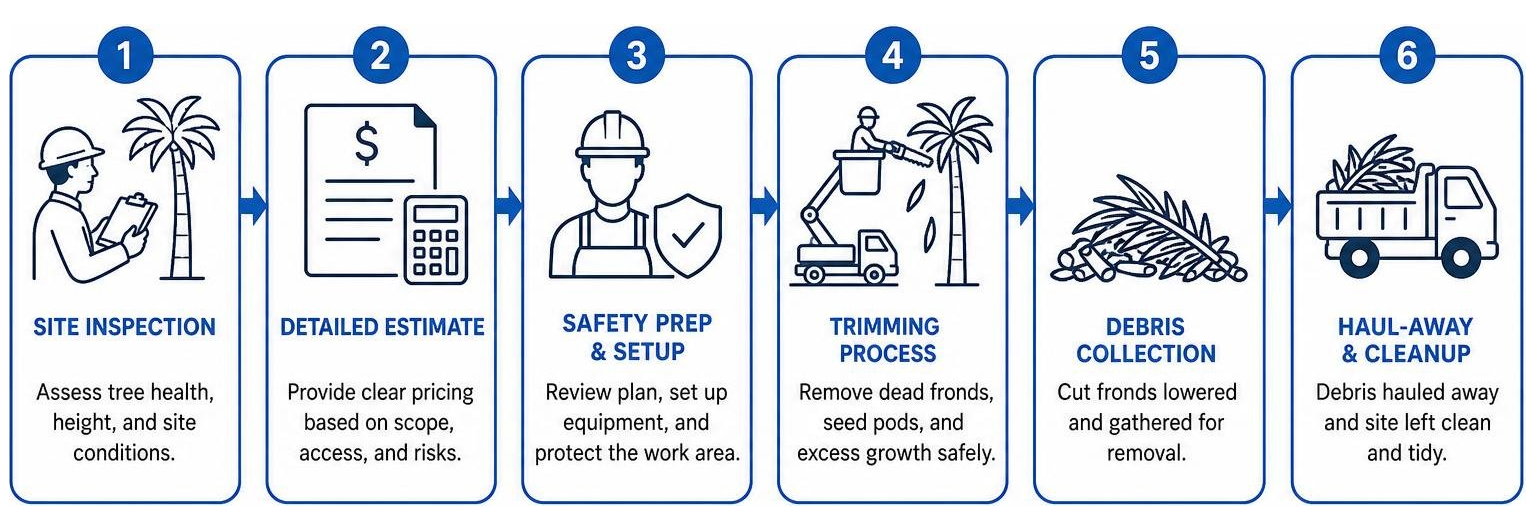
Tree Health: If a palm has been neglected for years, it will have a massive buildup of dead fronds, heavy seed pods, and thick "boots" (the woody remnants of old fronds). This extra weight takes much longer to cut down and haul away. Conversely, diseased trees require delicate handling and tool sanitization to prevent spreading pathogens, which can also increase the bill.
Physical Accessibility: Can a heavy bucket truck drive right up to the base of the tree? If so, the job will be fast and affordable. If the palm is tucked away in a tight backyard, squeezed between a swimming pool and a delicate pool cage, or blocked by narrow gates, crews must climb the tree manually or use compact aerial lifts. This added complexity drives up labor costs.
Proximity to Power Lines: This is a major safety hazard. Working near high-voltage lines requires specialized certifications, extra spotters, and extreme caution. If your palm's fronds are actively touching power lines, we highly recommend contacting your local utility company first—they will often trim these specific hazard areas for free to protect the grid.
For any complex property layout, hiring professional residential tree services ensures the job is completed safely without risking damage to your home, deck, or surrounding landscape.
Regional Factors Influencing the Average Cost to Trim Palm Trees
Where your property is located plays a massive role in what you will pay. According to the Cost of Tree Services - Last Updated July 2026 - Yelp , regional labor rates, local cost of living, and seasonal demand create distinct price variations across the country.
Arizona (Phoenix/Scottsdale): Trimming costs typically range from $100 to $500 per tree. The desert heat makes palm maintenance highly seasonal, with peak demand hitting between May and July before the summer monsoon winds arrive.
Florida (St. Augustine/Miami): Homeowners pay anywhere from $50 to $250+ depending on the species. Because of the frequent coastal storms and hurricanes, keeping palms trimmed is a matter of storm survival, keeping local crews highly competitive and busy year-round.
California (Los Angeles/San Diego): Due to higher labor rates, insurance costs, and strict disposal laws, trimming prices in California metro areas routinely run 15% to 30% above the national average, often starting at $150 for medium trees.
Las Vegas: Typical rates run from $100 to $1,000, with extra-large palms (50+ feet) costing $300 to $600 due to the high concentration of mature resort-style landscaping.
Additional Services: Skinning, Seed Pods, and Debris Hauling
When you receive a professional quote, make sure to ask exactly what is included. Some companies charge flat rates for a basic trim, while others itemize highly specific aesthetic and structural add-ons. According to the Palm Tree Trimming Cost — $75–$500 Average (2026 Guide) , these extra services include:
Palm Skinning (Shaving): This is a purely cosmetic service where the rough, textured "boots" left behind by old fronds are carefully shaved off using a sharp knife, leaving behind a smooth, clean, classic trunk. Because this requires highly skilled labor and precision, it typically adds $50 to $100 per tree (or about 35% to the base cost).
Seed Pod Removal: When palms flower, they produce massive, heavy seed pods that drop thousands of messy berries onto lawns, pool filters, and driveways. Removing these early in their growth cycle costs an extra $20 to $35 per tree but saves you hours of backyard cleanup.
Debris Hauling: Palm fronds are incredibly fibrous, bulky, and heavy. They cannot be easily mulched by standard wood chippers and must be hauled to specialized green waste landfills. While most reputable companies include haul-away in their base price, some charge an extra $40 to $75 surcharge for disposal. Always double-check your contract!
Boot Stub Removal: Removing individual stubborn old frond bases from the trunk costs roughly $30 to $50.
Fertilization: Applying specialized palm-specific fertilizer to keep the crown lush and green costs between $25 and $50.
Palm Tree Trimming vs. Complete Removal
Sometimes, a simple trim isn't enough to save a palm tree. If your palm is suffering from severe disease, structural instability, or significant storm damage, complete removal may be your only safe option.
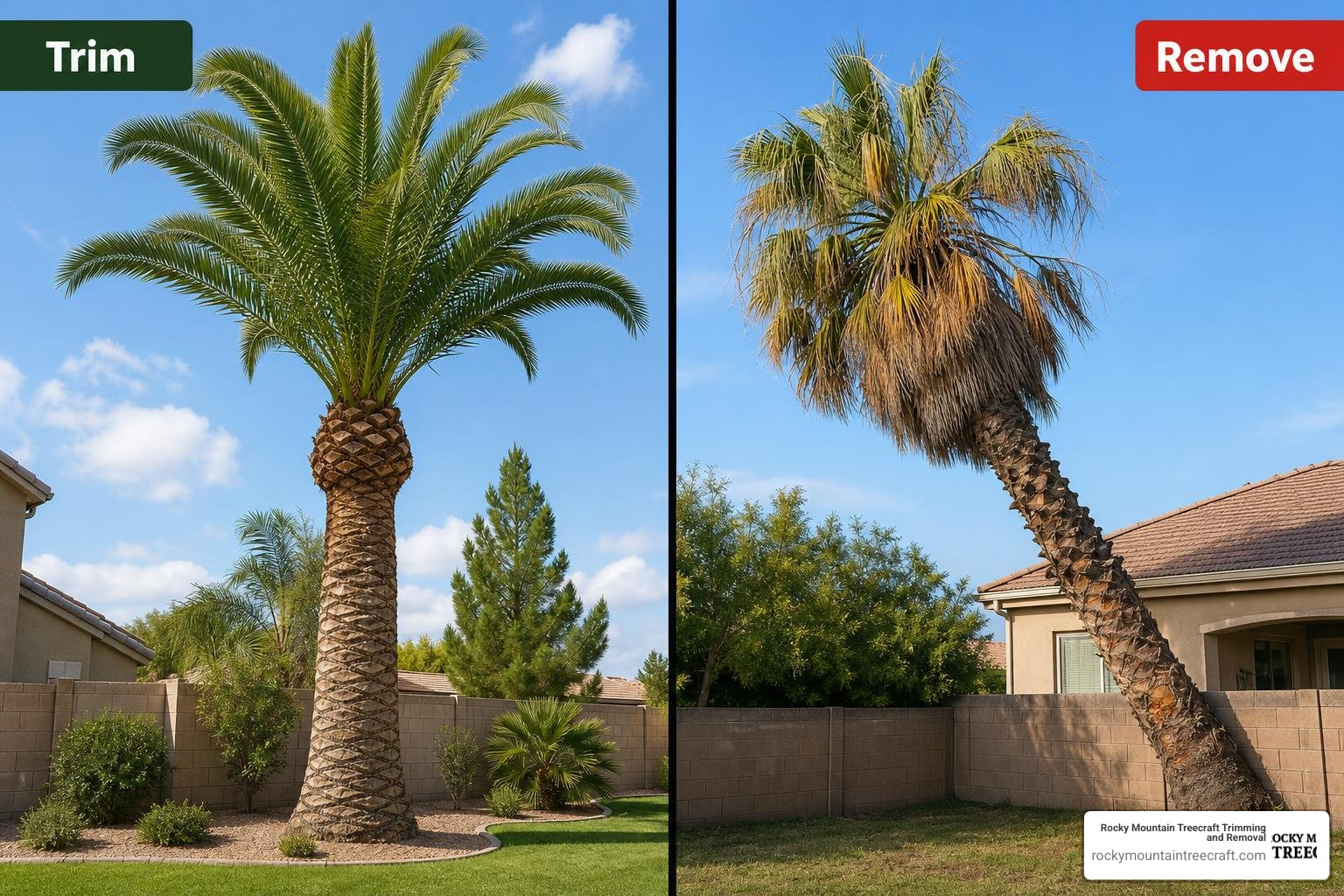
How do you know when to make the call?
When to Trim: Choose trimming if the tree is healthy but has brown, drooping lower fronds, active seed pods, or minor wind damage. Trimming maintains the tree's natural beauty and keeps it structurally sound.
When to Remove: Complete removal is necessary if you notice warning signs of severe decline. These include yellowing of the youngest, innermost fronds (which indicates bud rot), a trunk that is soft to the touch, a sudden dramatic lean, or pest infestations like the destructive South American palm weevil.
If removal is unavoidable, expect to pay between $150 and $1,500+ depending on the tree's height. Removing a palm is highly technical; because they have incredibly dense, fibrous trunks that quickly dull chainsaw blades, the labor is physically demanding.
Once the tree is down, you will also need to decide on stump grinding. Leaving a palm stump behind invites pests like termites and wood-boring beetles to move into your yard. Professional stump grinding typically costs an additional $125 to $350, while complete manual stump extraction can run $175 to $450.
If you are facing a hazardous or dying tree on your property, utilizing professional tree removal services is the safest way to clear the hazard without risking damage to your home or power lines.
Frequently Asked Questions About Palm Tree Maintenance
To help you plan your property maintenance, we have compiled answers to some of the most common questions we receive about palm tree care. For more general advice on tree care, safety, and property management, browse our comprehensive FAQs page.
How often should palm trees be trimmed?
Most palm trees should be trimmed once or twice per year. Species like the fast-growing Queen Palm and Washingtonia Palm benefit from bi-annual trims to manage heavy seed pods and fast-growing fronds. Slower-growing species like the Sabal Palm usually only require a single annual cleanup.
Regular maintenance is key; waiting years between trims allows a massive skirt of dead fronds to build up, which eventually becomes a breeding ground for rats, scorpions, and wasps, while dramatically increasing your ultimate trimming bill.
What is the best time of year to trim palm trees to save money?
The absolute best time of year to trim palm trees is late spring (ideally May or June). Trimming during this window allows you to clear away dead fronds and heavy seed pods right before the heavy summer storm and hurricane seasons begin, minimizing the risk of flying debris.
If you are looking to save money, try scheduling your maintenance during the winter off-peak season (January through March). Because tree service companies experience lower demand during these colder months, many offer off-season discounts of 10% to 25% to keep their crews busy.
What are the risks of DIY palm tree trimming?
While trimming a small, 10-foot ornamental palm from the ground is a safe weekend DIY project, attempting to trim any tree over 15 feet is incredibly dangerous.
Suffocation Hazards: This is a little-known but deadly risk. When a climber stands beneath a massive skirt of dead, drooping palm fronds and cuts the supporting fibers, the entire heavy mass can slough off at once. This heavy, dry material can slide down, trapping the climber against the trunk under hundreds of pounds of pressure, leading to rapid asphyxiation.
Falls: Working from high extension ladders with heavy, vibrating chainsaws or pole saws is a recipe for severe fall injuries.
Climbing Spike Damage: Many untrained DIYers use climbing spikes to scale palms. Unlike standard trees, palms cannot heal localized trunk wounds. Every spike puncture leaves a permanent scar that weakens the trunk and creates an open gateway for fatal fungal infections and boring insects. Professional crews use bucket trucks or specialized climbing straps that protect the trunk's living tissue.
Conclusion
Caring for your palm trees is an investment in your property's safety, curb appeal, and overall value. While the average cost to trim palm trees of $375 might seem like an extra line item in your annual budget, regular preventative maintenance is far cheaper than dealing with the aftermath of a heavy, wind-blown frond crashing through a roof or pool cage.
At Rocky Mountain Treecraft Trimming and Removal, we understand that many of our local clients in Heber City, Park City, and across Wasatch and Summit Counties are "snowbirds" who escape our freezing Utah winters to spend the colder months at secondary properties in sunny states like Arizona, Nevada, or Florida. While we specialize in managing the unique mountain pines, aspens, and maples of the Wasatch Back, we want our clients to have the expert knowledge they need to protect all of their real estate investments.
If you have trees on your primary Utah property that need professional care before the winter snows set in, we are here to help. From routine safety pruning to complex hazardous removals, our team brings fast, reliable, locally-based expertise tailored to our unique mountain terrain.
Ready to get your local Utah trees in perfect shape? Explore our professional professional tree trimming services or Contact us today to schedule your free on-site estimate!